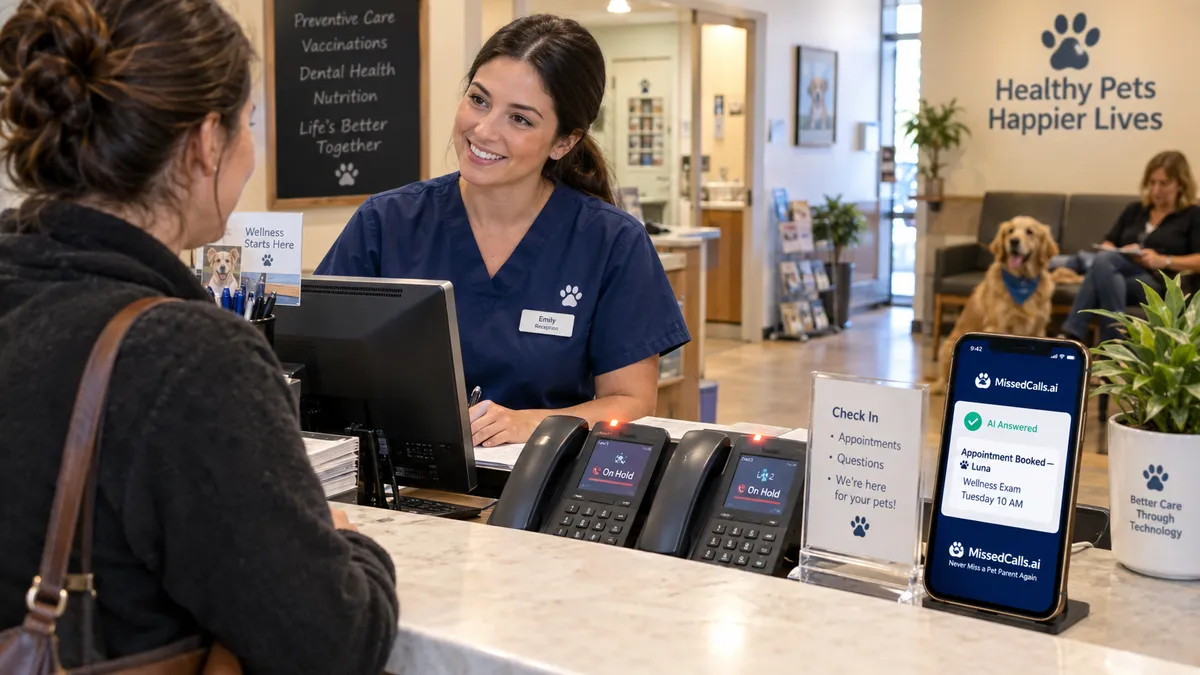
Your Veterinary Clinic Is Missing Calls During Every Exam. Here's What Those Calls Are Worth.
The short answer: Veterinary clinics miss an estimated 30–50% of inbound calls on any given day — not because the front desk doesn't care, but because there are only so many hands. When your receptionist is checking in a Golden Retriever, drawing payment for a spay, and managing a callback queue at the same time, the ringing phone loses. Every time that happens, a pet owner who needed you is already dialing the next clinic on Google.
This post breaks down exactly what those missed calls cost your practice, when the problem is worst, and how AI phone answering captures every inquiry automatically — without adding a single staff member.
Why Veterinary Clinics Have One of the Hardest Phone Problems in Small Business
Most businesses have predictable phone peaks. A restaurant gets hammered at noon and 6 PM. A contractor field office slows down in the early morning. Veterinary clinics are different — the calls come in all day, every day, and they're all emotionally urgent to the person on the other end.
A parent calling about a limping dog doesn't feel like they have time to wait on hold. A cat owner whose pet hasn't eaten in two days isn't going to leave a voicemail and hope for a callback. They're going to call the next number on the list. And if your competitor down the street picks up, they're probably booking that appointment within 60 seconds.
The structural problem is this: your front desk team is in exam support mode a large portion of the day. They're taking vitals, running diagnostics, processing payments, managing controlled substance logs, and relaying doctor notes. The phone is a second job layered on top of the first one. Something has to give — and it's usually the call that came in during a busy block.
After 6 PM, it gets worse. Most small and independent veterinary practices close their phones entirely. That means any pet owner who notices a problem in the evening — a dog that ate something, a cat with labored breathing, a puppy acting lethargic — has to either reach an emergency clinic or wait until morning. If your clinic was their vet, you just lost a loyalty touchpoint. If they were a new caller looking for a regular vet, you lost that relationship entirely before it started.
What a Missed Call Costs a Veterinary Practice
Let's put numbers on it. The American Pet Products Association estimates that Americans spend over $35 billion annually on veterinary care. The average pet owner spends roughly $400–$700 per year on routine vet visits, and significantly more when illness or injury is involved. A new client relationship at a typical small animal practice is worth $600–$1,200 in the first year alone — and far more over a pet's lifetime.
If your clinic misses 10 calls per day and converts even 20% of new inquiries into clients under normal circumstances, you're losing 2 potential new clients every day those calls go unanswered. At $800 average first-year value, that's $1,600 per day in uncaptured revenue. Across a month, that's over $40,000 in lifetime client value that walked out the door before a single appointment was ever booked.
That math doesn't account for the existing clients who called about a follow-up, a prescription refill, or a question about post-surgical care — and who start to feel like your clinic isn't accessible. Retention leaks quietly through unanswered phones.
The Three Worst Call-Drop Windows for Vet Clinics
Through patterns common to small veterinary practices, the worst missed-call windows tend to cluster in three places:
1. Mid-Morning Surgical Block (9 AM – 12 PM)
This is when your team is supporting procedures, prepping anesthesia, and managing recovery. The front desk is at minimum staffing while the clinical team is occupied. Calls back up. New patient inquiries hit voicemail. Appointment requests go unanswered until the afternoon — by which time the caller has booked elsewhere.
2. Afternoon Exam Rush (2 PM – 5 PM)
Back-to-back wellness exams and urgent visits mean your receptionist is cycling through check-ins, checkout payments, and follow-up scheduling constantly. Phone hold times spike. Callers who've already waited 3 minutes hang up. If your average hold time during this window is 4+ minutes, expect a significant drop-off rate.
3. After Hours (6 PM – 8 AM)
This is the largest unmanaged window. A pet owner who notices a problem in the evening has nowhere to go with a non-emergency concern. They'll call your number. If they get voicemail, they may leave a message — but studies consistently show that callback-dependent practices lose 40–60% of leads who hit voicemail. Many callers simply move on.
How Does AI Phone Answering Work for a Veterinary Clinic?
AI phone answering for a veterinary practice works like a trained, always-on front desk team member — one that never goes on lunch, never steps into an exam room, and answers every call within 2 seconds regardless of what time it is.
Here's what the workflow looks like in practice:
A pet owner calls at 7:45 PM about a dog that's been vomiting since afternoon. MissedCalls.ai picks up immediately. The AI answers in a natural, conversational tone using your clinic's name and greeting. It asks what's going on, whether this seems urgent, and what the pet's history is. Based on the owner's description, it either provides your after-hours emergency referral information (which you've pre-configured), or it captures the owner's name, pet name, concern, and preferred callback time — and logs it for your team to triage first thing in the morning.
A new client calls Tuesday at 10:30 AM to ask about new puppy wellness packages. The AI answers the questions your team has pre-loaded — vaccine schedules, first-visit inclusions, pricing ranges, what to bring — and then offers to book an appointment directly. It confirms the time, captures the owner's contact information, and delivers a summary to your team in real time.
An existing client calls for a prescription refill during the surgical block. The AI collects the pet name, medication, and preferred pickup time, then routes that summary to your team automatically. No callback needed. No sticky note on the desk.
Every call is documented with a transcript and outcome summary. Your team sees exactly what was said and what was promised. Nothing falls through the cracks.
What AI Answering Doesn't Do (And Why That's the Right Design)
MissedCalls.ai isn't trying to replace your clinical judgment. It's not diagnosing pets, recommending treatments, or making medical decisions. It's doing the intake, triage, and scheduling work that doesn't require a DVM — and doing it at a scale and availability level that no human team can match without significant staffing cost.
When a call involves a true emergency — an animal that's collapsed, is in respiratory distress, has been hit by a car — the AI is configured to immediately provide your emergency protocol, whether that's a referral to the nearest emergency hospital, an on-call number, or a direct transfer to your team. You control those rules completely.
The goal is to make sure every caller gets a response that matches the urgency of their situation — and that your team only handles the calls that actually need human intervention.
What This Looks Like 30 Days In
Most veterinary practices that implement AI phone answering report the same early wins: fewer calls going to voicemail, a measurable increase in new patient bookings from evening and weekend inquiries, and front desk staff who report feeling less overwhelmed during peak periods because they're not managing a backlog of callbacks.
The new patient pipeline is the most impactful early result. When a caller who finds your clinic on Google at 8 PM can immediately book an appointment — not wait until 9 AM tomorrow — the conversion rate climbs. First-mover advantage still matters in local veterinary markets. The clinic that answers first wins the client.
If you're a multi-doctor practice, the routing benefit compounds. AI can route calls by doctor, by appointment type, or by urgency — so a wellness inquiry goes through the standard booking flow while a concern about a recent surgical patient gets escalated to your on-call team immediately.
Is This the Right Fit for Your Veterinary Practice?
AI phone answering works best for veterinary clinics that:
- Have a front desk team that's regularly pulled in multiple directions during business hours
- Are open to new patients and want to capture more of the calls that currently go unanswered
- Don't have 24/7 staffing but still want to serve after-hours callers professionally
- Want to reduce front desk burnout without adding headcount
- Operate one or more locations and need consistent call handling across all of them
Solo practitioners, multi-doctor practices, and specialty clinics have all found value in AI call coverage — particularly in the windows when human capacity simply can't keep up with demand.
If your clinic is currently handling everything through a single receptionist or relying on voicemail after 6 PM, the gap between the calls you're receiving and the appointments you're booking is almost certainly larger than it looks.
Ready to see how AI phone answering handles a real veterinary call? Book a tailored demo at MissedCalls.ai and hear exactly how MissedCalls.ai sounds on the phone with your clinic's name, your services, and your call flow.
Related Reading
- How Dental Practices Use AI to Capture Every New Patient Call
- AI Appointment Reminder Calls for Dental Practices — Reducing No-Shows
- AI Phone Answering for Insurance Agents — Capturing Every Quote Request
Frequently Asked Questions
Can AI phone answering handle after-hours calls for a veterinary clinic?
Yes. MissedCalls.ai answers calls 24/7, including evenings, weekends, and holidays. For after-hours calls, it follows your configured protocol — whether that's capturing the concern for morning follow-up, providing an emergency referral, or escalating to an on-call number. Pet owners always get a response instead of voicemail.
Will the AI know when a situation is a veterinary emergency?
The AI follows rules you define. You configure how it identifies and handles urgent calls — for example, if an owner describes collapse, difficulty breathing, or poisoning, the AI can immediately provide your emergency hospital referral or transfer the call. It doesn't make clinical decisions, but it routes urgency appropriately based on your playbook.
Can the AI book appointments on my existing scheduling system?
MissedCalls.ai integrates with calendars and practice management tools to push appointment details and call summaries directly into your workflow. Depending on your setup, it can confirm appointment slots in real time or capture the request for your team to confirm — whichever fits your process.
What if a caller wants to speak to a doctor or a specific staff member?
The AI can transfer calls to your team when someone is available and a transfer is appropriate. Outside business hours or when staff are unavailable, it captures the message and reason for the call so your team has full context before they call back. No details are lost.
How quickly can a veterinary clinic get set up with AI phone answering?
Most practices go live in hours, not weeks. You provide your clinic's information, services, hours, call flow preferences, and any emergency protocols. The AI is trained on that content, tested, and ready to answer calls. No engineering required on your end.
