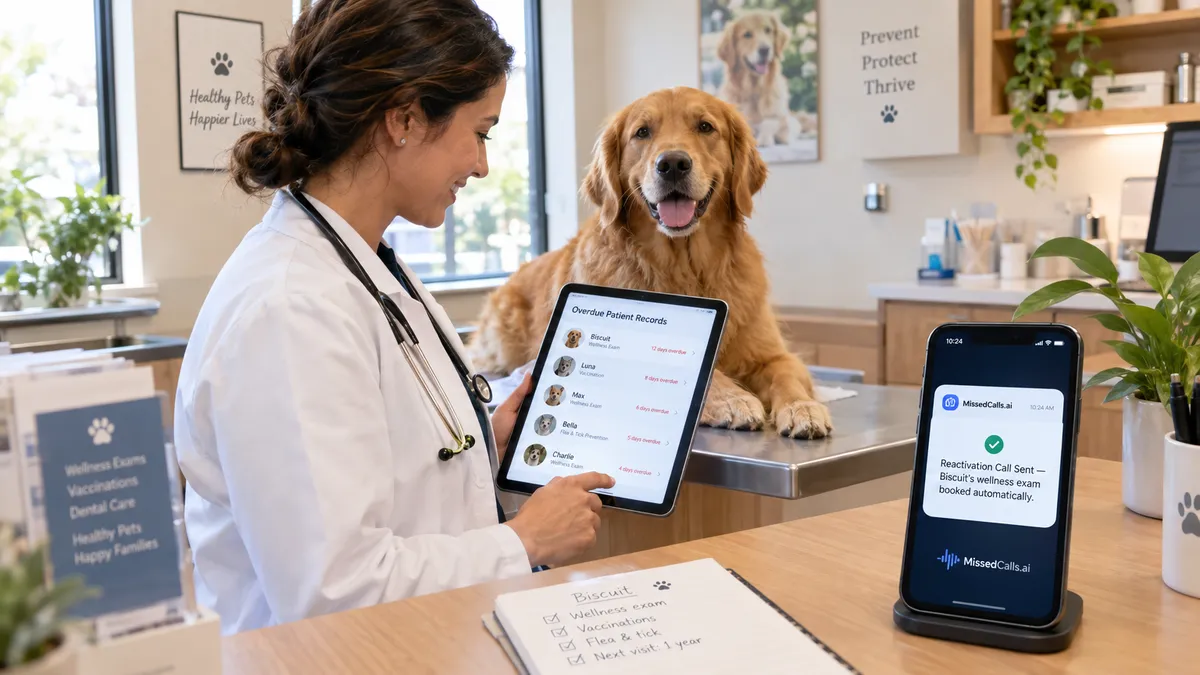
Your Vet Clinic Has Hundreds of Lapsed Patients Right Now. Here's How AI Calls Bring Them Back.
The short answer: AI outbound reactivation calls automatically contact your lapsed pet patients by name, remind them their pet is overdue for care, and book wellness appointments directly in the call — without your front desk team making a single manual dial.
Now for the part that might surprise you: those clients aren't gone. They're just waiting for someone to reach out first.
The Lapsed Patient Problem Is Bigger Than Most Clinics Realize
Every veterinary clinic has a gap between its total client list and the patients who actually came in last year. According to 2026 industry benchmarks, the average vet clinic loses roughly 22% of its active client base every year to lapsing. For a clinic with 1,000 active clients, that's 220 people who stopped returning — without explanation, without a complaint, and often without any outreach from the practice to bring them back.
It compounds from there. AVMA data from 2025 showed that the average practice added 1,214 new clients over the year and still ended up with a net loss of 326 patients — because existing clients were lapsing faster than new ones were arriving. Wellness visits specifically fell 3.8% that year, continuing a four-year downward trend that has carried into 2026. Your marketing budget may be working hard to fill the front door while overdue patients quietly walk out the back.
Industry analysis puts 30 to 40% of patients who are due for an annual wellness exam in any given month as having no appointment scheduled. That's a significant block of recoverable visits sitting idle in your records right now — not lost, just unreached.
What's driving the lapse? For many pet owners, it's not neglect. Veterinary service prices climbed 47% between 2019 and 2025 — nearly double the general inflation rate — and cost has become the primary barrier. But there's something else at play: most lapsed clients simply didn't hear from the clinic. Life got busy, the reminder email got buried, and no one ever called.
Why Standard Reminder Tools Fall Short
Most clinics already run some form of recall system — postcards, automated emails, text blasts. If those tools were enough, lapse rates wouldn't still be hovering at 22%. The problem is channel saturation and format. A subject line reading "Your pet is due for an annual wellness exam" looks identical to every other reminder a pet owner has trained themselves to skip past.
A phone call is different. It's direct. It's personal. It creates actual two-way dialogue. When a pet owner hears a voice say, "Hi, I'm calling on behalf of [Clinic Name] — Biscuit is 14 months overdue for his annual exam and we wanted to check in," that registers differently than a bulk email. It signals that the clinic noticed the absence and took a step to reconnect.
The challenge is execution. Your front desk team is already managing check-ins, incoming calls, prescription requests, and exam-room questions simultaneously. Working through a list of 300 to 500 lapsed patients — handling objections, checking available slots, and booking appointments — isn't a task that realistically fits into the daily flow. So the calls don't happen, the outreach doesn't go out, and that recoverable revenue stays on the table.
How AI Reactivation Calls Work for Vet Clinics
AI outbound reactivation calls solve the execution gap entirely. Instead of waiting for a free window that never materializes, the system automatically works through your lapsed patient list on a schedule you define — reaching pet owners whose last recorded visit was 12, 18, or 24+ months ago.
Here's what a typical reactivation call workflow looks like in practice:
- The AI contacts the pet owner by phone and identifies itself as calling on behalf of your clinic, using your practice name.
- It references the specific pet by name — "We're calling about Max's annual wellness visit" — which immediately signals that this isn't a generic blast. It's specific, and that specificity changes how the owner responds.
- It explains the purpose clearly and asks if the owner would like to schedule. If they're ready, the AI confirms available appointment times and books directly. If they want to call back, it notes the preference and can trigger a follow-up contact.
- If the owner has moved to another clinic, the AI handles the response naturally, notes the outcome, and removes that client from future outreach. No manual cleanup required.
- Every call is logged with a transcript and outcome — booked, declined, left message, no answer, transferred to another clinic — so your team has complete visibility without listening to a single recording.
The result is a consistent, personalized outreach cadence running in the background while your team focuses on the patients in the building.
What Does a Reactivation Campaign Actually Recover?
A properly configured AI reactivation campaign typically recovers 8 to 15% of lapsed patients within the first 90 days. For a clinic with a patient list of 2,000 and a 20% lapse rate, that's 400 overdue clients. Recovering 10% of them — a conservative outcome — means 40 wellness appointments that wouldn't otherwise have been booked.
At an average wellness exam value of $180 to $250, 40 recovered appointments generates $7,200 to $10,000 in revenue in the first quarter alone. Run the same campaign across the full year — reaching patients in rolling cohorts as they cross the 12-month mark — and the numbers compound meaningfully.
That's before accounting for downstream revenue. A bonded veterinary client with one or two pets, annual wellness plans, and routine diagnostics carries a lifetime value of $3,900 to over $10,000. A single reactivation call that reconnects a family of pet owners to your practice is worth far more than the value of one appointment. Industry analysis puts it plainly: every lapsed client isn't a single lost visit — it's a compounding loss of future revenue from a relationship you already built.
None of this requires new advertising. It doesn't require more staff. It requires reaching people who already know your clinic — before they establish a routine with the practice across town.
Is This the Right Move for My Clinic Right Now?
If your clinic has more than a few hundred patients in its records and no systematic process for proactive lapsed-client outreach, AI reactivation calls are worth a serious look. Setup is straightforward: define who qualifies as lapsed (12 months since last visit is the most common threshold), configure the call script with your clinic's name, tone, and available appointment windows, and the system handles the outreach from there.
This is an entirely outbound, proactive workflow — different from the inbound side, where AI handles calls coming in while your team is in exam rooms. We covered that use case in our earlier post on AI phone answering for veterinary clinics during exams. Reactivation runs the other direction: instead of waiting for the phone to ring, you're the one making contact first.
The same approach drives measurable results in closely related healthcare verticals. If you've read our post on AI patient reactivation calls for dental and medical practices, the core logic is identical — warm relationships in your database that have gone cold through inaction, reactivated at scale through consistent, personalized outreach that a postcard or email simply can't replicate.
Ready to Work the List You Already Have?
MissedCalls.ai handles AI outbound reactivation campaigns for veterinary clinics — with call scripts built around your practice name, services, and tone. The system contacts your lapsed patient list automatically, books appointments when owners are ready, and logs every outcome so your front desk stays informed without adding a single task to their day.
If your clinic has patients who haven't been seen in 12 months or more, that list represents recoverable revenue sitting in your records right now. Book a live demo tailored to your veterinary practice and see exactly how the reactivation workflow would run for your clinic, your patient list, and your schedule.
Frequently Asked Questions
How does AI know which patients to call for reactivation?
You define the criteria — typically any patient with no recorded visit in the past 12 to 18 months. The system works through that list automatically and can be segmented by pet type, service history, or how long ago the last appointment took place.
Will AI reactivation calls sound robotic or generic?
No. AI reactivation calls reference the specific pet by name and your clinic by name. The conversation is natural and two-way — the pet owner can respond, ask questions, and confirm an appointment in the same call rather than receiving a one-way recorded message.
What happens if the pet owner has moved to another clinic?
The AI handles the response naturally, notes the outcome in the call log, and removes that contact from future outreach. Your team has a complete record of the interaction without needing to listen to individual calls.
How long does setup take for a veterinary reactivation campaign?
Most clinics are up and running in hours, not weeks. The core setup requires your practice name, available appointment windows, the call script tone, and an export of lapsed patient contacts. The AI handles the rest from there.
Can AI outbound calls handle other veterinary workflows beyond reactivation?
Yes. The same outbound AI calling capability works for appointment reminders, vaccine due notices, post-procedure follow-up, and wellness plan renewal outreach — not just lapsed patient reactivation. It's the same system applied to different points in the patient lifecycle.
