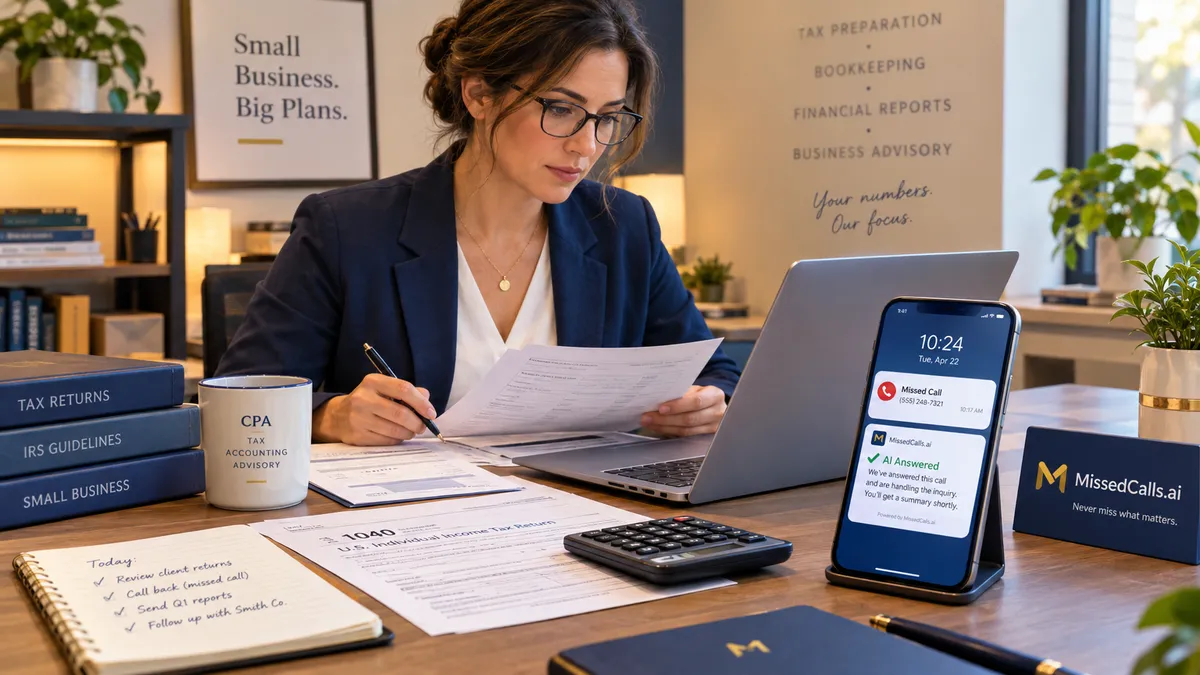
The short answer: Between January and April 15, call volume at accounting firms spikes 300-400% above normal. At the same time, every CPA and bookkeeper is buried in returns. The result is predictable — calls go to voicemail, prospects hang up without leaving a message, and first-time callers hire the next firm that picks up. AI phone answering solves this by handling every inbound call 24/7, capturing new client details, answering common questions, and booking consultations automatically — without pulling anyone away from the work that actually pays.
It's February. Your Phone Is Ringing. Your CPAs Are on a Return.
Picture this: it's the second week of February. W-2s and 1099s are hitting mailboxes across your city. Your team of two or three accountants is already running at full tilt. Your admin is juggling document requests, e-signature reminders, and a client who showed up without an appointment.
The phone rings. Nobody grabs it. It goes to voicemail.
That caller — a small-business owner looking for a new CPA before the filing deadline — hears your generic voicemail greeting, hangs up without leaving a message, and scrolls back to Google to call the next firm on the list.
That's not a hypothetical. For most small accounting practices, that's just a Tuesday in March.
The Tax Season Math No CPA Wants to Run
Tax season is the financial engine of most general accounting practices. January through April 15 generates 60-70% of annual revenue for the typical firm. It's the window that makes or breaks the year.
It's also the window when call management completely breaks down.
Industry data shows accounting firms experience a 300-400% increase in call volume during peak tax season. A firm that normally handles 20 inbound calls a day can see 60-80 calls hitting simultaneously — while every staff member is focused on deadline-driven work. The math is brutal:
- The typical accounting practice misses nearly 1 in 4 incoming calls during normal periods.
- During peak season, that rate climbs to 30-40% as staff capacity maxes out.
- 85% of callers who reach voicemail do not call back and do not leave a message.
- The average accounting client has a lifetime value of approximately $3,500 — meaning each missed prospect call costs your firm close to $3,000 in future revenue before they have ever met you.
If your firm misses just two or three prospect calls per week during the 14-week tax season window, you could be walking away from $40,000-$80,000 in long-term client revenue every single year. And unlike a one-time service job, accounting clients stay. Average client retention rates for CPA firms run 85-90%, which means every new client you capture during tax season compounds in value for years.
Why This Problem Does Not Solve Itself
The standard fix for tax season call volume is to hire temporary staff. But in practice, that solution falls apart quickly.
Temp receptionists need training — and you have no bandwidth to train anyone during your busiest months. They are unfamiliar with accounting terminology, so when a client calls about a K-1 delay or asks whether they need to file an extension for their S-corp, the message that lands in your inbox is often incomplete, wrong, or missing urgency context entirely. For clients calling about IRS notices or unfiled returns, a generic answering experience can feel unsettling when they are already stressed.
On top of that, traditional answering services often charge by the minute or by call volume — so when your calls quadruple in January, so does the bill.
The structural problem is that your firm runs lean by design. That works fine for ten months of the year. But tax season turns your phone into a fire hose, and a single admin cannot hold it steady alone.
What Calls Are Actually Coming In?
Not every tax season call requires a CPA. Most of them do not. When you break down what is actually hitting your phone line from January through April, the pattern looks something like this:
- New prospects asking about your services, your pricing range, and whether you are accepting new clients before April 15
- Existing clients checking in on their return status or asking where to upload their documents
- Deadline and extension questions — Do I need to file by April 15? What is the October 15 extended deadline?
- Document status calls — Did you receive the 1099 I mailed? Can I get a copy of last year's return?
- IRS notice callers — stressed existing or new clients who received a letter and need to talk to someone immediately
The majority of these calls do not require expert tax knowledge. They require someone available to pick up, capture the right information, answer common questions, and route genuinely urgent situations to the right person. That is exactly what AI phone answering does.
How AI Phone Answering Works at a CPA Firm
MissedCalls.ai answers your inbound calls in under two seconds — no menus, no hold music, no voicemail prompts. It engages callers in a natural conversation, identifies what they need, and handles it based on the rules your firm sets.
Here is what a real workflow looks like during tax season:
New prospect calls: The AI asks whether they are a new or existing client, captures their name, phone number, the type of service they need (personal 1040, S-corp return, bookkeeping, payroll), whether they have their documents ready, and what appointment times work. It books the consultation directly into your calendar and sends a confirmation. Your CPA walks into that consult with intake notes already waiting.
Existing client document calls: The AI identifies the client, collects the specific question, and either provides the document portal link or routes a summary task to the right team member. No interruption to the CPA mid-return.
Deadline inquiries: Common questions about filing deadlines, extension procedures, and estimated payment schedules are answered directly using your firm's configured information. The caller gets an accurate, professional answer at 9pm on a Sunday without anyone on your team touching the phone.
IRS notice or urgent calls: These get flagged and escalated with full call context — so when a CPA does follow up, they have everything they need to respond quickly and confidently.
Every call gets a transcript and summary logged automatically. Your team sees exactly what was discussed, what was promised, and what the caller needs — without playing back a voicemail or chasing anyone down.
Does the Responsiveness Gap Cost Firms Year-Round?
Yes — and it is larger than most CPAs realize. Research consistently shows that 67% of small business owners rank responsiveness as the top factor when selecting or staying with a CPA firm, placing it above both technical expertise and price. You can be the most skilled CPA in your market and still lose the client to whoever picks up the phone first.
Tax season is when the problem is most visible. But the phone does not stop mattering in mid-April. Accounting firms that use AI phone answering year-round see consistent value beyond the filing window:
- Bookkeeping inquiries that come in during summer and fall, when capacity exists to take on new monthly clients
- Payroll setup calls from small businesses that want a quick answer before they move on to the next option
- After-hours calls from business owners who only think about their accounting situation at 8pm, when they are done running their own day
- Q4 planning inquiries in October and November from clients wanting year-end tax strategy conversations before December closes out
A firm that answers every call, every time — regardless of season or hour — builds a reputation that compound-interests just like the clients themselves.
Professional service firms across industries face the same structural challenge: the phones ring hardest exactly when the professionals are least available. We covered how the same problem plays out for law firms in Every Missed Call Is a Missed Client: How AI Phone Answering Fixes the Number One Intake Problem for Law Firms, and for dental practices in The Front Desk Can't Do It All: How Dental Practices Use AI to Capture Every New Patient Call. The pattern is the same — and so is the fix.
Ready to Stop Losing Tax Season Clients to Voicemail?
Tax season 2027 starts in January. The firms that go into February with a working call answering system will convert more new clients, frustrate fewer existing ones, and deal with less chaos than the ones scrambling through March trying to return a backlog of missed messages.
MissedCalls.ai is built for exactly this kind of business — where the professional needs to stay in the work, not manage a phone queue. It sets up quickly, runs on your existing number, and costs the same in April as it does in August.
Book a tailored demo for your accounting firm and see exactly how it handles a new client intake call, a document status question, and an after-hours inquiry — all without you lifting a finger.
Frequently Asked Questions
How much does call volume increase for CPA firms during tax season?
Industry data consistently shows accounting firms experience a 300-400% increase in inbound call volume from January through April 15. A firm that normally handles 20 calls per day can see 60-80 or more calls hitting simultaneously during peak weeks in February and March.
What percentage of calls do accounting firms miss during tax season?
On average, accounting practices miss nearly 1 in 4 incoming calls. During peak tax season — when CPAs are focused on returns and staff capacity is maxed — that rate climbs to 30-40% for many firms. The majority of those callers never call back.
What does a missed call cost a CPA firm?
Based on an average accounting client lifetime value of approximately $3,500 and an 85% non-callback rate for callers who reach voicemail, each missed prospect call represents close to $3,000 in lost lifetime revenue. Missing just two or three prospect calls per week across the 14-week tax season can add up to $40,000-$80,000 or more in lost long-term client revenue annually.
Can AI phone answering handle tax-related questions without being a CPA?
Yes — within the appropriate scope. AI phone answering handles the high-volume calls that do not require a CPA: new client intake and qualification, appointment booking, document portal questions, filing deadline information, and extension procedure explanations. Complex questions, IRS notices, and anything requiring professional judgment are flagged and escalated to a human with a full call summary already prepared.
Is AI phone answering useful for accounting firms outside of tax season?
Absolutely. Year-round, accounting firms benefit from AI answering for bookkeeping inquiries, payroll setup calls, after-hours lead capture, Q4 planning consultation requests, and ongoing new client intake. Research shows 67% of small business owners rank responsiveness as the top factor in choosing or staying with a CPA — meaning every unanswered call, regardless of season, carries a real cost.
