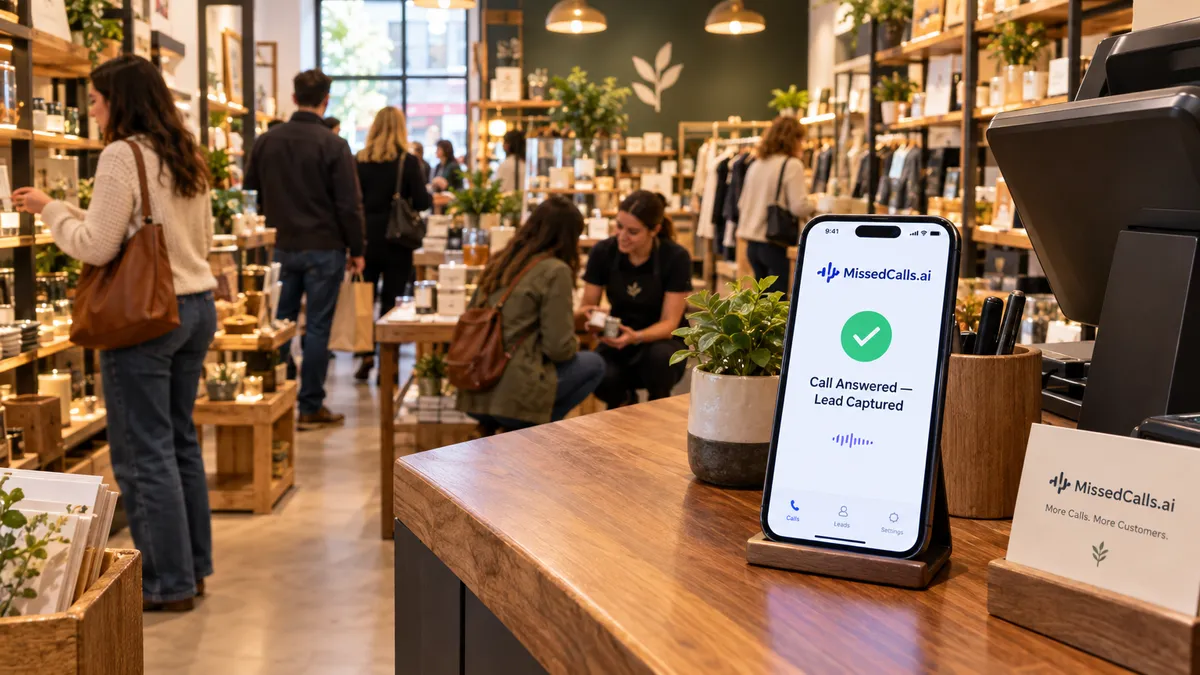
Your Floor Staff Is Helping a Customer. Your Phone Is Ringing. Here's What That Call Is Worth.
The short answer: more than most retail owners realize. Small retail stores miss close to half of all inbound calls while staff are occupied with in-store customers. Those callers almost never wait. They move on to the next result on Google Maps, the next tab they have open, or the competitor down the street who happened to pick up.
AI phone answering solves this by picking up every call instantly, answering product questions, checking availability, capturing contact details, and handling after-hours inquiries so your team can stay focused on the customer standing in front of them without losing the one on the phone.
Here is what is actually happening to your retail phone line, and why it matters more than most store owners think.
The Retail Phone Problem Nobody Talks About
Retail owners are used to thinking about foot traffic, inventory turns, shrinkage, and margins. The phone rarely shows up on the priority list because there is a reasonable assumption built into most small stores: someone is always there to answer.
But that assumption breaks down fast. Your associate is helping a customer in the fitting room. Your manager is handling a return at the register. You are in the stockroom pulling a size. Nobody is free to grab the phone and the caller is not going to wait through four rings to find out.
Analysis of call data across small businesses found that even retail stores with a dedicated front-of-house presence still miss roughly 48% of inbound calls. That is not a staffing problem. It is a coverage problem and it happens during your busiest moments, which are also the moments when the most callers are trying to reach you.
What are those callers asking about? Mostly things your team answers a dozen times a day in person: Do you carry this product in this size or color? Can you hold something until I get there? What are your hours today or this weekend? Do you do gift wrapping? What is your return policy?
These are not complicated questions. They are also not questions that should require a human to physically stop what they are doing, walk to the phone, and handle, especially when a live customer is already waiting on you.
What Happens When Retail Calls Go Unanswered
The behavior pattern after a missed retail call is predictable and not in your favor. Research from Invoca found that 79% of U.S. consumers say they would switch to a competitor that responds faster. That is not a hypothetical preference. It is a live decision that happens in real time when someone is calling to check if you have something in stock before driving over. If you do not answer, they call the next store. If that store answers and has the item, they go there. You do not even know the opportunity existed.
It compounds from there. A shopper who cannot reach you does not just skip one visit. They often do not come back at all, especially if they had a good experience wherever they ended up. That first unanswered call can quietly end a customer relationship before it starts.
According to research tracking consumer behavior, 82% of callers who do not reach a live person will not leave a voicemail. They simply move on. Voicemail is effectively a dead end for retail, where the question is usually time-sensitive and the caller has alternatives within seconds on their phone screen.
The Surge Periods Where Retail Stores Lose the Most Leads
Missed retail calls are not evenly distributed across the week. They cluster around exactly the moments you least want to be losing business.
Weekend afternoons. Your busiest in-store hours are also your highest call volume windows. Shoppers who cannot make it in person call to check availability, ask about hours, or place phone holds. Your staff is stretched thin serving the customers already in the store.
Holiday lead-up periods. The weeks before major holidays are when call volumes spike significantly. These are also the weeks when your best products sell out fast, meaning availability questions are highest-stakes. A caller asking if you have something in stock is often ready to buy immediately. If you do not pick up, they order it online or drive to a competitor.
Before opening and after closing. Over 60% of consumers expect businesses to be reachable outside standard hours. Retail shoppers frequently call the evening before a planned trip to check hours, ask about stock, or try to set aside an item. If your store closes at 6 PM and someone calls at 7, they get nothing. No answer, no information, no reason to come in tomorrow.
Lunch hour rushes. If your store is in a shopping center or downtown district, lunch hour generates a real spike in calls from nearby workers who want to pop in during their break. They are calling ahead because they only have 30 minutes. No answer means no visit.
What AI Phone Answering Actually Does for a Retail Store
MissedCalls.ai picks up every call in seconds with no press 1 for sales, no hold music, no voicemail and handles the conversation naturally using your store's actual information.
Availability and product questions. You train the system on your inventory categories, your brands, and your most common questions. When a caller asks whether you carry a specific type of product, the AI answers based on what you have shared, accurately and consistently every time.
Hours and location information. Store hours, holiday schedule changes, parking, and directions get handled automatically so your staff is not pulled to the phone for something a caller could get in 20 seconds.
Phone holds and appointment bookings. For stores that offer styled appointments, fittings, consultations, or gift concierge services, MissedCalls.ai walks callers through the booking process, captures their name and contact details, and confirms the appointment without your team lifting a finger.
After-hours coverage. When your store is closed, calls still come in. The AI picks up, captures the caller's question and contact information, and makes sure nothing slips through. If someone calls Sunday night to ask about a product for Monday morning, you have their name and number waiting when you open instead of a blank call log.
Lead capture and follow-up triggers. Every call interaction is logged with a summary and transcript. If a caller asked about an item you were out of, you know who to contact when it comes back in. That is a warm, ready-to-convert lead your team did not have to chase.
Transfers when needed. For calls that genuinely need a human, a complex return issue or a wholesale inquiry, MissedCalls.ai escalates cleanly. The caller is not trapped in an automated loop. They get a real handoff when the situation calls for one.
How This Plays Out in a Real Retail Store
Here is a realistic scenario. It is a Saturday afternoon in late November. Your boutique has five customers in the store. Two associates are actively helping shoppers. You are ringing someone up at the register. The phone rings and goes unanswered.
That caller was asking if you had a specific item in a particular size for a gift. They were going to come in that afternoon. Instead, they called the shop across town, who answered on the second ring, confirmed they had it, and made the sale.
That is not an edge case. That is a Saturday in November for any busy retail store without call coverage. The math adds up fast. If your average sale is $85 and you miss 10 calls like that on a busy Saturday, you have quietly lost $850 in one afternoon. Do that across four or five busy weekends and a couple of holiday surges and you are looking at thousands of dollars that never showed up in your register, from customers who never came back.
With MissedCalls.ai running in the background, every one of those calls gets answered. Your floor team never breaks stride. The caller gets accurate information. And if they need to come in, they are already primed. They spoke with a knowledgeable, friendly AI voice that represented your store professionally.
Does AI Phone Answering Actually Fit Small Retail?
It is a fair question. Retail owners sometimes assume this kind of technology is for enterprise chains with call centers, not a boutique with four employees.
The reality is the opposite. Enterprise retailers have IT departments, dedicated phone staff, and systems for managing call volume at scale. Small retail stores are the ones where a single missed call during a busy Saturday genuinely represents meaningful lost revenue and where there is no backup system when the team is slammed.
MissedCalls.ai starts at $99 per month, goes live in hours, and does not require engineering or phone tree menus to maintain. You share your store information, hours, products, policies, and FAQs, and the AI handles the conversations. You get call summaries and transcripts so you always know what came in and what was asked.
Unlike hiring part-time front desk help or paying a human answering service, the AI is available at 2 AM on Christmas Eve if that is when someone decides to call ahead for tomorrow's shopping trip.
If you have been losing retail calls to voicemail during your busiest shifts, the fix does not require more staff. It requires making sure there is always something ready to answer, regardless of how busy the floor is.
See a live demo tailored to your retail store: Book at MissedCalls.ai
Related Reading
- How Restaurants Use AI to Answer Every Call During the Dinner Rush
- After Hours Is When Home Service Calls Actually Come In
Frequently Asked Questions
How many calls does a small retail store typically miss?
Analysis of call data across small businesses shows that even retail stores with a staffed front of house still miss roughly 48% of inbound calls, primarily because staff are occupied with in-store customers during the same peak periods when call volume is highest. The problem is especially acute on weekends, during holiday shopping seasons, and after store closing hours.
What do retail customers call about most often?
The most common inbound retail calls involve product availability and sizing, store hours especially around holidays, phone holds on items, return and exchange policies, gift wrapping or special services, and directions or parking. Most of these are straightforward questions that AI phone answering handles accurately and consistently without requiring a human staff member.
What happens when a retail caller does not reach anyone?
Most callers do not wait or call back. Research from Invoca found that 79% of consumers say they would switch to a competitor that responds faster, and the majority of callers who hit voicemail simply move on rather than leaving a message. For a retail caller checking product availability before driving over, an unanswered phone almost always means they end up at a different store.
Can AI phone answering handle retail-specific questions like product holds and availability?
Yes. MissedCalls.ai is trained on your store's specific information including product categories, brands you carry, policies, hours, services, and frequently asked questions. It answers availability questions based on what you have shared, captures caller details for phone holds, and handles appointment or fitting bookings automatically. For questions that require a live staff member, it transfers the call cleanly or captures the caller's information for a prompt follow-up.
Is AI phone answering cost-effective for a small retail store?
Yes, especially compared to the alternative. MissedCalls.ai starts at $99 per month. If your store misses even a handful of calls each week that would have converted to sales, the AI more than pays for itself. Unlike part-time phone staff or traditional answering services, it is available 24 hours a day, requires no training or turnover management, and scales with call volume automatically during holiday surges and peak seasons.
