Your Regulars Didn't Quit -- They Just Drifted. Here's How AI Brings Them Back.
The short answer: Most lapsed restaurant guests didn't leave angry -- they simply got busy, found somewhere convenient, and never had a reason to come back. AI outbound reactivation calls give them that reason automatically, reaching your dormant guest list by phone with a personal message and booking them back in -- without your team lifting a finger.
Think about the last time a regular stopped coming in. There was probably no angry review, no complaint, no dramatic exit. They just stopped. That quiet churn is the most expensive problem most independent restaurants deal with -- and almost nobody has a system to address it.
The Lapsed Regular Problem Is Bigger Than You Think
Research from Bloom Intelligence finds that 78% of restaurant guests visit only once. Of those who return for a second visit, fewer than half make it to a third. For independent operators, that means a constant battle to refill the dining room with people who may never come back regardless of how good the food was.
The math gets painful quickly. A one-time visitor is worth roughly $26 in lifetime revenue. A regular -- someone who comes in monthly, brings a partner, orders dessert, tips well -- is worth closer to $685. That gap is the entire financial argument for taking your lapsed guest list seriously.
The typical independent restaurant location loses around 500 repeat guests per year. At $685 each, that is nearly $342,000 in annual revenue opportunity walking quietly out the door. No complaint. No goodbye. Just an empty seat where someone used to sit every other Tuesday.
And in 2026, the drift is accelerating. A recent Phygital Index Report found that 45% of diners say their favorite restaurant changed in the past year -- up from 33% the year before. Your regulars are not locked in. They are being pulled by new options, delivery apps, and whatever a friend recommended last weekend.
What Happens When Nobody Reaches Out
Most restaurants do nothing. There is no system, no follow-up, no outreach when a regular goes quiet. Owners are running kitchens, managing staff, handling vendors. The idea of personally calling every lapsed customer is somewhere between laughable and impossible.
So those guests drift further. After 60 days they've built a new habit somewhere else. After 90 days, reactivating them requires more effort and a stronger offer. After six months, the connection to your restaurant has faded enough that many won't come back even if they want to.
The research on this is consistent: reactivating a lapsed customer costs $5 to $15. Acquiring a brand-new customer costs $25 to $50 -- and for fast-casual concepts, often $80 or more. You're spending more to bring in strangers who are statistically unlikely to return when you could spend far less to bring back people who already liked you.
How AI Reactivation Calls Work for Restaurants
MissedCalls.ai connects to your guest list -- whether from your reservation system, your POS, or your loyalty program -- and identifies customers who haven't visited in 60, 90, or 120 days depending on your visit-frequency baseline. It then places outbound calls to those contacts automatically, without anyone on your team managing the dial.
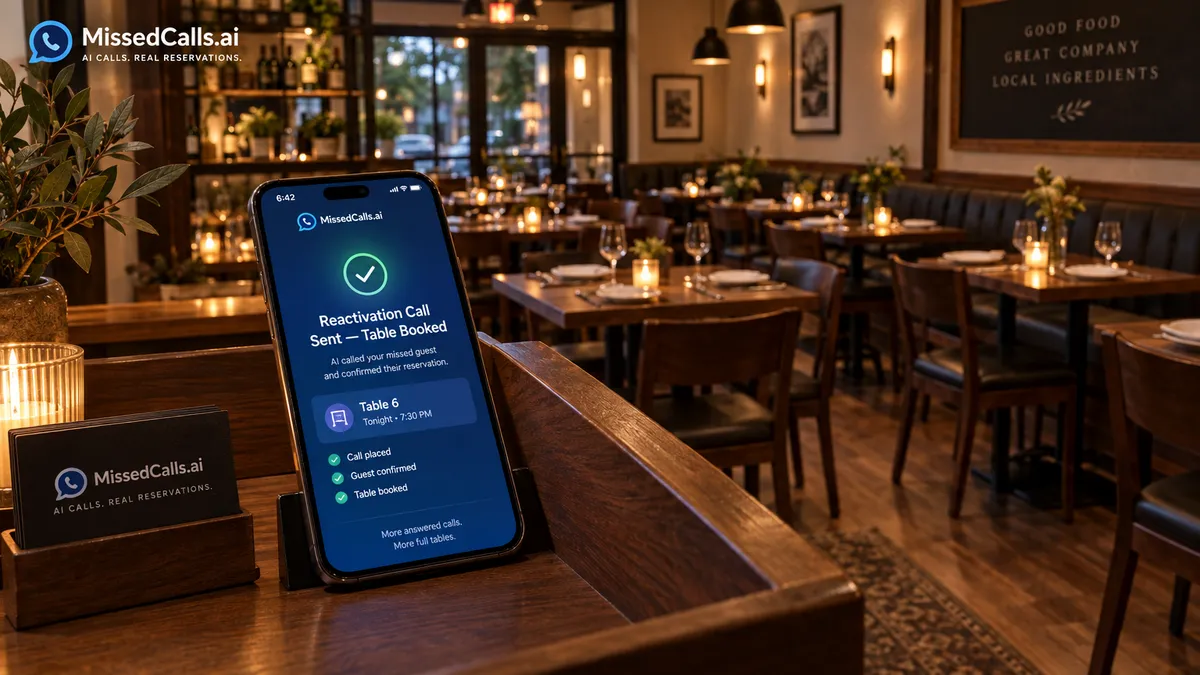
The call is not a robocall. It's a natural AI voice conversation that introduces itself, acknowledges the relationship, delivers a relevant offer or update, and -- when the guest is interested -- either books a reservation directly or captures a callback request for your team.
What Does the Script Actually Sound Like?
You control the parameters. Common approaches for restaurants include:
- The menu update: We just launched our fall menu and wanted you to be the first to know. Can we get you back in this week?
- The occasion tie-in: The holidays are coming up and we have limited reservation slots. We wanted to reach out to our regulars first.
- The simple we-miss-you: It's been a few months and we'd love to see you back. Can we hold a table for you this weekend?
The key is specificity and timing. Generic outreach gets ignored. A call that arrives at the right moment -- 90 days after the last visit, before the habit has fully transferred to a competitor -- consistently outperforms email blasts and social posts for high-value guest reactivation.
Every call is logged with a transcript and outcome summary. If a guest wants a specific table or has a dietary note, that's captured and forwarded. No context lost.
The Revenue Math Behind One Reactivation Campaign
Keep it simple. Say you have 200 guests in your system who haven't visited in 90 or more days. You run an AI reactivation campaign. If even 15 to 20% respond and return -- a conservative outcome for personalized outreach versus generic email -- that is 30 to 40 people walking back through your door.
At an average check of $48 per person and two visits over the next 90 days, that is $2,880 to $3,840 in recovered revenue from a single campaign. And that assumes they each visit only twice. Real regulars, once re-engaged, often resume their prior pattern.
Restaurants using automated win-back systems have recovered an average of more than $53,000 per location in the first year of running consistent reactivation workflows -- normalized across full-service and quick-service locations. That is not a chain benefit. It is a per-location result that independent operators can match or exceed.
This Is Not Just for Big Chains
The perception is that reactivation campaigns require a marketing team, a loyalty platform with complex segmentation, and months of setup. That is the enterprise version. MissedCalls.ai is built for the independent operator running three to five nights a week, one location, no corporate support.
You don't need a 10-step automation sequence. You need a system that looks at your guest list, identifies who has gone quiet, calls them at a reasonable time, has a good conversation, and reports back what happened. That is the entire workflow. It runs automatically after initial setup and keeps running without anyone managing it day-to-day.
For related outbound strategies, see how home service businesses use AI for review request calls after job completion and how salons recover lapsed regulars with AI reactivation outreach -- the same core approach translates directly to the restaurant setting.
If you're also losing guests during the dinner rush because nobody picks up the phone, the previous post on AI phone answering during peak hours covers that separately.
Why a Phone Call Works Better Than an Email Blast for This
Email is useful. SMS is useful. But for re-engaging a guest who has already stopped responding to passive marketing -- who unsubscribed, ignored the last three promotions, or never opened your newsletters -- a phone call cuts through in a way that a message cannot.
It is personal. It acknowledges the relationship. And critically, it requires an active response rather than a passive scroll-past. When a guest picks up and hears a warm voice acknowledging their history with your restaurant, that moment of recognition is often enough to restart the habit.
The restaurant industry's average retention rate sits around 55% -- well below the cross-industry benchmark of 75%. The operators closing that gap aren't doing it with bigger ad budgets. They're doing it with better follow-through on the guests they already have.
Your next $50,000 in annual revenue isn't sitting in a cold ad audience. It's in your existing guest list, waiting for someone to call.
Ready to see what AI reactivation looks like for your restaurant? Book a live demo with MissedCalls.ai and we will walk through a reactivation workflow built around your actual guest list and call volume.
Frequently Asked Questions
How does AI know which restaurant guests to call for reactivation?
MissedCalls.ai pulls from your existing guest data -- reservation records, POS history, or loyalty program exports -- and identifies contacts who have not visited within your defined lapse window, typically 60, 90, or 120 days. The system targets those contacts automatically without manual list-building on your end.
Will AI reactivation calls feel impersonal to my guests?
No. The calls are conversational and natural, not robocall menus. The AI acknowledges the guest's prior visits, uses a warm tone, and delivers a specific reason to return. Guests can respond naturally, ask questions, and book a reservation in the same call.
What kind of results can a restaurant expect from AI reactivation calls?
15 to 25% reactivation rates are a reasonable benchmark for well-targeted personalized outreach. Restaurants using automated win-back systems have recovered more than $53,000 per location in the first year, with the strongest results from campaigns targeting guests in the 60 to 120 day lapse window.
Does this work for small independent restaurants or only large chains?
MissedCalls.ai is built specifically for independent operators -- single-location restaurants and owner-operators without dedicated marketing staff. Setup is fast, the workflow runs automatically after launch, and there is no requirement for a loyalty platform or complex CRM already in place.
How is an AI reactivation call different from an email win-back campaign?
A phone call requires an active response and creates a moment of personal recognition that email cannot replicate. For guests who have already disengaged from passive marketing, a voice call cuts through and restarts the relationship in a way that a message in an inbox rarely does.
