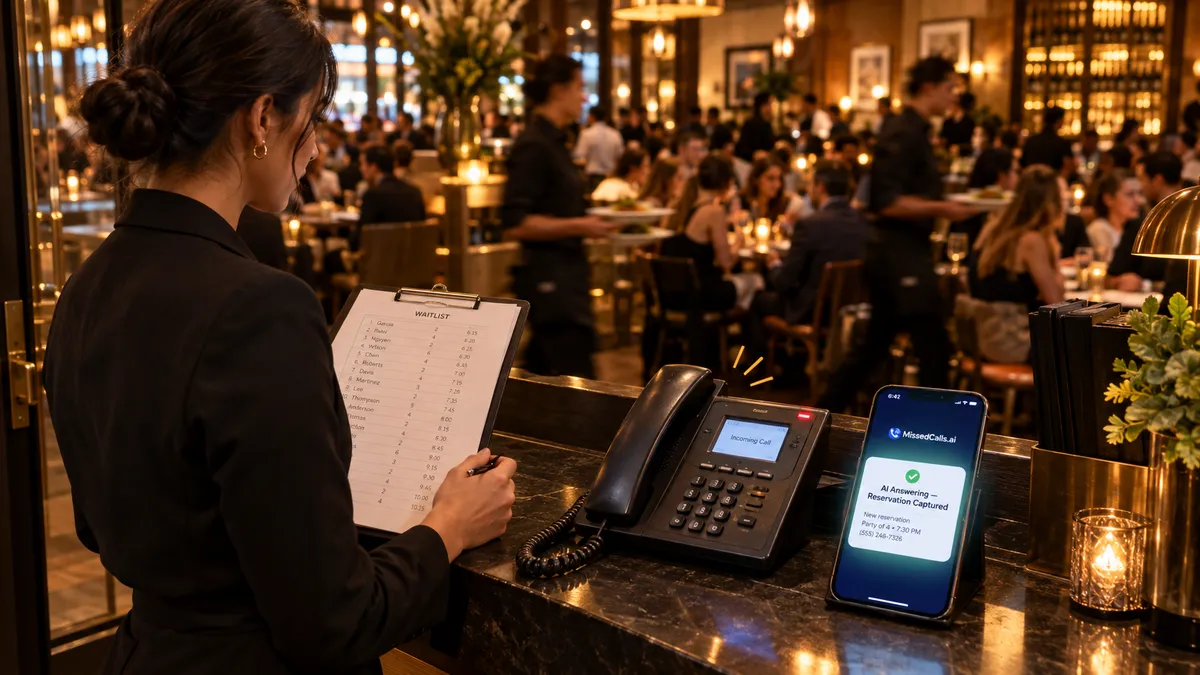
The Phone Rings 40 Times on Friday Night. Your Team Answers 12. Here's What You're Losing.
Short answer: Every unanswered restaurant call during peak hours is a reservation, takeout order, or catering inquiry that walks straight to a competitor. Industry data shows restaurants miss 43% of all inbound calls — and between 5 PM and 8 PM, that number gets worse. AI phone answering solves this by picking up every call instantly, capturing the guest's intent, and booking or logging the request automatically while your team stays focused on the people already in the building.
The Dinner Rush Is When Your Phone Loses the Most Revenue
Picture a Friday at 6:45 PM. Your dining room is full. Your host is managing a 20-minute wait list. Two servers are in the weeds. The phone rings.
Nobody answers.
It rings again at 6:52. Same thing.
This isn't a staffing failure. It's a structural reality. The moments your phone rings most are exactly the moments your team is least available to answer it. Peak call times overlap almost perfectly with peak service times — when staff are carrying plates, taking payments, seating parties, and managing the floor.
The math on this is painful. Between 5 PM and 8 PM, the average restaurant misses roughly 32% of all incoming calls. And according to a Harris Poll conducted in 2025, 69% of guests who can't reach a restaurant give up — they don't call back, they don't leave a voicemail, they open a competitor's website or walk across the street.
Think about what each of those calls represents. A party of four calling to reserve a table on a Friday night is worth $160 to $240 in dinner revenue. A catering inquiry for 40 people is worth thousands. An anniversary dinner booking for two, with wine, becomes a loyal regular couple you'd see four times a year. You lose all of that from a single unanswered ring.
Why Traditional Approaches Don't Work
Most restaurant owners know the problem. The fixes they try usually don't hold.
Voicemail is essentially a dead end. Guests don't leave messages for restaurants — they assume you're too busy or don't care. A 2025 Harris Poll found that 71% of guests who hear a busy signal or voicemail assume the restaurant is either closed or simply too overwhelmed to accommodate them. First impression: failed.
Dedicated phone staff sounds reasonable until you run the shift economics. A part-time host hired purely to answer phones costs $15–$18 an hour in most markets, and you'd need them every evening and weekend without exception — the exact windows when call volume is highest. You're also adding a fixed cost to handle a variable problem, and a human phone host can only handle one call at a time.
Online reservations only cuts you off from a significant portion of guests. Industry research consistently shows that a majority of full-service restaurant reservations and a large share of takeout and catering calls still come in by phone — especially for special occasions, large parties, and anything that requires a real conversation.
The problem isn't your staff. It's physics. One host, one call at a time, at the exact moment they're handling everything else.
What Happens to the Calls Your Team Can't Get To
Industry data puts the average restaurant at about 150 missed calls per month. Around 60 to 71% of those represent real revenue intent — someone trying to book a table, place a takeout order, ask about private dining, or inquire about catering. That's roughly 90 to 106 lost opportunities per month, every month, just from calls that went unanswered.
Plug in even a modest average order value and the math gets uncomfortable fast. At $45 to $60 per reservation converted, 90 lost calls per month is $4,050 to $5,400 in monthly revenue that quietly disappeared while you were busy actually running a restaurant.
And that's just the immediate loss. Guests who couldn't reach you don't always disappear after one attempt — they sometimes write a review about how you never answer your phone. The couple who was going to celebrate their anniversary at your restaurant this year becomes someone else's regular instead.
How Does AI Phone Answering Work for a Restaurant?
MissedCalls.ai answers every call in under two seconds — the same way a real host would, but without the bandwidth constraint. It greets the caller in your restaurant's voice, identifies what they need, and handles it.
For a reservation call during the dinner rush, the AI confirms the date, time, and party size, captures any special requests (birthday, allergy, high chair needed), and either books the reservation directly into your system or logs everything your host needs to confirm. The caller gets a real answer. Your team gets a clean handoff summary.
For a takeout or pickup order, the AI walks through the order, confirms details, and captures the caller's contact information. For a catering inquiry — easily the highest-value call type you're missing — MissedCalls.ai captures the event date, headcount, and contact details, then alerts your manager immediately so you can follow up before that business goes anywhere else.
After hours, it keeps working. A full 34% of restaurant phone calls come in outside business hours according to Slang AI's 2025 State of the Restaurant Phone Report — late-night reservation requests for the following evening, early-morning event inquiries, and Sunday morning calls about weekend brunch availability. Those don't go to voicemail. They get answered.
Every call is logged with a transcript and outcome summary so your team knows exactly who called, what they needed, and what was captured. Nothing falls through the cracks in a notes app or a sticky note by the register.
The Real Business Case: What You're Actually Recovering
This isn't about replacing your front-of-house team. Your hosts are irreplaceable for in-person hospitality — managing the room, reading the energy, making guests feel welcome. What AI phone answering does is remove the impossible choice your team faces every busy service: the guest standing at the door versus the phone ringing on the counter.
When the phone is covered, your host can be fully present with the room. Guests who call get an immediate, professional answer. Private dining and catering inquiries — the calls most likely to generate large revenue — never bounce to voicemail again.
For a restaurant doing 150 calls a month and currently answering roughly half of them, recovering even a fraction of those missed calls at an average ticket of $50 adds real money back to the weekly revenue line. For a location missing 80 calls a month, recovering 60% of those at $50 average is $2,400 per month — $28,800 a year — from calls that were already coming in and simply going unanswered.
Other industries face the same problem and find the same solution. Home service businesses deal with calls they can't answer while technicians are on jobs — the same structural conflict, different context. Auto repair shops use AI to follow up with customers for service reminders. The underlying mechanism is identical: your phone becomes a revenue asset instead of a liability the moment it never goes unanswered.
What to Expect When You Set It Up
MissedCalls.ai is trained on your restaurant's specifics — your hours, your menu highlights, your reservation policy, your pricing range for private events, your pickup lead time. The setup is fast. You're not reconfiguring a phone system or onboarding new staff. You're adding a layer that answers calls you're already missing.
Once live, every incoming call gets answered instantly. Your team gets transcripts and summaries. And the calls that used to disappear during the Friday rush now turn into confirmed reservations, captured leads, and booked private events.
The phone that rang 40 times on Friday night? MissedCalls.ai answers all 40.
Stop losing reservations and catering leads to a busy Friday night. See exactly how MissedCalls.ai answers your restaurant's calls during peak hours, captures every guest's intent, and hands off cleanly to your team. Book a tailored demo at MissedCalls.ai →
Frequently Asked Questions
How many calls does the average restaurant miss each month?
Industry data shows the average restaurant misses approximately 150 calls per month. During peak dinner hours (5–8 PM), miss rates climb to 32% or higher. Roughly 60–71% of those missed calls represent real revenue — reservations, orders, catering inquiries, or private dining requests.
Do guests leave voicemails when a restaurant doesn't answer?
Rarely. A 2025 Harris Poll found that 69% of guests give up entirely when a restaurant doesn't answer — they don't wait for a callback. 71% assume the restaurant is closed or too overwhelmed to accommodate them. Most move on to the next option immediately.
Can AI phone answering handle catering and private dining inquiries?
Yes. MissedCalls.ai captures the caller's event date, headcount, contact information, and any specific needs, then alerts your team immediately. Catering calls are among the highest-value inquiries restaurants miss — often worth thousands per booking — and they almost never leave voicemails.
Does AI phone answering work after the restaurant is closed?
Yes. Slang AI's 2025 State of the Restaurant Phone Report found that 34% of restaurant calls come in outside business hours. MissedCalls.ai answers 24/7, capturing late-night reservation requests, next-day brunch inquiries, and event questions that would otherwise go unanswered.
Will AI phone answering replace my front-of-house team?
No. MissedCalls.ai handles the calls your team physically can't get to during peak service. Your hosts stay fully focused on in-person guests. The AI removes the impossible choice between the person at the door and the phone ringing on the counter — making your whole team more effective, not redundant.
Related reading: How Home Service Businesses Capture After-Hours Calls with AI | How Auto Repair Shops Use AI Outbound Calls to Fill Slow Days
