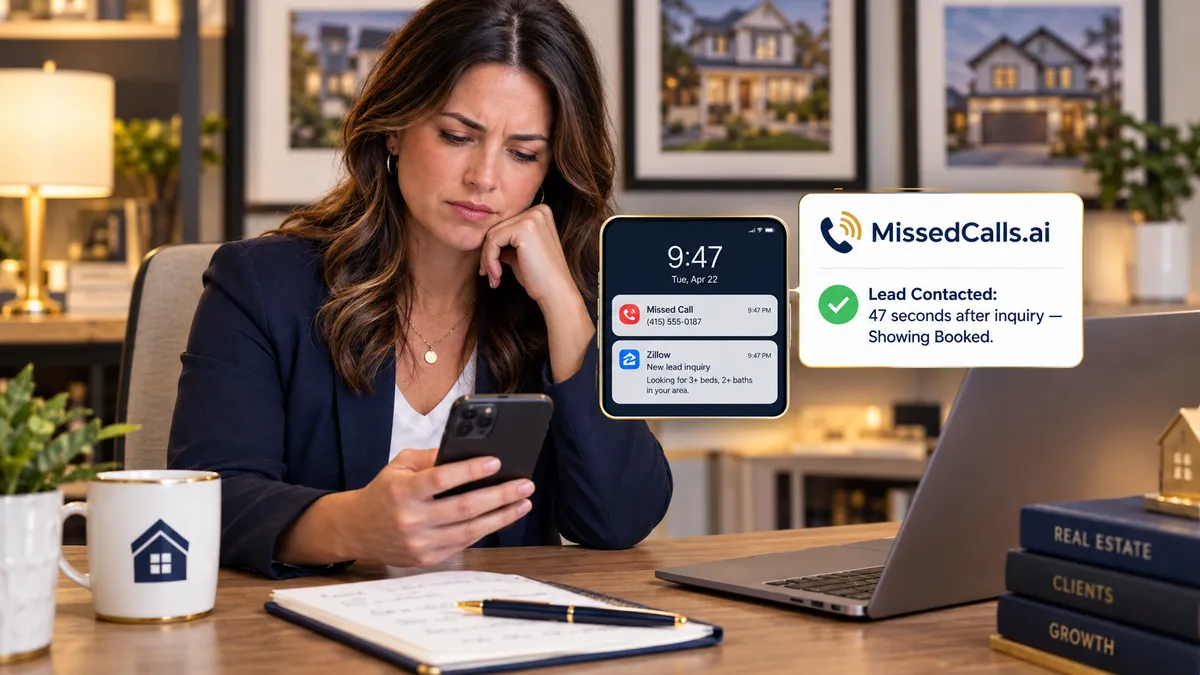
The Lead Came In at 9 PM. You Called Back the Next Morning. Here's Why That's Costing You Deals.
The short answer: in real estate, speed wins. A buyer submits an inquiry on Zillow, your website, or a listing portal at 9:14 PM. You see it the next morning, pour your coffee, and call back around 8:45 AM. That lead has already talked to two other agents — one of them called back within four minutes of the original inquiry. You're not getting that appointment.
This is not speculation. Research on lead response time consistently shows that agents who follow up within five minutes of an online inquiry are dramatically more likely to make contact and convert than agents who wait even 30 minutes. Wait until the next morning and your odds drop close to zero — not because the lead is bad, but because someone else already built the relationship.
The problem is not motivation. Most agents would call back immediately if they could. The problem is timing. Leads come in at 9 PM, on weekends, during showings, and while you are sitting at a closing table. You physically cannot be on the phone the moment every inquiry lands. That gap — measured in minutes on the good days and hours on the rest — is where commissions disappear.
Where Real Estate Leads Actually Come From (And When They Come In)
Online real estate leads land from a lot of places: Zillow, Realtor.com, your own website contact form, social media ads, Google Business Profile, and paid lead programs. What almost all of them have in common is that the person submitting the inquiry is actively shopping right now, in that moment. They searched, found a listing they liked, and filled out a form because they wanted to talk to someone.
The catch is that the moment of peak intent is rarely during business hours. Inquiry patterns in real estate consistently show a major spike in form submissions during evening hours — after work, when people are home, scrolling listings, and finally having time to reach out. Another surge hits weekend afternoons. These are exactly the windows when agents are least likely to be monitoring their email or CRM in real time.
So you have a motivated buyer or seller submitting at peak intent at the exact moment no agent is picking up the phone. The first agent who calls wins the introduction. Everything after that is just relationship-building on top of whoever got there first.
What Happens When You Don't Call Back Fast Enough
Here is the scenario that plays out dozens of times a month for the average producing agent:
A homeowner submits a seller inquiry for a home valuation at 8:37 PM on a Thursday. You see it Friday morning. You call at 9 AM — no answer. You leave a voicemail and send a follow-up email. You try again at 2 PM. By then, the homeowner has already had a 20-minute conversation with an agent who called back within six minutes Thursday night, scheduled a listing presentation for Saturday morning, and has already built enough rapport that they have no reason to start the process over with someone new.
You did not lose that lead because your services were worse. You lost it because you were not there when the window was open.
Multiply that by every online lead you receive in a month. The ones you reach quickly convert at a meaningful rate. The ones that age even a few hours become increasingly difficult to engage — because by the time you call, they have already talked to someone else, lost urgency, or simply moved on.
How AI Outbound Follow-Up Calls Close the Speed Gap
AI outbound calling addresses this problem at the source. Instead of relying on you to check your CRM and manually dial within minutes of every new inquiry, the system does it automatically — no matter what time the lead comes in.
Here is how it works in practice with MissedCalls.ai:
A buyer submits an inquiry on your website at 9:47 PM asking about a four-bedroom listing in a specific school district. Within about 60 seconds, an outbound call goes to that number. The AI introduces itself as your team's automated assistant, confirms the buyer's interest in the property, asks a few qualifying questions — budget range, timeline, whether they are pre-approved — and if they are ready to move forward, offers to schedule a showing or consultation directly on your calendar. By the time you wake up Friday morning, that lead has been contacted, qualified, and in many cases already booked.
If the call goes to voicemail, the AI leaves a professional, personalized message and can follow up with a text so the lead has multiple ways to respond when they are ready.
The buyer experiences the call as fast, professional, and helpful. You get a warm handoff with qualification notes — not a cold lead you have to remember to chase.
What Does the AI Actually Ask?
The qualification questions are fully customizable to your business and the type of lead. For buyer inquiries, a typical flow might include confirming which property or neighborhood they are interested in, whether they are currently working with another agent, their general timeline, whether they have been pre-approved or are still in the financing process, and offering a specific showing time or a consultation call with you directly.
For seller leads, the flow shifts to confirming address, timeline for listing, whether they have had any other valuations done, and scheduling a listing presentation.
None of this replaces your relationship-building. It front-loads the qualification and scheduling so that when you actually talk to the buyer or seller, you already know what they need, what their situation is, and what the next step is. You are showing up to a warm conversation, not starting from scratch.
Is This the Right Move for Independent Agents — or Only Teams?
Both. Solo agents actually benefit more from AI follow-up in some ways, because they have no admin staff to handle the initial call volume. There is no fallback — it is just you, and you can only be in one place at a time. AI outbound calling gives a solo agent the first-contact speed of a full team without the overhead.
For teams, it creates consistency. Not every team member responds to new leads with the same urgency. AI outbound follow-up creates a floor — every lead gets contacted fast, regardless of what any individual agent is doing at that moment.
The Revenue Math Worth Running
A typical producing agent in a mid-size market might receive 15 to 30 online leads per month from paid and organic sources combined. If the average commission on a transaction in that market is $8,500, and improving speed-to-contact converts even two additional deals per quarter that would otherwise have gone cold, that is roughly $17,000 in recovered revenue — per quarter — from fixing a timing problem that the AI handles automatically once it is set up.
The leads were already coming in. The marketing budget was already spent. The only thing missing was the first call.
If you are also losing leads during showings when your phone rings and you cannot answer, the inbound side of this equation matters too. See how AI phone answering captures buyer and seller leads when you are in the middle of a showing: You're in a Showing. Your Phone Just Rang. That Was a Buyer Lead.
Ready to Stop Losing Leads to Whoever Called First?
If online leads are coming in and you are not reaching them in the first few minutes, you are already behind. MissedCalls.ai AI outbound follow-up calls contact every new inquiry automatically — day, night, or weekend — so you are always the agent who called first.
Book a tailored demo and see exactly how the follow-up flow works for real estate leads.
Frequently Asked Questions
How quickly should a real estate agent follow up on a new online lead?
Research consistently shows that contacting a new lead within 5 minutes dramatically increases your chances of making contact and booking an appointment. Agents who wait 30 minutes or more see conversion rates drop significantly. Waiting until the next business day typically means the lead has already engaged with a competing agent.
Can AI automatically call real estate leads the moment they come in?
Yes. MissedCalls.ai places an outbound AI call to new leads automatically — typically within about 60 seconds of the inquiry arriving — regardless of the time of day. If the lead does not answer, the AI leaves a professional voicemail and can follow up via text as well.
What information does the AI capture when it contacts a real estate lead?
You define the qualification questions. Common captures include the property or neighborhood of interest, buyer timeline, pre-approval status, whether they are working with another agent, and their preferred showing or consultation time. Seller lead flows typically capture address, listing timeline, and schedule a valuation appointment.
Will leads feel put off by an AI calling them so quickly?
Most leads respond positively to immediate follow-up — it signals that you are responsive and organized. The AI opens the conversation, confirms interest, and books the meeting. The agent handles all relationship-building from there. A fast professional response is almost always better received than a next-morning voicemail.
Does this work with leads from Zillow, Realtor.com, or my own website?
Yes. MissedCalls.ai can connect with your CRM or receive lead data from any source where leads land — including third-party portals and your own website contact forms. When a new lead record arrives, the outbound follow-up call is triggered automatically.
