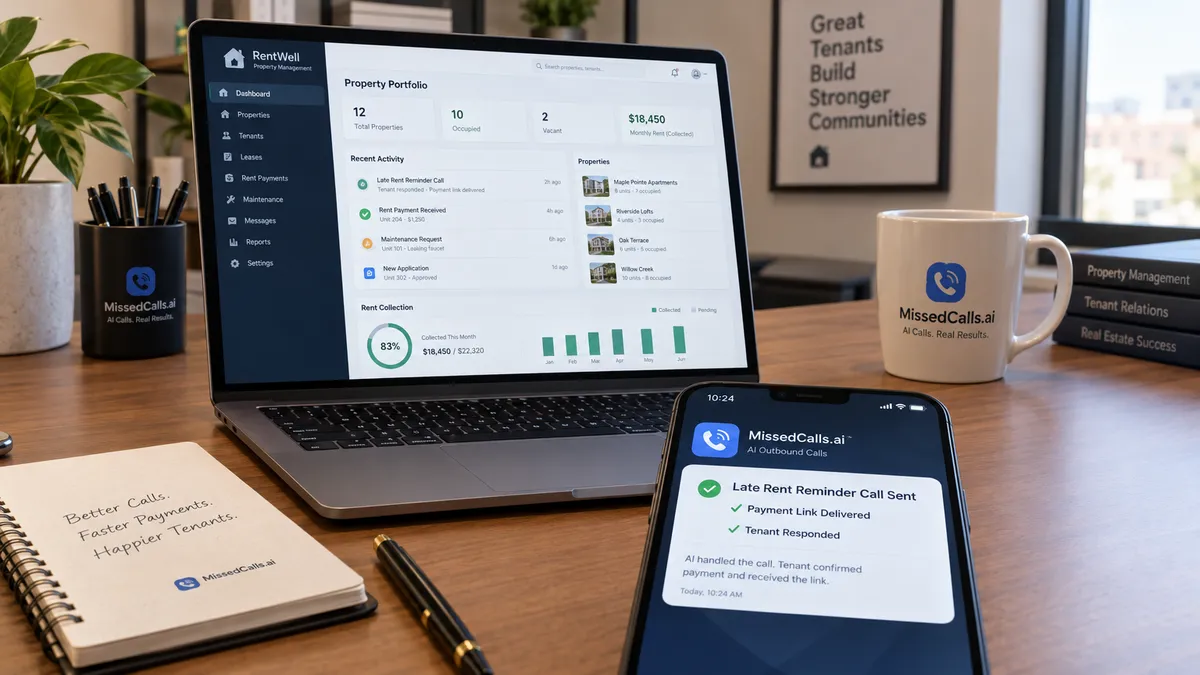
Your Tenants Are 3 Days Late on Rent. Here's Why an AI Call Works Better Than You Making It.
The direct answer: AI outbound rent reminder calls go out automatically — before the due date and again when payment is overdue — without the awkwardness, the documentation burden, or the hours your team spends chasing tenants one by one. They work while you're focused on everything else a rental portfolio demands.
And right now, that matters more than ever. Property managers are already stretched thin handling maintenance calls, tenant communication, and leasing activity. Adding rent collection follow-up on top of that — manually, every month — is one of the most expensive things you can do with your time.
Late Rent Is Getting More Common, Not Less
Here's the current environment: as of May 2026, only about 83–85% of independent rental tenants are paying rent on time, depending on property type. That means roughly 1 in 7 tenants is running late every single month. Late payments in independently owned rentals climbed from 8.8% in mid-2024 to 11.7% by mid-2025 — and that trend has held at elevated levels into 2026.
The Federal Reserve's 2025 survey found that 23% of U.S. renters reported being behind on rent at some point during the preceding year. The Consumer Financial Protection Bureau found that 42% of renters who incur a first late fee incur another one the following month — meaning a single late payment is more likely than not to become a pattern without early intervention.
None of this is because your tenants are bad people. Most of them are dealing with timing issues — mid-month income, irregular pay cycles, or simply forgetting that the first rolls around faster than expected. The property managers who catch late payments earliest, with the least friction, collect the most rent on time. The ones who wait until day five to start calling are already a week behind.
What Rent Collection Actually Costs You in Time
Say you manage 40 units. If 15% pay late in a given month — which is squarely in line with current industry data — that's six tenants you need to follow up with. Each manual follow-up takes 10 to 15 minutes when you factor in the call, the voicemail, the note in your records, and the follow-up text if nobody picks up. That's 60 to 90 minutes in the first round alone.
Multiply that across a second round for tenants who still haven't paid, formal notice drafting, and the documentation required if the situation escalates — and you're looking at three to four hours every month on rent collection administration. Work that generates zero revenue, pulls you away from leasing vacant units, and is frankly the least enjoyable part of the job for most property managers.
At 100 units? You're looking at a full half-day, every month, just chasing what's already owed.
How AI Rent Collection Calls Work
MissedCalls.ai can run outbound reminder calls to your tenant list automatically — triggered by dates relative to the rent due date, or any condition you define. Here's what a standard workflow looks like:
- Day −3 (before due date): A friendly, professional AI call goes out to every tenant reminding them rent is due in three days and providing their payment instructions or link. This is where most of the behavior change happens — tenants who intended to pay but hadn't gotten around to it pay before the due date instead of after.
- Day 0 (due date): A same-day confirmation for any tenant who hasn't yet paid, noting that rent is due today and including a clear payment path.
- Day +3 (grace period): For tenants still showing unpaid, a follow-up call notes the account is past due, mentions any late fee that will apply, and offers to connect them with your office if there's a situation they'd like to discuss.
- Day +7: A final automated reminder before the formal notice process begins — with every contact attempt and outcome logged automatically for your records.
Every call is documented. Live answers, voicemails, tenant responses — all logged without your team lifting a phone. Only the genuinely complicated situations land on your desk, and when they do, you already have the contact history.
Why an AI Call Actually Outperforms You Making It
This is the part most property managers don't expect.
When you personally call a tenant about late rent, the dynamic immediately becomes personal. The tenant knows it's you. They either dodge the call entirely, or they answer and the conversation becomes an uncomfortable negotiation about their situation, your flexibility, and what happens next. That's a hard position to be in every single month — and it strains tenant relationships that you've often spent years building.
An AI call removes that dynamic entirely. The message is professional, consistent, and non-confrontational. The tenant receives it as a standard business notification — the same way they'd receive a reminder from their bank or their utility provider. There's no social friction, no awkwardness, and no ambiguity about what the call is for.
The reminder before the due date — not after — is where the biggest impact is. Most tenants aren't trying to skip rent. They got busy, forgot, or assumed they had more time. An AI call a few days early catches that entire group before they become a late account. That's not debt collection — it's customer service.
It's Not Just for Rent
The same outbound call workflow applies across the recurring touchpoints that consume property management time every month:
- Lease renewal outreach: AI calls go out at 90 and 60 days before lease expiration to gauge renewal intent and book renewal discussions — before tenants start shopping elsewhere.
- Move-out inspection scheduling: Automatic calls in the final 30 days of a lease coordinate the walkthrough without back-and-forth texts.
- Maintenance follow-up: After a repair is completed, an outbound call confirms the work is done and surfaces anything unresolved before the tenant calls to complain about it.
- Annual rent adjustment notices: Deliver upcoming rate change communications in a professional, documented format — before the written notice period even starts.
Each of these is a touchpoint your team already handles — just manually, inconsistently, and reactively. Outbound AI call workflows turn these reactive tasks into automated systems that go out on schedule, every time, regardless of how busy your team is that week.
What Happens When a Tenant Needs to Talk to a Person?
Every AI call includes a clear path to escalation. If a tenant says they want to speak with someone about their account, the AI captures the reason and routes or flags the conversation for your team to follow up with context already logged. You're not replacing the relationship — you're removing the friction for routine touchpoints so the human conversation happens when it actually matters.
Tenants going through a real hardship — a job loss, a medical situation, a temporary cash flow gap — will surface it during the call or ask to speak with someone. You go into that conversation already knowing what the situation is. That makes the resolution faster and the relationship stronger than a cold call where you're walking in blind.
Setup Takes Hours, Not Months
Getting an outbound rent reminder workflow live doesn't require a lengthy implementation project. You define the schedule (which days, relative to the due date), the message (which you control and can update at any time), and the routing rules (what happens when a tenant responds or needs to escalate). MissedCalls.ai handles the calls, the logging, and the follow-up routing from there.
Most property managers running single or multi-family portfolios are live within a day. If you manage multiple properties or locations, routing can be set by address or unit group so tenants always hear messaging that matches their specific property.
If you want to see exactly how the workflow would run for your portfolio, the best next step is a tailored demo: book one at MissedCalls.ai and walk through your specific setup live.
Frequently Asked Questions
Can AI calls actually reach tenants, or do most go to voicemail?
Both outcomes are productive. Live pickups allow the AI to deliver the reminder conversationally and capture a tenant response. Voicemails deliver the reminder message and payment instructions — both are logged as documented contact attempts. The goal is consistent, documented outreach, not just live conversations.
How do tenants react to receiving an AI call about rent?
When the message is professional, friendly, and brief, tenant reception is generally neutral to positive — especially for pre-due-date reminders. The key is tone: informative, not threatening. Tenants respond better to an early, professional reminder than a late-stage escalation, which is exactly what this workflow prevents.
Can I customize the message script for my properties?
Yes. You define the message — the AI follows your script, stays on-brand, and delivers it consistently across every call. You can maintain different scripts for different property types, locations, or tenant groups if needed.
What happens if a tenant says they can't pay?
The AI captures the response — including any reason provided — and flags the account for your team to follow up with that context already logged. You can also configure the call to offer a direct transfer to your office if the tenant wants to discuss their situation live.
Does this work alongside my existing property management software?
Yes. MissedCalls.ai integrates with your existing tools — CRM, property management platforms, calendar systems — so call outcomes and tenant responses push to your records automatically without manual data entry.
