Every Missed Call Is a Missed Client: How AI Phone Answering Fixes the #1 Intake Problem for Law Firms
The short answer: Most solo attorneys and small law firms miss 35-60% of inbound calls while in court, client meetings, or after hours. The majority of those callers do not leave a voicemail. They call the next lawyer on the list. AI phone answering solves this by capturing new client intake, answering common questions, and booking consultations automatically around the clock, without hiring a receptionist.
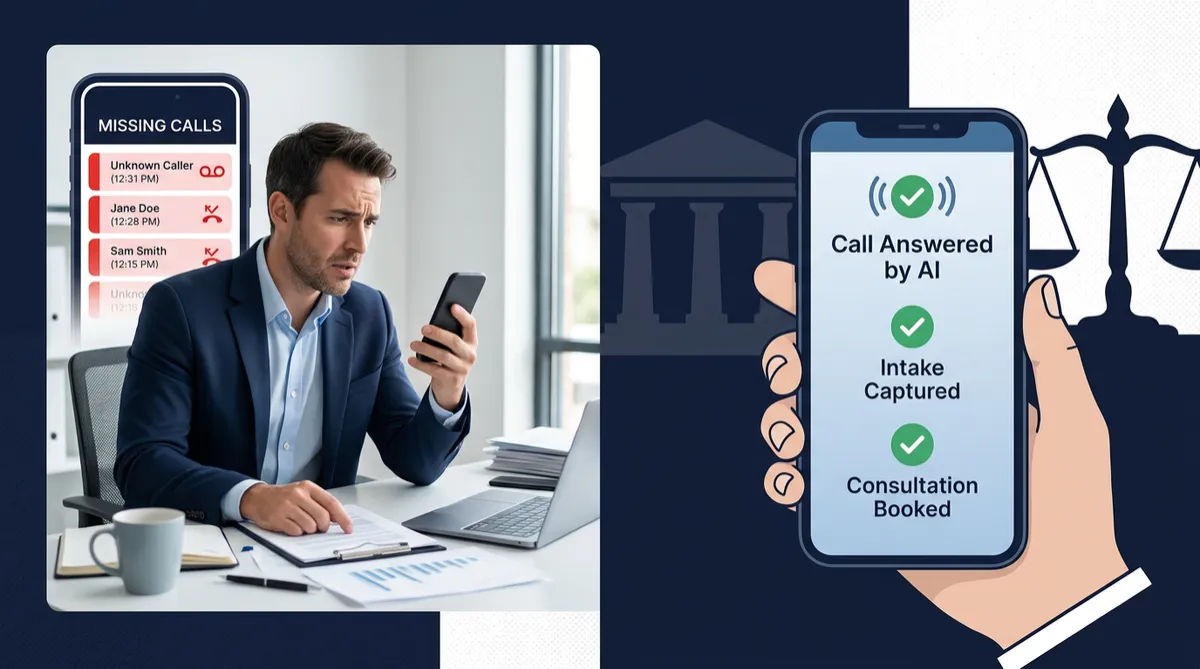
If you run a solo practice or a small firm, you already know this problem. You finish a two-hour deposition, check your phone, and see three missed calls with no voicemails. You will never know who called, what they needed, or whether they were a viable client. By the time you try to call back, they have already retained someone else.
This is not a minor inconvenience. It is the most expensive operational problem most small law firms have, and almost nobody is treating it that way.
Why Law Firms Lose More Calls Than Almost Any Other Industry
Legal is one of the worst industries for phone coverage — not because attorneys do not care, but because the nature of legal work makes consistent phone availability nearly impossible.
Think about what a typical Tuesday looks like for a solo or small-firm attorney. Morning: court appearance. Midday: a client consultation that runs long. Afternoon: depositions. Between each of those blocks, the phone rings and nobody answers. After 5 PM, it rings and nobody answers again.
Research on law firm intake consistently shows that 42% of law firms do not answer the phone during business hours — a number that climbs dramatically after hours. When someone is dealing with a potential DUI charge, a custody dispute, an employment termination, or a real estate transaction gone wrong, they are calling multiple firms simultaneously. The one who answers first wins the client.
Voicemail does not fix this. Most legal callers do not leave one. They move on.
What Happens to a New Client Inquiry When Nobody Answers?
Here is a realistic scenario that plays out hundreds of times a week at small law firms across the country.
It is 7:30 PM on a Thursday. Someone was just served with eviction papers. They are scared, they do not know what their rights are, and they need to talk to a lawyer tonight. They search online for an eviction defense attorney nearby and find your firm. They call. It rings four times and goes to voicemail.
They do not leave a message. They scroll down and call the next result. That firm uses AI phone answering. The system picks up immediately, captures the caller name, phone number, and situation type, and books a consultation for 9 AM the next morning. Your firm never knew they existed.
That is not a hypothetical. It is the default outcome when there is no coverage system in place. For practice areas with time-sensitive intake needs — criminal defense, family law, personal injury, immigration, landlord-tenant — the urgency of the caller situation is exactly what makes them most likely to move on quickly.
How Does AI Phone Answering Work for a Law Firm?
AI phone answering for law firms is not a chatbot or an IVR menu. It is a natural-conversation system that answers calls, asks the right intake questions, handles common FAQs about your practice, and either books a consultation or flags the call for your team — all without a human receptionist on the line.
Here is what a real call flow looks like with MissedCalls.ai:
- A potential client calls during court hours or after 5 PM
- The AI picks up in under 2 seconds — no hold music, no voicemail prompt
- It introduces itself as a representative of your firm and asks how it can help
- It collects the caller name, contact information, and the nature of their legal matter
- It answers common questions your firm defines: practice areas, general process, whether you offer free consultations, your service area
- If the caller qualifies, it offers available consultation times and books directly to your calendar
- Every call is logged with a transcript, summary, and outcome — so you walk out of court knowing exactly who called, what they need, and what was promised
No press 1 for billing, press 2 for scheduling. Just a real conversation that gets the intake done.
What Can You Configure for Your Legal Practice?
This is where small law firms often get skeptical — and understandably so. Legal intake is not like booking a haircut. The questions matter. The language matters. Confidentiality expectations matter.
With MissedCalls.ai, you control the full call flow. You define what the AI asks, what it answers, and what it escalates. For example:
- What it asks: Practice area, opposing party, urgency level, whether it is a new matter or existing client inquiry
- What it answers: Your practice areas, consultation fee structure, geographic coverage, what documents to bring to the first meeting
- What it does not answer: Legal advice, case-specific evaluations, anything outside your defined scope — those get flagged immediately for your team
- When to escalate urgently: You can set criteria for high-priority matters — criminal in-custody situations, active protection order needs — that trigger an immediate alert to your cell phone even after hours
- Your calendar windows: The AI books only into slots you have opened, so it never conflicts with court schedules or double-books existing clients
The AI captures intake and routes appropriately — the same thing a good receptionist would do, but without the staffing cost, the sick days, or the 9-to-5 limitation.
The After-Hours Window Is Where You Are Losing the Most
For most law firms, the biggest intake gap is not during office hours — it is evenings and weekends. Legal matters do not follow business schedules. Someone gets arrested at 10 PM. A domestic situation escalates on Saturday afternoon. A business owner receives a cease-and-desist on a Sunday morning and panics.
These are high-urgency, high-value potential clients. They are calling at unusual hours precisely because something urgent just happened. If your phone rings and goes to voicemail, you have lost them — not because your legal skills are lacking, but because someone else was available when they needed help.
AI phone answering covers that window completely. It answers at 10 PM on a Saturday the same way it answers at 10 AM on a Tuesday — collecting the intake information, setting expectations with the caller, and either booking the consultation or sending you a real-time summary so you can decide whether the situation warrants a call back that night.
The Real Revenue Impact of Missed Legal Intake Calls
Let us put a rough number on it. Say your firm receives 40 inbound calls per month from potential new clients. Based on industry patterns, you are missing 14-24 of those calls while in court, in meetings, or outside office hours. Of the callers you miss, roughly 70% move on without leaving a voicemail or trying again.
That is 10-17 potential new client inquiries per month that evaporate. If your average case value is $3,500 — modest for most practice areas — and you convert 30% of qualified inquiries, you are losing $10,000-$20,000 in potential revenue every month simply because no one picked up the phone.
The math is uncomfortable. But it also means that fixing your intake coverage is one of the highest-ROI moves a small firm can make, because you are not building new marketing spend — you are capturing the leads already calling you.
Does This Work for Solo Attorneys and Small Firms?
Yes — and in many ways, AI intake coverage is more impactful for solo and small-firm attorneys than for large firms with full reception staff.
Large firms have receptionists, legal assistants, and intake coordinators whose only job is to answer phones and qualify callers. A solo attorney has none of that. It is just you — and when you are in front of a judge, you cannot also be answering the phone.
AI phone answering fills that gap without the overhead. You do not need to hire a full-time legal receptionist at $40,000-$55,000 per year. You do not need to manage an employee. You get consistent intake coverage for a fraction of that cost, with every call logged and summarized for your review.
For small firms with two to five attorneys, it also eliminates the who-is-on-phone-duty-today problem and ensures that when the entire team is in depositions, new client calls still get answered professionally.
Is AI Phone Answering the Right Move for Your Practice?
If any of these describe your situation, the answer is likely yes:
- You regularly come out of court or client meetings to find missed calls with no voicemails
- You know your after-hours and weekend coverage is essentially zero
- You have tried virtual receptionist services but found them inconsistent, expensive, or difficult to train on your intake script
- You spend more time playing phone tag with potential clients than you would like
- You practice in a high-urgency area where callers expect a fast response — criminal defense, family law, immigration, personal injury, or landlord-tenant
The goal is not to replace your judgment or your relationship with clients. It is to make sure every qualified potential client gets through the front door instead of calling the firm next on the search results page.
If you want to see how the call flow works for a legal practice specifically — what it sounds like, what questions it asks, how it handles a variety of caller situations — book a live demo and we will walk through it with your intake scenario.
Book a live demo tailored to your law firm
Frequently Asked Questions
Can AI phone answering handle legal intake without giving legal advice?
Yes. You define exactly what the AI answers and what it does not. Intake AI captures caller information, describes your practice areas, explains your consultation process, and books appointments — but it does not provide case evaluations, legal opinions, or advice. Anything outside the defined scope is flagged for your team to handle directly.
How quickly does AI phone answering pick up calls for a law firm?
MissedCalls.ai answers calls in approximately 2 seconds — faster than most human receptionists. This matters significantly in legal intake because callers with urgent matters are often calling multiple firms simultaneously. The first professional response wins the client.
What happens if a caller has an emergency legal situation after hours?
You can configure the AI to recognize urgent matter types and trigger an immediate alert to your cell phone — so you can decide in real time whether to call back that night. For non-urgent matters, the AI captures intake and logs a complete summary for your review the next morning.
Is AI phone answering cost-effective for a solo attorney or small firm?
Yes — significantly more so than hiring a full-time legal receptionist or a part-time virtual receptionist service. AI phone answering provides 24/7 coverage at a fraction of staffing cost, with no training curve, no sick days, and consistent intake quality on every call.
Which legal practice areas benefit most from AI phone answering?
Any practice area where callers have urgency and low patience for voicemail benefits significantly — criminal defense, family law, personal injury, immigration, and landlord-tenant in particular. Estate planning and business law firms also benefit from consistent intake and appointment booking workflows, especially for after-hours and weekend inquiries.
