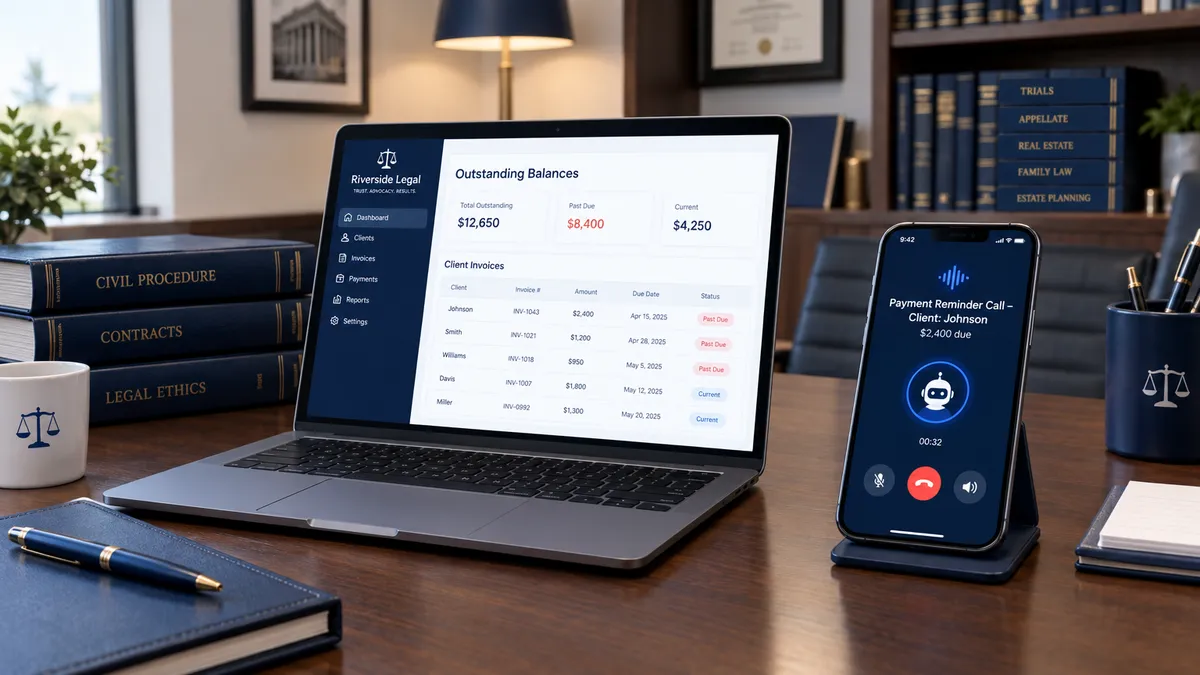
Your Law Firm Did the Work. Now Get Paid: How AI Payment Reminder Calls Collect Faster Without the Awkwardness
Short answer: Most law firms lose money not because clients refuse to pay, but because no one follows up consistently. AI outbound payment reminder calls automate that follow-up — calling clients on the firm's behalf, capturing payment commitments, and escalating only the cases that need a human — so attorneys stop spending billable time chasing invoices.
You closed the matter. You did the work. You sent the invoice. And then… silence.
A week goes by. You send a follow-up email. Another week. You write a polite reminder. The client responds with a vague "I'll take care of it" and you never hear back. Now you're three months out, the balance is aging, and every time you think about calling you feel like you're begging for money you already earned.
This is not a client problem. It's a process problem. And it costs small law firms far more than most attorneys realize.
How Bad Is the Law Firm Collections Problem in 2026?
The numbers are uncomfortable, but they're real.
The average law firm collects only about 85% of the revenue it actually invoices. On $2 million in annual billings, that's $300,000 left on the table — money that was earned, billed, and never recovered. Across small and mid-size firms, the average outstanding invoice balance sits around $206,000, with some practices carrying unpaid balances above $2.5 million.
According to a 2025 industry report, 68% of law firms say fee collection is a moderate or significant operational hurdle. And a separate analysis found that 35% of firms identified "chasing past-due bills" as their most frequent day-to-day operational challenge — ahead of staffing issues, court scheduling, and software problems.
In Q1 2026, uncollected legal fees grew nearly 17% year-over-year even as firm revenue climbed. The gap between work performed and cash collected is widening, not closing.
The root cause isn't client unwillingness. For most firms, the leakage happens earlier: delayed billing, inconsistent follow-up, and awkward collection conversations that nobody wants to have. Clients don't ignore invoices because they're refusing — they ignore them because nothing is creating urgency.
Why Email Reminders Don't Actually Work
The default collection process at most small law firms looks roughly like this: an invoice goes out, a paralegal or office manager sends a reminder email at 30 days, another at 60, and then the matter gets escalated to a partner who has to decide whether to write it off, damage the client relationship, or make an awkward call they've been avoiding for weeks.
Email is easy to ignore. A client who's busy, short on cash, or just procrastinating will let an invoice email sit unread for days. Even when they open it, the "I'll handle it later" instinct kicks in. Your invoice lands in a mental queue that never reaches the top.
A phone call is different. When someone calls you about money you owe, you deal with it. You either pay, ask a question, explain a problem, or set a date. The conversation forces a resolution. Email allows indefinite deferral.
The problem is that making payment reminder calls at scale — across 20, 50, or 100 open invoices at various aging stages — is time-consuming, uncomfortable, and wildly inconsistent when done manually. Most firms don't do it. Which is exactly why their AR keeps aging.
What AI Outbound Payment Reminder Calls Actually Do
AI payment reminder calls are outbound voice calls placed automatically on the firm's behalf. The AI identifies itself as calling from the law firm, references the specific matter and balance, and opens a real two-way conversation — not a recorded message, not an IVR menu, but an actual exchange where the client can respond naturally.
Here's what a typical call workflow looks like in practice:
Stage 1 — Pre-Due Reminder (3–5 days before due date)
A friendly, professional call confirms the upcoming balance, thanks the client for their business, and offers to answer any billing questions. This single touchpoint alone recovers a meaningful portion of invoices before they ever go past due — because many late payments are simply forgotten ones.
Stage 2 — Due-Date Follow-Up
If no payment has posted, the AI calls again on or just after the due date. The tone is courteous and direct. It states the balance, asks if the client has any questions about the invoice, and captures the client's intended payment date. That commitment is logged automatically — no manual notes required.
Stage 3 — 14-Day and 30-Day Escalation
For invoices still outstanding at 14 and 30 days, the call sequence escalates in directness while staying professional. The AI can offer to connect the client with someone at the firm to discuss a payment arrangement, or flag the account for a partner to call personally. Only the genuinely complex cases — disputes, hardship situations, clients who need negotiation — land on a human's desk. Routine follow-up runs automatically.
Every call is logged with a transcript, the outcome (payment promised, date committed, dispute raised, escalation needed), and any relevant notes. Your team sees exactly where every open invoice stands without spending time on manual tracking.
Why This Hits Different for Law Firms
Collections follow-up is uncomfortable in every industry. But in law, it carries a particular tension. You have an ongoing relationship with the client. You may still be handling other matters for them. You don't want to damage trust over an invoice when there's potential future work or referrals at stake.
This is exactly why AI-handled reminder calls work so well in a legal context. The call isn't coming from you. It's not an attorney calling a client awkwardly about a bill. It's a professional, branded touchpoint from your firm — consistent, courteous, and completely separate from the attorney-client relationship. Clients don't experience it as pressure; they experience it as organized, professional follow-up.
Clients don't like being chased any more than you like chasing them. A well-timed, personalized reminder that references the specific matter and amount feels like good service. A generic email that arrives 60 days late feels like an afterthought — and gets treated like one.
The result: invoices clear faster, write-offs drop, and neither the attorney nor the client has to sit through an uncomfortable conversation that neither party wanted to have.
What the Numbers Look Like at Small Firm Scale
For firms doing $500K to $3M in annual billing, the math on accounts receivable is not abstract — it's operational cash flow. Consider a typical solo or small-team practice:
- Monthly billings: $80,000
- Average past-due rate: 20% of invoices at any time
- Average age of outstanding invoices: 60–90 days
- Typical write-off rate: 10–15% of past-due balances
That's $1,200–$1,800 in written-off revenue every single month — $14,000 to $21,000 per year — from a practice that has no collections problem on paper. It just has no consistent follow-up system.
Firms that shift from manual email-based follow-up to AI-driven outbound calls typically see a 25–35% improvement in how quickly invoices are collected. Invoices that used to take 60 days now close in 40. Balances that would have aged into write-offs get resolved at the 30-day mark. For a firm billing $1.5M annually, that improvement translates to tens of thousands in working capital that was previously tied up — or lost entirely.
How Does This Fit With My Current Billing Software?
AI outbound reminder calls don't replace your legal billing software. They sit on top of it. When an invoice hits a defined aging threshold, the outbound call sequence triggers automatically. Outcomes sync back to your records. You define the script, the tone, the escalation rules, and the thresholds — and the AI executes consistently, every time, without anyone on your team needing to remember to follow up.
Setup is typically fast. You're not rebuilding your billing process; you're adding a phone layer to the follow-up step that currently either doesn't exist or relies on whoever has time to make an uncomfortable call.
For small and solo practices especially, this is the difference between an AR problem that quietly costs you $15K a year and a collections system that actually works without adding staff.
Is This the Same as a Collections Agency?
No — and that distinction matters. Collections agencies handle accounts that have already failed every other recovery step. They typically take a percentage of whatever they recover (often 25–40%), they contact clients on their own terms, and the relationship with the client is usually over by the time they get involved.
AI payment reminder calls operate in the early and mid-stage of the AR cycle — the window where most invoices still get paid without escalation. The goal isn't to recover a bad debt; it's to prevent a paying client from drifting into 90-day territory because nobody called. That's where the real leverage is: the firm billing $2M a year that has a 10% slower collection rate than it should isn't losing those fees to bad clients — it's losing them to a gap in its own process.
If you'd like to read more about how MissedCalls.ai handles inbound call capture and new client intake for law firms, that piece covers the front end of the revenue cycle. The AI payment reminder workflow covers the back end — ensuring the revenue you've already earned actually arrives.
Frequently Asked Questions
Can AI handle payment reminder calls for law firms without sounding robotic?
Yes. Modern AI voice calls are conversational, not scripted recordings. The AI opens with the client's name and the specific matter or invoice, listens to the client's response, and adapts in real time — whether that's confirming a payment date, answering a billing question, or noting that the client wants to talk to someone at the firm directly. Clients don't hear a robot; they hear a professional, organized follow-up from your office.
Is it ethical for a law firm to use AI for billing follow-up calls?
Billing follow-up is a standard operational function at every law firm. Using AI to automate that follow-up is no different ethically than using billing software to send invoice emails. The AI handles routine reminder conversations — it does not give legal advice, make settlement offers, or discuss matter strategy. Any sensitive conversations are escalated to a human immediately.
How quickly does the AI outbound call system start producing results?
Most firms see meaningful AR improvement within the first billing cycle. The biggest gain comes from invoices in the 0–30 day window: catching them early with a professional, personalized call before they drift into the 60-day aging bracket where collection rates start falling sharply.
What happens when a client disputes the invoice or wants to negotiate a payment plan?
The AI captures that intent and escalates it immediately. Disputes, payment plan discussions, hardship situations, and any conversation that requires attorney judgment are flagged and routed to a human. The AI handles the routine cases so your team's time goes to the cases that actually need it.
Does this work for solo practitioners and very small law firms?
It's especially well-suited to small and solo practices. Large firms have dedicated billing staff. Solo practitioners and small teams often have nobody whose job it is to make follow-up calls — which is exactly why their AR ages quietly. Automated outbound calls fill that gap without the overhead of a full-time billing coordinator.
Stop Leaving Earned Revenue on the Table
You already did the hard part. You handled the case, served the client, and sent the invoice. The follow-up shouldn't require more of your time, more awkward conversations, or more money written off at year-end.
MissedCalls.ai's outbound AI calling handles payment reminders, captures commitments, and escalates the cases that need a real person — so your firm collects what it's already earned, faster and without the friction.
Book a tailored demo today and see exactly how the outbound payment reminder workflow would run for your firm's billing cycle.
