Your Landscaping Clients From Last Season Are Being Called by a Competitor Right Now. Here's How AI Calls Keep Them Yours.
The short answer: most landscaping companies lose 15–30% of their client roster every year — not because their work was bad, but because nobody made contact during the off-season. AI outbound reactivation calls fix that by automatically reaching past clients in the fall and early spring, before a competitor gets there first.
Picture this. You wrapped up a solid season in October. 85 mowing accounts, plus fertilization, aeration, and cleanup work on top. You were feeling good about where the business stood.
Then January rolls around. You send renewal reminders. Eight customers don't respond. You follow up on three. Three come back. Five don't reply at all.
Five accounts out of 85 doesn't sound catastrophic. But those five accounts were worth $6,750 in mowing revenue alone — and once you add in the fertilization, cleanup, and aeration work you'd have billed on top, you're looking at $9,000–$10,000 in annual revenue that walked out the door without a conversation. Now you have to replace it. That means more advertising, more estimates, more time on the phone, and more fuel driving to properties that may or may not convert.
This is the landscaping churn cycle — and it's happening to most companies at a scale much bigger than five accounts.
The Off-Season Is When You Lose Them (And You Don't Even Know It's Happening)
Customer churn in residential lawn care and landscape maintenance runs between 15–30% annually, based on NALP benchmarks and industry surveys. That means a company with 100 accounts can expect to lose 15–30 of them every single year — some to relocation, some to budget shifts, and a significant portion to something far more preventable: inertia.
The off-season silence is brutal for client retention. Your last communication was the final invoice in October. By March, your company name is buried somewhere in their email and texts. A competitor who sent a "spring is coming" outreach in February is now top of mind. You are not. The homeowner schedules with the company that showed up in their inbox — not because that company is better, but because they made contact first.
For a company doing $250,000–$400,000 in annual revenue, losing 15–25% of your top line to seasonal drift every year means you're running hard just to stay in place. You're not growing — you're replacing.
What a Lapsed Landscaping Client Actually Costs
It's easy to underestimate the true cost of a churned client because the loss is spread across the year. But the math adds up fast.
A typical residential lawn care customer on a $1,200 annual contract — mowing plus seasonal add-ons — represents a lot more than just that contract value once you account for lifetime trajectory. Customers in year three of service buy, on average, 1.5–2x more services than a first-year client. They've added fertilization, aeration, seasonal cleanups, and occasional project work. When a year-three client churns, you don't just lose mowing revenue — you lose the entire upsell stack you built over time.
And replacing that client isn't free. Industry benchmarks put acquisition cost for a new residential landscaping customer at $400+ per client once you factor in advertising, estimate time, and the ramp-up period on a new property. The new customer also starts at base level — mowing only. It takes one to two full seasons to build them back up to the service level of the client you just lost.
Keeping the clients you already have is the single highest-leverage growth move available to a landscaping company. A 5% improvement in retention drives a 25–95% lift in profits, according to Bain & Company research — not from new leads, not from lowering prices, just from holding onto the relationships you've already earned.
Why They Left Had Nothing to Do With Your Work
When a landscaping company loses clients, the owner usually assumes it was price. "They found someone cheaper." Sometimes that's true. But research on service business retention consistently shows that price is the primary reason for leaving only 9–15% of the time.
Most lapsed landscaping clients fall into one of four buckets:
- They forgot about you. Your last communication was the October invoice. By March, they've moved on without really deciding to.
- A competitor reached them first. Another company sent a spring outreach in February and became top of mind.
- They assumed you were full. Good landscapers fill up fast. If you don't reach out, clients assume there's no room for them this season and go find someone who has openings.
- Life changed. They moved, downsized, or had a budget shift — and if nobody checked in, you'll never know until spring when they simply don't call.
Three of those four reasons are entirely within your control — if you have a system to reach out before the decision gets made without you.
How AI Reactivation Calls Work for Landscaping Companies
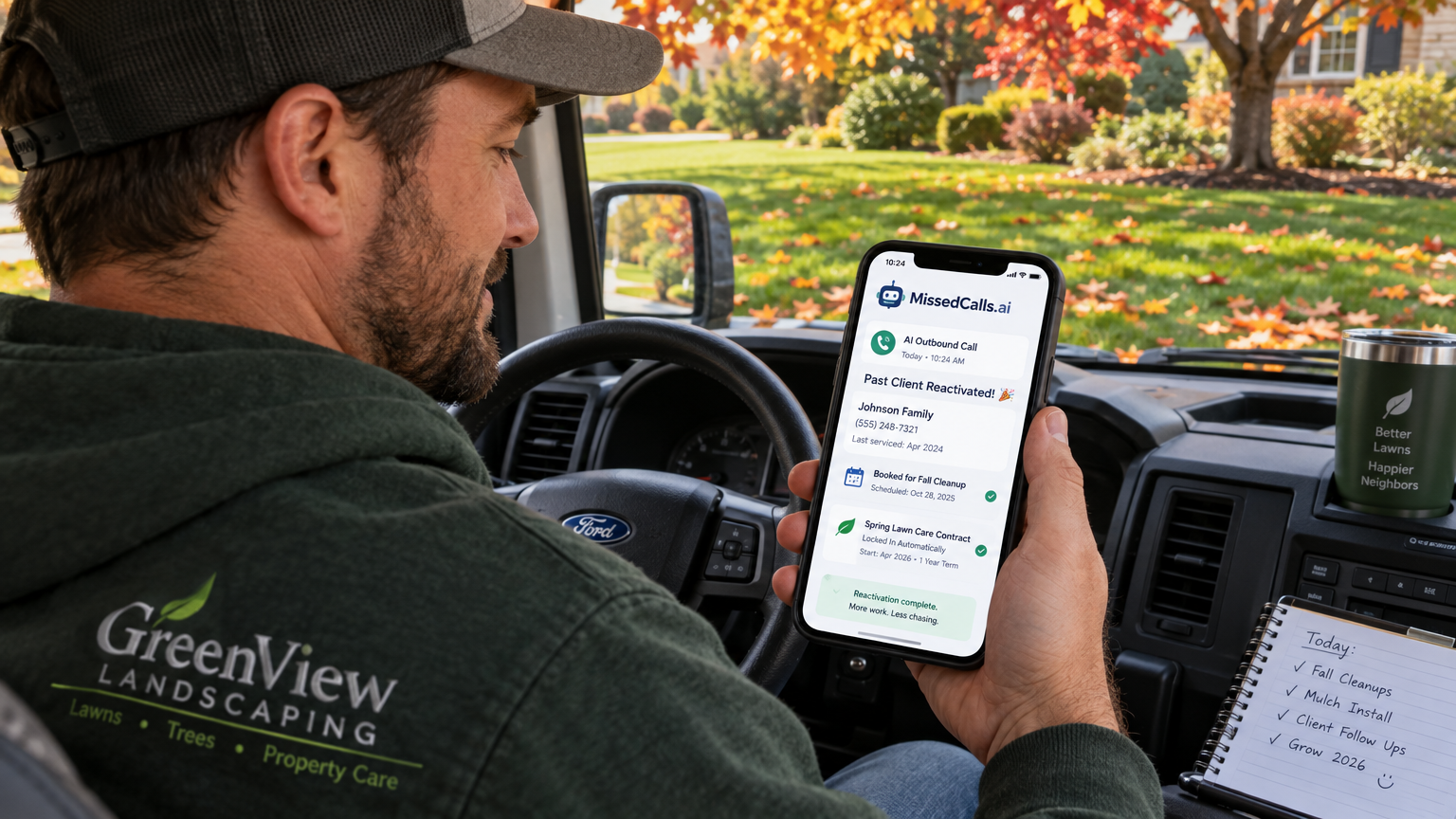
AI outbound reactivation calls are automated phone calls that go out to your past client list at the right moments in the season cycle — typically fall wrap-up (October–November) and early-bird spring booking (January–February). The AI places the call, speaks naturally with the client, confirms their interest in returning, handles common questions, and can lock in a service renewal or book an estimate callback for your team.
Here's what a two-touchpoint reactivation cycle looks like in practice:
Touch 1 — Fall Wrap-Up (October/November): After the final service of the season, an AI call goes out thanking the client for the season, confirming what services they had, and letting them know your company will be in touch early in the new year to lock in their spring schedule. This sets an expectation of contact and signals that you value their account.
Touch 2 — Early-Bird Spring Outreach (January/February): The AI calls back with a specific offer — first pick of their preferred service day, priority scheduling as a returning client, or early-season booking confirmation. The client can say yes to renewing right on the call, ask a question the AI handles directly, or request a callback from your team if they want to discuss changes to their service package.
Clients who weren't ready to commit on the first call get flagged automatically for a follow-up. Your team only steps in when the client is warm and ready — not to do the initial outreach work that the AI handles at scale.
Why a Phone Call Beats Email and Text for Landscaping Reactivation
Email reactivation campaigns for landscaping companies are easy to send and easy to ignore. By February, most homeowners are receiving two or three spring service outreach emails per week from local companies. Your email competes with everyone else's email.
A phone call is different. Phone leads in home services convert at 46% — nearly six times higher than digital lead channels overall, according to CallRail benchmarks. When a client hears a familiar voice (or a friendly, natural AI voice) referencing their property by name, their prior service history, and a specific offer for the coming season, that cuts through in a way that an email subject line never will.
It also communicates something the email doesn't: that your company pays attention. That you remember them. That they're a client worth calling, not just a contact on a list to blast. That's exactly the kind of interaction that keeps long-term clients loyal — and brings lapsed ones back.
For a landscaping company with 100 accounts, running AI reactivation calls across your past-client list in January and February — before your busy season estimates start stacking up — is one of the highest-ROI activities you can do. It costs a fraction of a new lead acquisition campaign, and the people on the other end of the call already know your work.
What Happens to Clients Who Don't Respond?
Not every past client will pick up on the first call. That's expected. AI reactivation workflows can run a multi-touch sequence automatically — a first call, a follow-up call two to three weeks later, and a text-back if the client requests contact that way. Each unanswered attempt is logged so your team has a clear view of who's been contacted and what the status is.
Clients who have relocated or genuinely moved on get removed from future reactivation cycles. The ones who come back — and in landscaping, properly timed outreach brings back a meaningful percentage of lapsed clients — do so without your team having made a single manual call.
The goal isn't to reach everyone. It's to reach the clients who would have returned if someone had just called them first.
See How It Works for Your Landscaping Business
MissedCalls.ai handles outbound reactivation calls, seasonal renewal outreach, and inbound call answering for landscaping and lawn care companies. If you've got a list of past clients and a season coming up, the opportunity is already in your records — it just needs someone to make the call.
Book a tailored demo at missedcalls.ai/bookademo and we'll show you exactly how the reactivation call flow works for a landscaping business like yours.
Related Reading
- Storm Hits Your Neighborhood: How AI Phone Answering Captures Roofing Surge Leads
- The Easiest Jobs You're Not Booking: How AI Reactivation Calls Bring Past Contractor Customers Back
- The Job Is Done. Are You Asking for the Review? How AI Calls Turn Every Completion Into 5-Star Revenue
Frequently Asked Questions
How many landscaping clients do companies typically lose each year?
Customer churn in residential lawn care and landscape maintenance runs between 15–30% annually, based on NALP benchmarks. A company with 100 active accounts can expect to lose 15–30 clients each year, with a significant portion of those losses driven by preventable causes like lack of off-season contact — not dissatisfaction with the work.
When is the best time to run AI reactivation calls for landscaping clients?
The highest-impact windows are fall wrap-up (October–November) and early-bird spring booking (January–February). Fall calls set the expectation that you'll be in touch, while early spring calls make first contact before competitors do — when clients are still open to returning rather than already committed elsewhere.
What does the AI say on a landscaping reactivation call?
The call references the client's history with your company, confirms interest in returning for the upcoming season, outlines any early-booking offer or priority scheduling benefit, and asks if the client wants to lock in their spot or speak with your team. If the client is unavailable, the AI logs the attempt and queues a follow-up automatically.
Is a phone call really more effective than an email for winning back lapsed landscaping clients?
Yes. Phone leads in home services convert at 46%, nearly six times higher than digital channels. A personalized call referencing the client's specific property and prior service history stands out in a way that mass email campaigns simply don't — especially in January and February when every local landscaper is sending the same spring outreach email.
Can MissedCalls.ai handle both the reactivation calls and inbound calls during busy season?
Yes. MissedCalls.ai handles both outbound reactivation and renewal campaigns and inbound AI phone answering. That means your phone gets answered during the spring rush when your team is busy on estimates, and your past clients are being re-engaged proactively during the off-season — all from the same system.
