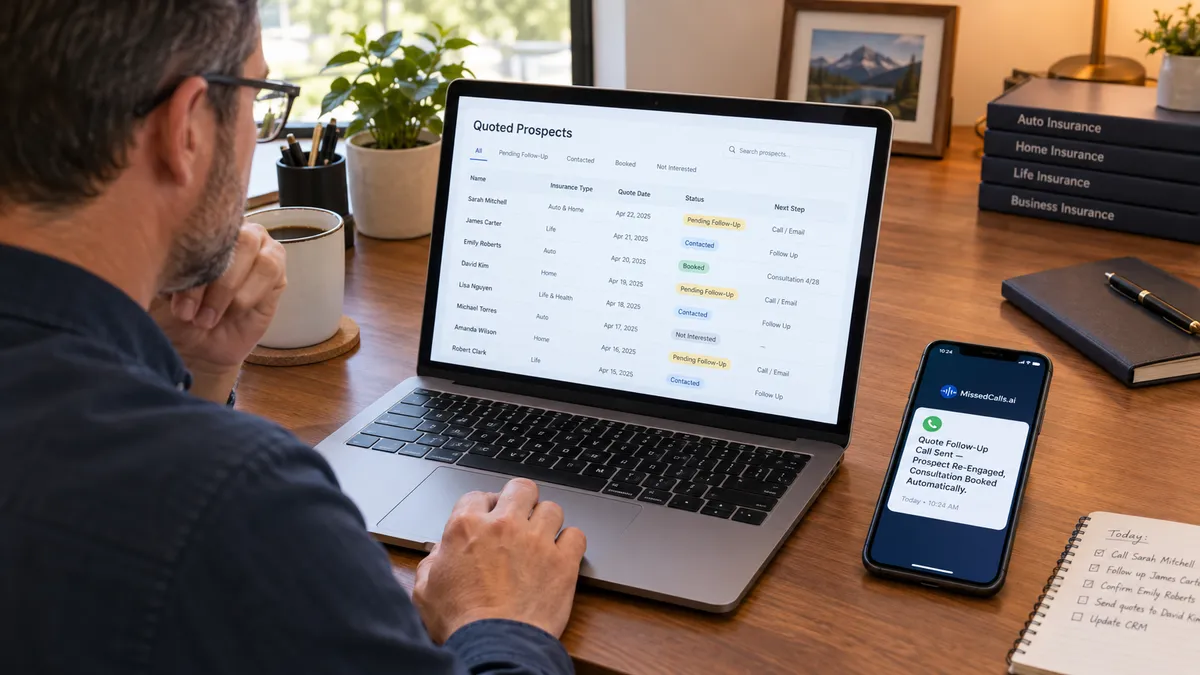
Short answer: Between 40–60% of insurance quotes never convert into policies — primarily because follow-up is inconsistent or never happens at all. AI outbound follow-up calls fix this by automatically contacting every quoted prospect on a structured cadence, re-opening the conversation, and booking consultations with your licensed producers before the quote expires and the competition wins the policy.
You Sent the Quote. They Said They'd Think About It. Here's What Happens When Nobody Follows Up.
You spent 45 minutes on the phone with a prospect. You asked the right questions. You pulled carriers, ran the numbers, put together a competitive quote. You sent it over. They said, "Looks good — let me think about it."
And then you moved on. Because you had three renewals due, two new applications to process, and a client calling about a claim. The follow-up was on your list. It just never made it to the top.
A week later, that prospect is insured — just not by you.
This is the central revenue leak in independent insurance agencies, and it's hiding in plain sight. Industry benchmarks consistently show that between 40–60% of insurance quotes never turn into bound policies — not because the prospect chose a competitor on price, not because your coverage was wrong, but because the follow-up fell through the cracks of a manual process that depends on a producer remembering to call.
That's the problem this article is about. And AI outbound follow-up calls are how you fix it without hiring more staff or leaning on your producers to do more than they already do.
The Quote Follow-Up Problem Is Bigger Than You Think
Here's what the data looks like for a typical independent agency in 2026:
- 44% of agents give up after just one follow-up attempt — even though 80% of insurance sales require five or more touches before the prospect makes a decision.
- 35% of insurance leads are never contacted at all — leads that were purchased, quoted, and then simply lost in the pipeline.
- The average agent response time is 47 hours — by which point, 78% of prospects have already moved on to whoever called first.
- Quote-to-bind conversion drops 25–40% within 14 days when follow-up is handled manually rather than through a structured automated sequence.
Put those numbers together and what you have is a system that does most of the expensive work — lead generation, needs analysis, carrier quoting — and then skips the last step that actually closes the deal.
A producer juggling renewals, endorsements, and new business applications genuinely can't manually track 15–25 open quotes at different stages without dropping some. That's not a character flaw. It's a workflow problem. And the fix is not asking producers to do more. The fix is automating the part that doesn't require their license.
Why Quoted Prospects Go Cold — And Why It's Not About Price
When a prospect requests a quote, they're in research mode. They're motivated, they're comparing, and their intent is high. But the moment they receive your quote and get off the call, that energy starts draining fast.
Decision fatigue sets in. The comparison between your quote and two others becomes overwhelming. The current policy — even if it costs more — starts to feel safer because it's familiar. And insurance, unlike buying a car or booking a flight, doesn't feel urgent until something bad happens.
So "I'll think about it" usually means "I haven't prioritized this yet." That's not a no. That's a window — and it closes faster than most agents realize.
Research from multiple industry sources confirms that contacting a prospect within five minutes of quote delivery increases conversion by up to 21x compared to waiting even 30 minutes. By the time the average agent follows up at 47 hours, the probability of converting that prospect has fallen off a cliff.
The agents winning in 2026 aren't necessarily offering better coverage or lower rates. They're the ones whose follow-up system contacts every quoted prospect on a structured cadence — first touch within hours of quote delivery, then consistent outreach over the next 7–14 days — so the prospect never has time to drift.
How AI Outbound Follow-Up Calls Work for Insurance Agencies
AI outbound follow-up calling is not robocalling. It's a voice-based follow-up workflow that contacts your quoted prospects in a natural, conversational way — checking in on the quote, answering basic questions, and routing the prospect to a licensed producer when they're ready to talk.
Here's what a practical workflow looks like for an independent agency:
Day 1 — The First Touch (Hours After Quote Delivery)
An AI call goes out the same day the quote is sent. The call is brief and conversational: it acknowledges the quote, asks if the prospect had a chance to review it, and offers to connect them directly with their agent. If the prospect picks up and has questions, the AI captures the concern and either answers basic informational questions or schedules a callback with the licensed producer. If there's no answer, it leaves a natural voicemail and triggers an SMS follow-up.
Day 3–5 — The Reopen
Most prospects don't respond to the first touch. That's normal. The AI makes a second attempt a few days later — this time leading with something specific. Maybe it's a reminder that the quoted rate is time-sensitive, or a question about whether anything changed in their coverage needs. The goal isn't to push; it's to give the prospect a reason to re-engage without feeling pressured.
Day 7–10 — The Persistence Round
Agents who follow up six or more times convert 3.8x more quoted prospects than those who stop after two attempts. But no producer can manually run a seven-touch cadence across every open quote in the pipeline. AI can. This touchpoint checks back in one more time, confirms the quote is still available, and offers a simple next step: a 10-minute call to answer any remaining questions before the rate changes.
Day 14+ — The Win-Back Queue
Quotes that expire without binding don't have to disappear. AI can tag them for a win-back sequence timed to the prospect's renewal date — typically 9–12 months out. When that date approaches, an outbound call goes out re-opening the conversation with a fresh competitive quote. These are warm prospects who already know your agency. Win-back conversion rates are significantly higher than cold outreach.
What This Looks Like in Practice
Say you're running an independent P&C agency with two producers. Each week, they issue 15–20 quotes across auto, home, and commercial lines. That's 60–80 open quotes in any given month, each at a different stage — some waiting on a callback, some never responded, some sitting in an inbox with an auto-reply acknowledgment and nothing else.
Manually tracking that volume and running a consistent multi-touch follow-up cadence on every quote is functionally impossible alongside renewals and new applications. Something gets dropped every week.
With AI outbound calling, every quoted prospect gets contacted. Not the ones your producers remembered. Every one. The AI runs the cadence automatically — calls, voicemails, SMS follow-up — and flags warm prospects for the producer to close. Your licensed agents spend their time on conversations that are ready to convert, not chasing cold quotes.
Automated multi-touch sequences convert 47% more leads than manual follow-up through consistency alone. For an agency losing two out of every three quoted prospects, recovering even a fraction of that is meaningful revenue — booked from leads you already paid for and work you already did.
Is This the Right Fit for a Small Agency?
Yes — especially for small agencies, where producers wear multiple hats and pipeline management competes with everything else. The agencies that benefit most from AI outbound follow-up are those where:
- Producers are issuing more quotes than they can manually track
- Open quotes are routinely aging past 7–10 days without contact
- The agency is spending money on lead generation but losing too many at the follow-up stage
- There's no dedicated CSR or sales coordinator to manage the follow-up pipeline
If that describes your operation, the problem isn't your producers or your rates. It's the gap between "quote sent" and "follow-up initiated" — and that gap is exactly what AI outbound calling is built to close.
One important note: AI handles the follow-up and scheduling. It does not provide coverage advice, bind policies, or quote new coverages. Those steps stay with your licensed producers. The AI's job is to keep the prospect engaged until they're ready for that conversation — and then hand them off cleanly.
The Quote You Already Sent Is Your Best Revenue Opportunity Right Now
Most agencies, when they want to grow revenue, think about buying more leads. But if 40–60% of your quoted prospects aren't converting, buying more leads doesn't solve the problem — it just amplifies it. You'd be paying to generate more prospects who eventually drift because the follow-up system couldn't keep up.
The more efficient move is to recover the premium sitting in your existing open quote pipeline. Those prospects already raised their hand. You already did the analysis. The work is done. The only thing missing is the persistent, consistent follow-up that keeps the conversation alive until the prospect is ready to bind.
That's the job AI outbound calling takes off your producers' plates — and it's why the agencies pulling 25–35% quote-to-bind rates in 2026 aren't necessarily bigger or better-resourced than their competitors. They just have a system that follows up every time, on every quote, without depending on a producer finding a gap in their calendar.
If you want to see how this workflow runs for an insurance agency — what the call sounds like, how the cadence is structured, and what your producers see when a hot prospect is flagged for close — the best way is a live demo built around your actual business.
Book a Tailored MissedCalls.ai Demo →
Or call and speak directly to the AI: (678) 679-9862
Related Reading
- Insurance Shoppers Call When You're Off the Clock — How to Never Miss a Quote Request Again
- Most Financial Advisors Give Up After 2–3 Follow-Up Attempts. The Prospect Hired the One Who Didn't.
Frequently Asked Questions
Why do so many insurance quotes never convert into policies?
Industry data shows 40–60% of insurance quotes never bind — primarily because follow-up is inconsistent or doesn't happen at all. Producers juggling renewals and new applications can't manually track every open quote, so prospects who said they'd think about it simply never hear back and eventually bind with a competitor who called twice.
How many times should an insurance agent follow up on a quote?
80% of insurance sales require 5 or more follow-up touches before the prospect makes a decision. Agents who follow up six or more times convert 3.8x more quoted prospects than those who stop after two attempts. A structured 7–9 touch cadence run over 14 days is the industry benchmark for maximum conversion on open quotes.
Can AI make outbound calls to quoted insurance prospects?
Yes. AI outbound calling tools like MissedCalls.ai can contact every quoted prospect on a structured multi-touch cadence — calls, voicemails, and SMS follow-up — and hand off warm prospects to a licensed producer when they're ready to talk. The AI handles the follow-up workflow; licensed agents handle coverage advice, quoting, and binding.
How quickly does quote conversion drop if an agent doesn't follow up?
Quote-to-bind conversion drops 25–40% within 14 days when follow-up is manual and inconsistent. Conversion probability falls roughly 60% if the first follow-up doesn't happen within 48 hours of quote delivery. By the time the average agent follows up at 47 hours, most motivated prospects have already moved on.
What can AI do versus what must a licensed producer handle in insurance follow-up?
AI can handle follow-up calls, voicemails, appointment scheduling, basic informational responses, and cadence management. It cannot provide coverage advice, bind policies, quote new coverages, or make promises about claims handling. Those steps must stay with a licensed producer. The AI's role is to keep the prospect engaged and schedule the conversation — then hand off cleanly.
