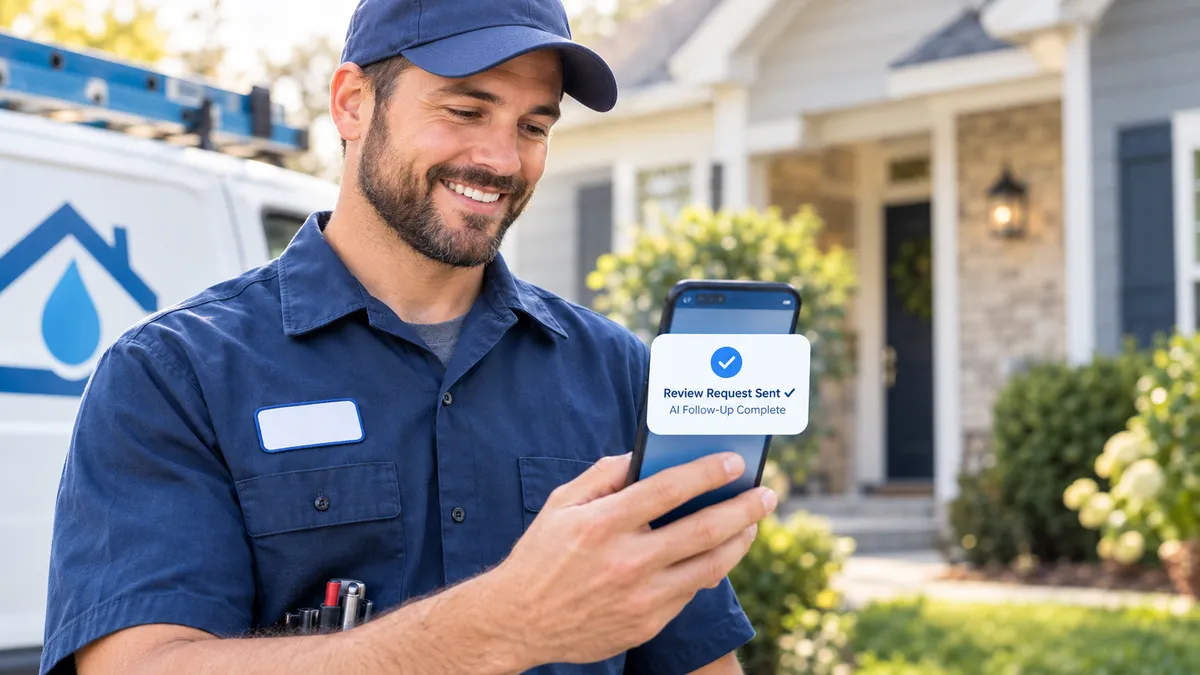
The Job Is Done. Are You Asking for the Review? How AI Outbound Calls Turn Every Home Service Completion Into 5-Star Revenue
The short answer: If your team isn't requesting a review within an hour of job completion, you're leaving most of your reviews on the table. Automated review request calls placed within minutes of a job closeout consistently reach customers when satisfaction is highest — and the response rate difference compared to a next-day email is not close.
Here's the problem most home service owners don't see clearly: the reviews you're missing aren't from unhappy customers. They're from happy ones who just never got asked at the right moment.
Your HVAC tech did a clean install. Your plumber fixed the leak fast. Your electrician showed up on time and left no mess. The customer is genuinely impressed. They'd leave a glowing review if someone asked. But by the time anyone circles back — if they do at all — the moment has passed. The customer has moved on. The review never happens.
This is a volume problem disguised as a quality problem, and AI outbound calls solve it automatically.
Why Timing Is the Entire Game
Review conversion isn't about the ask itself — it's about when the ask lands. A customer reached within 30 minutes of job completion is in a completely different mental state than one reached 24 hours later by a generic email.
Industry data makes this stark: automated review requests sent within two hours of job completion achieve a 34–48% response rate. The same ask sent days later by a manual process drops to 6–9%. That's not a marginal difference — it's five to eight times as many reviews from the same customer base, without doing better work, hiring more staff, or spending more on marketing.
The window closes fast. A homeowner who just had their furnace serviced is thinking about that clean, warm house for about 90 minutes before life takes over. Kids, dinner, the next thing on the list. Miss that window and you're not getting that review.
What the Average Contractor's Review Profile Actually Looks Like
Most home service businesses have between 40 and 80 Google reviews total — and many of those were left years ago. Review recency matters to Google's local ranking algorithm. A contractor getting eight new reviews a month will consistently outrank a competitor with a higher overall score but nothing recent, because Google weights ongoing social proof over a static historical average.
The consumer math is equally clear. According to BrightLocal's 2026 Local Consumer Review Survey, 68% of consumers will only use a business with four or more stars, and 31% now require 4.5 stars or higher — nearly double the percentage from a year earlier. If your rating sits below that threshold, you're being filtered out before the phone even rings.
The good news: the gap between the reviews you have and the reviews you could have is almost entirely an asking problem. Research from BrightLocal found that 96% of consumers are open to writing a review — but only 29% wrote one in the past year. The bottleneck isn't willingness. It's your system for asking.
What the Revenue Impact of Reviews Actually Looks Like
Before we get into how AI review request calls work, it's worth understanding what you're actually compounding when you build a steady review engine.
- Businesses with 25 or more fresh reviews in a 90-day window earn 108% more revenue than the average business, according to Womply's analysis of 200,000 US small businesses — and that's 108% more revenue, not 108% more reviews.
- Contractors with 50 or more Google reviews convert website visitors to booked jobs at 2.7 times the rate of businesses with fewer than 10 reviews.
- A one-star improvement in your Google rating correlates with a 5–9% revenue increase for independent local businesses, based on Harvard Business School research.
- A 4.8-star average gets roughly three times the click-through rate on Google Local Services Ads compared to a 4.2-star average — a direct, measurable impact on paid channel performance.
- Reviews now account for approximately 20% of local pack ranking, which means they affect not just conversions but whether you show up in the first place.
None of this requires a bigger ad budget. It requires a consistent system that captures what your work already earned.
Why Techs Don't Ask Consistently (And Why That's Not Really Their Fault)
Ask any experienced home services owner about their review strategy and you'll hear the same answer: "We tell our techs to ask at the end of the job." Ask how consistently it happens and the answer changes.
It's not a motivation issue. At the end of a full day of service calls, a technician's mental bandwidth is focused on getting to the next job, handling paperwork, or getting home. Asking for a review — in the right way, to the right customer, with the right follow-up link — requires a specific kind of consistent effort that's nearly impossible to maintain across a team.
Manual asking also has another problem: it can feel awkward, especially for new technicians. The result is that review requests happen inconsistently, too late, or not at all — and the customers most likely to leave a great review are the ones who just quietly don't.
How AI Review Request Calls Work in Practice
Here's what the workflow looks like when you automate review requests with an AI outbound call through MissedCalls.ai:
- Job is marked complete. The moment your technician closes the work order or marks the job done, the trigger fires automatically. No one has to remember anything.
- AI places the call within minutes. The customer is reached while the experience is still fresh — they haven't moved on yet. The call is brief, professional, and sounds like your business, not a robo-dialer.
- Satisfaction is gauged first. Before any review request, the AI asks how the service went. If the customer is frustrated or neutral, the call takes a different path — their concern gets logged and escalated to your team privately, before it becomes a one-star post online. This protects your profile while giving you a chance to recover the relationship.
- Happy customers get the review ask. For customers who had a great experience, the AI thanks them and offers to text a direct link to your Google Business Profile. One tap and they're on the review page — no searching, no logging in, no friction.
- Everything is logged. Every call outcome — answered, not answered, satisfied, escalated — is captured and available to your team, so nothing falls through the cracks.
This isn't a text blast or a generic email sequence. It's a phone call — the channel that home service customers actually pick up — timed for maximum impact and designed to protect you from amplifying unhappy customers.
How Does This Fit With After-Hours Answering?
If you've already read about how AI handles after-hours calls for home service businesses, or how missed calls quietly drain revenue from HVAC and plumbing businesses, you already understand the inbound side of AI for home services. Review request calls are the outbound counterpart.
Inbound AI makes sure every caller gets captured and every job gets booked. Outbound review request calls make sure every completed job builds the reputation that fills the calendar. They're different parts of the same loop: answer more calls, book more jobs, complete more work, capture more reviews, rank higher locally, get more calls.
More jobs mean more review opportunities. More reviews mean better local visibility. Better local visibility means more inbound calls. The entire pipeline compounds when both sides are automated.
What Should You Expect in Terms of Volume?
Contractors who automate review requests consistently see three to five times more reviews per month than those relying on technicians to ask manually. If your team is currently generating four or five reviews per month through informal asks, automated outbound calls — timed correctly and routed intelligently — can realistically push that to 15–25 monthly reviews within a quarter.
That's the cadence that moves the needle. Businesses hitting 25 or more fresh reviews every 90 days show meaningfully different revenue outcomes than those with sporadic or stale review profiles. It's not just about the star rating — it's the signal to Google and to prospective customers that your business is active, trusted, and in demand right now.
Is Asking for Reviews Allowed?
Yes — asking customers to leave an honest review is explicitly permitted by Google and every major platform. What's not allowed is incentivizing reviews, directing customers to leave specific content, or pressuring customers on-premises immediately after service. A post-job phone call that asks a customer how their experience went and, for satisfied customers, offers a review link is entirely compliant with Google's 2026 review policies.
The key word is "honest." You're not scripting the content. You're not filtering only happy customers and leaving unhappy ones alone (in fact, the sentiment check described above actually routes frustrated customers to a private channel, which is the right approach). You're systematizing the ask so your best work has a fair chance of generating the recognition it earned.
Ready to See It in Action?
MissedCalls.ai handles both sides of the phone for home service businesses — inbound AI answering that captures every lead, and outbound AI calls that convert every completed job into a review opportunity. If you want to see exactly how the workflow would look for your trade and your call volume, book a live demo tailored to home services.
👉 Book a tailored demo at MissedCalls.ai
Bring your current monthly job volume and your average review count. We'll show you exactly what a realistic review velocity target looks like and how the outbound call workflow integrates with your existing job management setup.
Frequently Asked Questions
How soon after a job should an AI review request call go out?
Within one to two hours of job completion is the optimal window. Automated requests sent in that timeframe achieve response rates of 34–48%, compared to 6–9% for manual requests sent a day or more later. The customer's satisfaction is at its highest point right after a successful service call, and catching them in that window is the single biggest driver of review response rate.
What happens if a customer is unhappy when the AI calls?
The AI gauges satisfaction before it ever asks for a review. If a customer expresses frustration or dissatisfaction, the call does not request a review — instead, the concern is logged and flagged for your team to follow up privately. This protects your Google profile from reactive one-star posts while giving you a genuine chance to recover the relationship.
How many more reviews can I realistically expect per month?
Contractors who automate review requests typically see three to five times more reviews per month than those relying on technicians to ask manually. Exact results depend on your job volume, current review baseline, and how quickly customers answer post-job calls, but doubling or tripling monthly review output within a quarter is a realistic and common outcome.
Does asking for reviews violate Google's policies?
No. Asking customers to share their honest experience is explicitly permitted by Google. The key compliance rules are: don't incentivize specific star ratings, don't script review content, and don't pressure customers on-premises immediately after a job. A post-job outbound call that asks how the service went and offers a review link to satisfied customers is fully compliant with Google's current 2026 review policies.
Can AI review request calls work alongside inbound AI phone answering?
Yes — and they're designed to complement each other. Inbound AI answering captures every lead and books every job. Outbound review request calls convert every completed job into a reputation asset. Together, they create a closed loop: more answered calls lead to more booked jobs, more completed jobs generate more review opportunities, and more reviews improve local ranking and drive more inbound calls.
