You Paid for the Lead. You Got the Form Fill. Here Is Why That Job Is Already Gone.
You Paid for the Lead. You Got the Form Fill. Here Is Why That Job Is Already Gone.
If a homeowner submitted a quote request on your website, Google Local Services, Angi, or Thumbtack, and you have not called them back within five minutes, there is a better than 50 percent chance they have already booked with someone else. Speed to contact is the single most controllable variable in whether a home service lead becomes a paying job -- and AI outbound follow-up calls are how the fastest-responding contractors are winning those jobs automatically, 24 hours a day.
The Answer Most Home Service Businesses Do Not Want to Hear
You already know leads come in. Maybe you are running Google LSA, paying for Thumbtack, or your website is finally generating organic traffic. The form fills arrive -- a name, a phone number, what they need done -- and then something happens on the way to that job: someone gets busy.
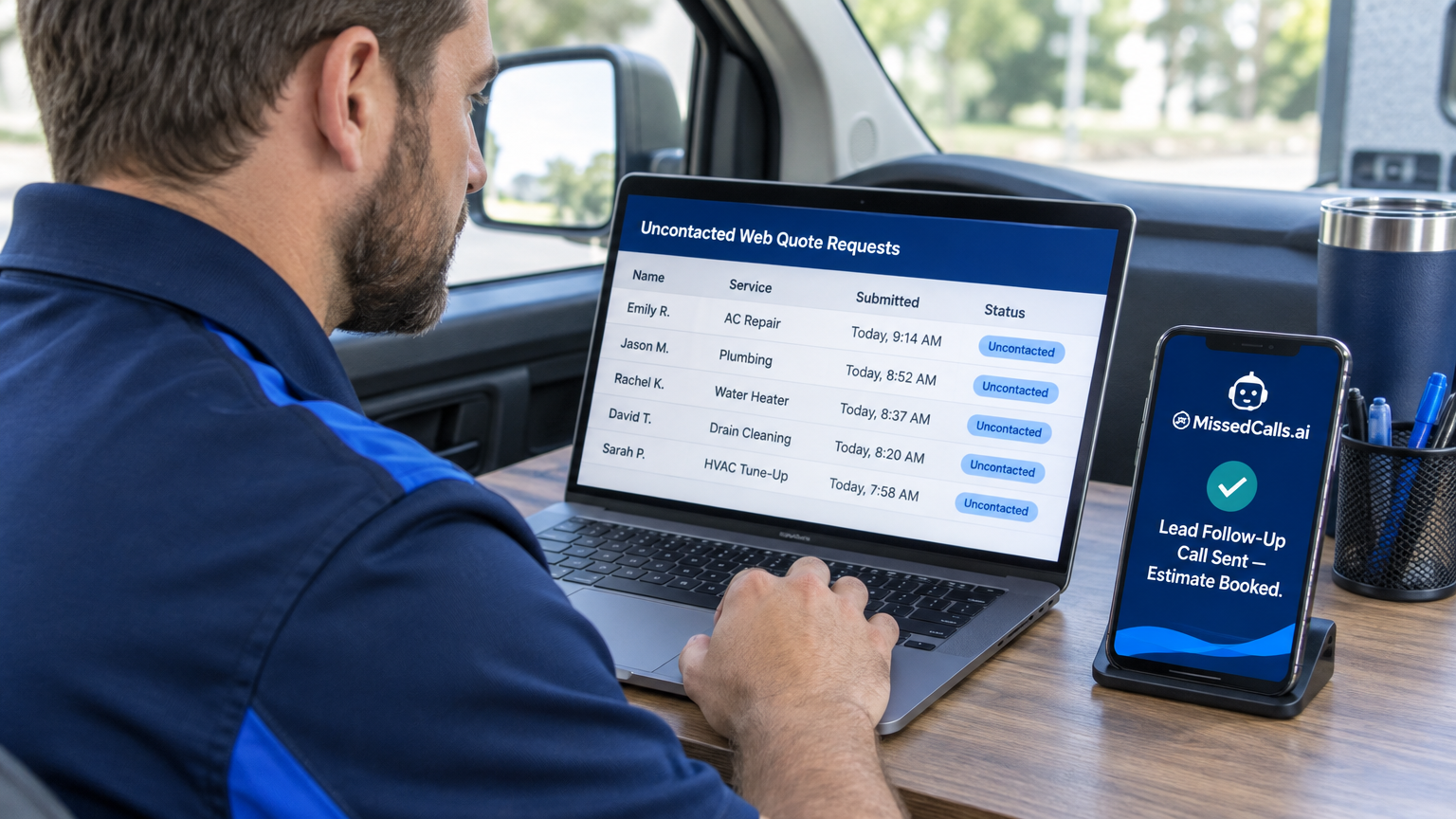
The technician is mid-install. The owner is on a service call. The notification sits in an inbox nobody checked until dinner time. By then, the homeowner has already given their credit card to whoever called them back at 2:19 in the afternoon.
This is not a staffing failure. It is a structural one. The window between a homeowner requesting a quote and their decision to book closes faster than most contractors realize, and no amount of hustle after the fact reopens it.
What the Speed-to-Contact Data Actually Shows
The numbers on lead response time for home service businesses are well-documented and consistently striking. Research published in the Harvard Business Review found that companies responding to web leads within one hour are nearly 7 times more likely to qualify a lead than companies waiting even a little longer. MIT lead response research found that leads contacted within 5 minutes are 100 times more likely to result in a live conversation than leads contacted after 30 minutes.
In home services, the stakes are even higher because the homeowner is usually comparing you to two or three other contractors at the same time. A 2026 benchmark study found that 78 percent of homeowners hire the first business that responds to them. First responder does not mean the fastest company in town -- it means whoever called back while the lead was still warm and undecided.
Meanwhile, Hatch's 2026 benchmark of more than 30,000 lead-response campaigns found that 58 percent of companies take longer than 30 minutes to send a first reply to a web form lead. An earlier mystery-shopper study of 466 home service companies found that if a business had not responded within six hours, there was a 75 percent chance it never would.
So: 78 percent of homeowners go with the first responder. 58 percent of contractors are sitting on leads for 30 minutes or longer. The math writes itself.
Why Calling Back Later Does Not Work Anymore
The common workaround is to batch return calls at the end of the day or first thing the next morning. That approach made sense when homeowners sent one quote request and waited patiently. It does not make sense now.
When a homeowner fills out a form on your website or clicks Request a Quote on Google LSA, they are not sitting quietly waiting for you. They are submitting to you, then submitting to the competitor two results down. The first contractor who calls while the homeowner is still at their phone -- still mentally in get-this-done mode -- has an enormous advantage over the contractor who calls the next morning from a cold lead list.
The conversion data confirms this. Contractors using speed-to-lead automation report lead-to-booked-appointment conversion rates of 18 to 28 percent. Without that automation, the same leads convert at 8 to 14 percent. That gap is not about price, reputation, or marketing spend. It is entirely about what happens in the first few minutes after the lead arrives.
And this is not just a weekday problem. More than a third of home service inquiries come in after 5 PM -- evenings, weekends, and holiday mornings -- when no one is staffed to respond. A lead that arrives at 8:40 PM on a Thursday is just as real as one that comes in at 10:15 AM on a Tuesday. It just needs different infrastructure to capture it.
What AI Outbound Follow-Up Calls Do Instead
When a new lead comes in through your website form, Google LSA, or any connected lead source, MissedCalls.ai can fire an outbound AI call to that homeowner within seconds -- not minutes, not the following morning.
The call is a natural conversation, not a robocall. The AI introduces itself as a representative of your business, confirms it received their inquiry, finds out what they need, qualifies the job details -- service type, address, timeline, any urgency -- and books an estimate appointment directly into your calendar. If the homeowner asks about your services, pricing range, or availability, the AI answers based on your business information. If a live handoff is needed, it transfers the call or captures everything so your team picks up with full context.
The homeowner gets an immediate, professional response. Your team gets a booked appointment instead of a cold lead to chase. The whole sequence runs automatically, whether the inquiry came in at noon or midnight.
This same outbound capability also applies to review requests after a job is completed, appointment reminders, and estimate follow-up for quotes that went quiet. The workflow is the same -- trigger an outbound call, have a natural conversation, capture the outcome automatically.
What This Looks Like in Practice
Consider a small HVAC company running Google LSA in a mid-size market. They generate about 60 inbound leads per month across their website form and LSA. Historically, the owner calls back when he can -- usually same day, sometimes the next morning after things settle down.
At an 11 percent conversion rate -- a realistic number for delayed follow-up on competitive shared leads -- that is about 6 or 7 booked jobs per month. At an average job value of $900, that is roughly $6,300 per month in revenue from those leads.
Switch to AI outbound follow-up with immediate calls on every new lead, 24 hours a day, and the conversion rate moves to the 20 to 25 percent range that contractors with speed-to-lead automation consistently report. That same 60 leads becomes 12 to 15 booked jobs. At $900 average, that is $10,800 to $13,500 per month from the exact same leads and the exact same ad spend.
The difference is not better leads. It is not a bigger marketing budget. It is what happens in the first five minutes after the notification arrives.
How Does AI Lead Follow-Up Work Across Multiple Lead Sources?
MissedCalls.ai connects to your existing lead sources and CRM. When a new lead comes in -- from your website, Google LSA, Angi, Thumbtack, or any connected platform -- the system fires an outbound call automatically. The AI qualifies the lead, books the appointment, and logs a full transcript and summary so your team always has the context they need for the follow-up. No manual step required. No leads falling through the cracks because someone was on a job.
Ready to Stop Watching Paid Leads Go to Whoever Called First?
If your team is manually calling back form submissions hours after they arrive, you are competing with one hand tied behind your back. AI outbound follow-up calls close the speed gap without adding headcount -- and they work around the clock, including the Thursday night at 8:40 PM when your best lead of the week came in.
See a live demo of MissedCalls.ai built specifically for home service businesses.
Frequently Asked Questions
How fast does MissedCalls.ai call back a new web form lead?
When connected to your lead sources, MissedCalls.ai can fire an outbound call within seconds of a new form submission -- well inside the five-minute window that research consistently identifies as the threshold for maximum conversion rates in home services.
Can AI outbound calls work for Angi, Thumbtack, and Google LSA leads?
Yes. MissedCalls.ai can be connected to your lead sources through CRM integrations so that any new lead -- regardless of where it originated -- triggers an automatic outbound follow-up call with no manual step required from your team.
What does the AI say when it calls a home service lead?
The AI introduces itself as calling on behalf of your business, references the homeowner inquiry, qualifies the job details, answers common questions about your services, and books the estimate appointment. It uses your business information -- services offered, service area, typical response times -- to respond consistently and accurately.
What happens if the homeowner does not answer the first call?
MissedCalls.ai can be configured to leave a professional voicemail and attempt follow-up calls on a schedule you define, so that a missed first call does not automatically mean a lost lead.
Does this work for emergency home service calls or just scheduled estimates?
Both. For urgent requests -- a homeowner describing a burst pipe or a no-heat situation -- the AI can triage the urgency and immediately transfer to your on-call technician or dispatcher, capturing all relevant details for a clean handoff.
