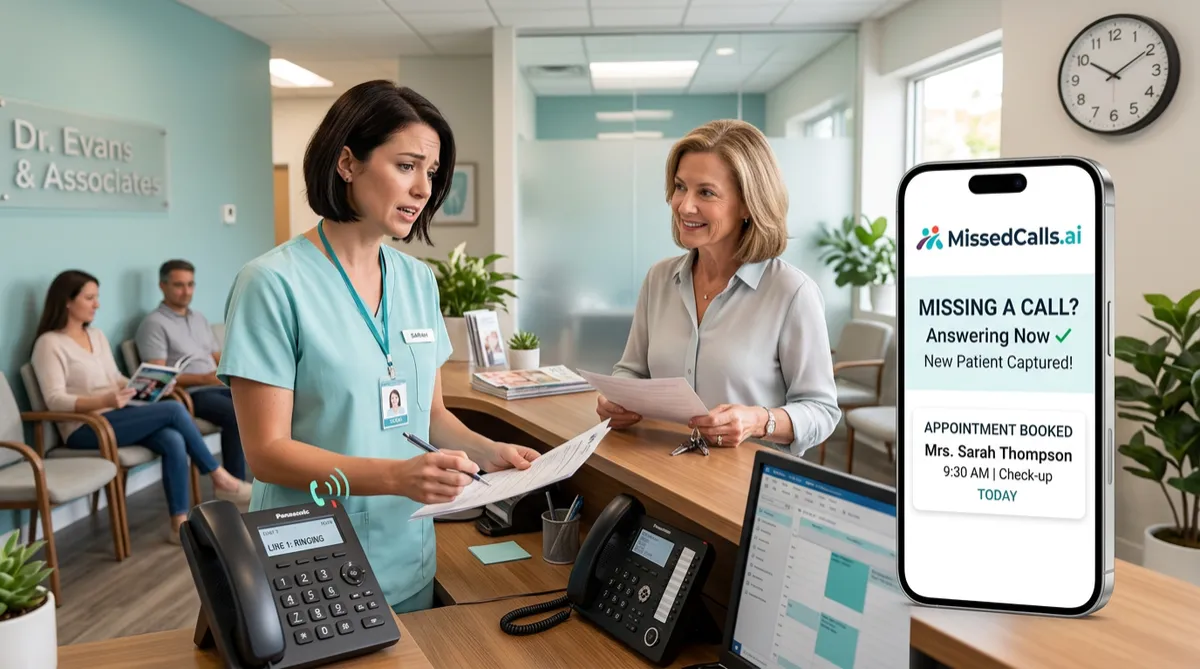
The Front Desk Can’t Do It All: How Dental Practices Use AI to Capture Every New Patient Call
Short answer: When a dental practice’s front desk is occupied with a patient in the chair, on lunch, or closed for the evening, AI phone answering automatically picks up, answers common questions, captures new patient information, and books appointments — so no caller hits voicemail and bounces to the practice down the street.
If you run a dental office, you already know the math is brutal. Your front desk coordinator is one person. At any given moment she’s checking someone in, running insurance on another patient, handing a form to a third — and the phone rings. She can’t get to it. That call goes to voicemail. And nine times out of ten, a new patient with a toothache or a family shopping for a new dentist is not leaving a message. They’re calling the next practice on the list.
That’s not a staffing problem. That’s a structural one. And it happens dozens of times a week in practices that have no idea how much new patient revenue is quietly walking out the door.
How Much Revenue Is a Missed Dental Call Actually Worth?
Let’s put real numbers to it. The average new dental patient is worth between $1,200 and $1,800 in first-year revenue when you factor in the initial exam, X-rays, cleaning, and any treatment that follows. Research consistently shows that dental practices miss 25–40% of their inbound calls — and that number climbs above 60% during peak patient hours and after-hours windows.
If your practice misses just 10 new patient calls per week — a conservative estimate for a busy single-location office — and half of those callers were ready to book, that’s five lost patients per week. At a $1,400 average first-year value, you’re looking at $7,000 in missed revenue. Every single week. That’s more than $360,000 a year quietly evaporating because the front desk was occupied.
The math tends to land hard when you see it written out.
Why Voicemail Doesn’t Solve the Problem
The reflex answer most practices fall back on is: “We have voicemail, we return calls.” That logic made sense in 2005. Today’s dental patient — especially someone shopping for a new provider — behaves completely differently.
A new patient searching for a dentist is usually calling three or four practices in a row. Whoever picks up first and gives them a clear, helpful interaction gets the appointment. Practices that send new callers to voicemail see callback rates below 15%. Even established patients calling for urgent concerns — a cracked tooth, pain after a procedure, a lost crown — often won’t wait. They’ll find another office that can help them now.
Voicemail is a holding pen, not a patient acquisition strategy.
What AI Phone Answering Actually Looks Like in a Dental Practice
When a call comes in that the front desk can’t reach — during a procedure, at lunch, or at 7:30 pm on a Tuesday — MissedCalls.ai answers in under two seconds. Not a phone tree. Not “press 1 for appointments.” A natural, conversational voice that sounds like a receptionist and behaves like one.
Here’s what a typical new patient call flow looks like:
- Caller asks about becoming a new patient and whether the practice accepts their insurance
- AI confirms the practice is accepting new patients, names the accepted carriers based on your configured business info, and answers follow-up questions
- AI collects the caller’s name, preferred contact number, and best appointment window
- The intake is logged and your front desk receives a full transcript and summary when they’re free
The caller got a real, helpful response. The appointment is captured. Your coordinator didn’t have to stop mid-check-in to make it happen.
What Types of Calls Does It Handle?
Beyond new patient intake, dental practices field the same categories of calls over and over. AI handles all of them without putting anyone on hold:
Hours and location questions. “Are you open Saturday?” “Where are you located?” “Do you validate parking?” These are routine — the AI answers instantly using your configured practice information.
Insurance questions. “Do you take Delta Dental?” “Are you in-network with Cigna?” These are the most common new-patient screening questions. The AI answers based on the carrier list you provide.
Appointment requests. New patient exams, cleanings, follow-up visits, emergency slots. The AI captures the request with name, contact info, and availability, then delivers a clean summary so your team can confirm the slot in seconds.
Post-procedure calls. Patient calling after an extraction about swelling or discomfort? The AI can answer common post-care FAQs and flag anything that sounds clinically urgent for immediate human follow-up.
After-hours coverage. The biggest gap in most practices. Calls that arrive after 5 pm, on weekends, or over holidays are answered and captured — instead of hitting voicemail or going completely unanswered.
Does AI Replace the Front Desk?
No — and this is worth saying directly. AI phone answering is not a replacement for your coordinator. It handles the calls that were already falling through the cracks: the overflow, the after-hours volume, the peak-hour collisions when three patients need attention at once. Your front desk still runs the day. The AI captures what they physically couldn’t get to.
The practical result is that your coordinator spends more time on high-value interactions — treatment plan conversations, insurance resolution, patient experience — and less time anxiously watching the phone ring while she’s mid-checkout with someone else.
Solo Practice or Group Practice — Does It Matter?
Both benefit significantly, just for slightly different reasons. Solo practices with a single coordinator feel the impact immediately — there’s no backup when the one desk is occupied. Every missed call was already a real loss with no safety net. Group practices and multi-location offices use AI answering to standardize intake across locations and ensure no single site has a weak link at the phones.
Setup doesn’t require replacing your existing scheduling system. MissedCalls.ai works alongside your current tools — passing captured leads and call transcripts to your CRM, calendar, email, or scheduling software so follow-up flows the same way it always has, just without the gaps.
The Practical Outcome: More New Patients, Same Team Size
Practices that close the missed-call gap see the impact first in new patient volume. Calls that used to evaporate now convert. After-hours inquiries that never had a chance result in booked appointments waiting in the schedule the next morning. The front desk coordinator starts her day with a queue of captured leads instead of a voicemail inbox nobody checked overnight.
It’s not a magic fix — you still need strong clinical care, solid reviews, and a team patients trust. But you can’t fill chairs from calls you never answered. Related reading: How After-Hours Calls Become Your Biggest Revenue Leak and How AI Phone Answering Fixes the #1 Intake Problem for Law Firms.
Frequently Asked Questions
Can AI phone answering book dental appointments directly into our scheduling system?
MissedCalls.ai captures all appointment request details — name, contact info, preferred time, reason for visit — and pushes outcomes to connected calendars or CRM tools. For practices using specific dental scheduling software, the AI captures and delivers the intake so your team can confirm the slot with a single action rather than starting from scratch on a cold callback.
Will patients know they’re talking to an AI?
The AI is designed to sound natural and conversational, not robotic. Most callers experience it as a smooth, helpful phone interaction. Transparency preferences vary; MissedCalls.ai can be configured to identify itself as an automated assistant if your practice prefers that approach.
What happens if a caller has an urgent dental emergency?
Escalation logic can be configured so calls flagged as emergencies — acute pain, post-surgical complications, dental trauma — are routed for immediate human callback or connected to an on-call line. The AI captures the details and triggers the appropriate path based on your settings.
How long does setup take for a dental practice?
Setup typically takes hours, not weeks. You provide your practice hours, accepted insurance carriers, services offered, FAQs, and call flow preferences. MissedCalls.ai learns your business quickly and is ready to handle calls without engineering work or a lengthy onboarding process.
How does the cost compare to hiring another front desk staff member?
A part-time front desk employee in most markets costs $18–$26 per hour plus benefits and training overhead. AI phone answering delivers 24/7 coverage at a fraction of that cost — with no sick days, no turnover, and no dropped calls during lunch. Most practices see a return within the first few captured new patients.
Ready to stop losing new patients to unanswered calls? Book a tailored demo with MissedCalls.ai and see exactly how it would work for your practice’s call volume and patient intake flow.
