Your Dental Practice Is Losing $47,000+ a Year to No-Shows. AI Reminder Calls Fix That.
The short answer: The average dental practice loses between $47,000 and $240,000 every year to patient no-shows — and the leading cause isn't rudeness or indifference. It's forgetfulness. Thirty-six percent of patients who miss appointments report they simply forgot. AI outbound appointment reminder calls fix that by automatically reaching every patient before their appointment, confirming attendance, offering easy rescheduling, and filling newly opened slots — all without adding a single task to your front desk's day.
If you've ever walked into your operatory on a Tuesday morning and found a chair that was supposed to be occupied sitting empty, you already know what no-shows feel like on a gut level. The hygienist is ready. The instruments are set. The patient just isn't there.
What most practice owners don't fully account for is what that empty chair actually costs. At $200–$375 per missed appointment, a practice running 30–40 daily appointments with a 15–20% no-show rate loses 4–6 appointments every single day. That compounds to $2,000–$3,000 in unrecoverable production daily. Annually, that's a six-figure hole in your schedule — and it's almost entirely preventable.
Why Patients No-Show (And Why the Fix Is Simpler Than You Think)
Before you invest in complicated systems or punitive cancellation fees, it's worth understanding what's actually driving your no-shows. The data is clear:
- 36% simply forgot they had the appointment
- 61% cite scheduling friction — they couldn't easily cancel or reschedule when life got complicated
- 15% skipped due to dental anxiety and didn't feel comfortable calling to cancel
That first number is the one that should grab your attention. More than one in three no-shows is a patient who wanted to come — they had every intention of sitting in that chair — they just didn't remember it was today. A well-timed, human-sounding reminder call would have saved that appointment.
Your front desk already knows this. The problem is they don't have the bandwidth to personally call every patient 48 hours out, then again the morning of, then chase down every cancellation to fill the newly open slot. They're managing check-ins, insurance verifications, post-visit follow-ups, and incoming calls — all at the same time. Reminder calls fall through the cracks not because no one cares, but because there aren't enough hours.
That's exactly the gap AI outbound calls were built to fill.
What Does an AI Appointment Reminder Call Actually Do?
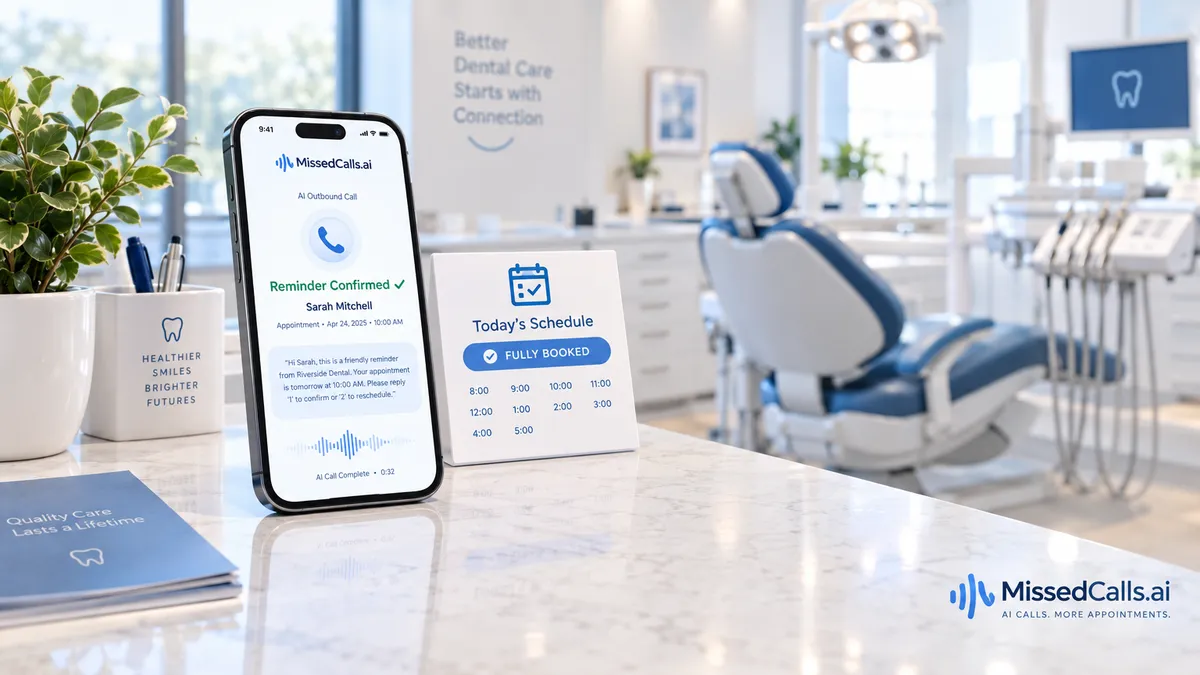
An AI outbound reminder call isn't a robocall playing a pre-recorded message. It's a natural, conversational voice interaction that reaches the patient, confirms their appointment, answers basic questions, and — critically — gives them an easy path to reschedule right then and there if they can't make it.
Here's how a typical workflow plays out for a dental practice using MissedCalls.ai:
- 48–72 hours before the appointment: The AI places an outbound call to the patient. It identifies itself, confirms the appointment date and time, and asks the patient to confirm attendance or flag a conflict.
- If the patient confirms: The appointment is logged as confirmed. No further action needed.
- If the patient needs to reschedule: The AI handles the conversation in real time — offering alternative times, capturing the new slot, and updating the record. Your front desk doesn't make a single call.
- Morning-of reminder: A second touchpoint fires the day of the appointment — a brief, friendly check-in that significantly reduces last-minute no-shows.
- When a cancellation opens a slot: The AI immediately begins working the waitlist, contacting patients who've expressed interest in earlier appointments. Manual fill rate by staff? Roughly 10–20% of opened slots. Automated fill rate? Systems can simultaneously reach 10–20 waitlist patients the moment a slot opens — dramatically improving recovery speed.
The whole sequence runs without anyone on your team lifting a finger. Your front desk sees a clean, updated schedule. Patients get a professional, personalized reminder experience. And the chair gets filled instead of sitting empty.
How Much Does a No-Show Actually Cost Your Practice?
Most practice owners think of no-shows in terms of the single appointment value — the $300 cleaning, the $400 check-up. But the real cost runs deeper:
- Lost immediate production: $200–$375 per missed appointment
- Staff idle time: $100–$175 in committed staff wages per no-show incident across the clinical team
- Fixed overhead continues: Rent, equipment, insurance — none of it pauses because the chair is empty
- Downstream treatment loss: The hygiene visit that was missed doesn't just cost that one visit — it delays or eliminates the treatment recommendation that would have followed
Run the full math on a solo practitioner losing five appointments per week to no-shows. At a conservative $250 average production value, that's $1,250 per week — $65,000 per year — vanishing silently from the schedule. Add idle staff cost and the downstream treatment pipeline loss, and that number climbs significantly higher.
Automated reminder systems consistently reduce no-show rates by 40–60% within three months of implementation. If your practice currently loses $65,000 a year to no-shows, a 40% reduction means $26,000 recovered — from a system that costs a fraction of that to operate.
What About Your Front Desk — Isn't This Their Job?
It should be. In a perfect world, your front desk has the time to personally call every patient two days out, confirm every appointment the morning of, and work the waitlist the moment a cancellation comes in. In the real world of a busy dental practice, that's not what happens.
The American Dental Association notes that practices can receive up to 50 inbound calls per day. A two-person front desk physically cannot answer 50 calls while simultaneously managing check-ins, insurance work, treatment coordination, and recall outreach. Reminder calls — which require consistency and repetition to work — are almost always the first thing that gets deprioritized when the waiting room fills up.
AI doesn't deprioritize. It runs the same reminder sequence for every patient, every time, without fail. Your front desk gets the benefit of a fully confirmed schedule without the manual calling load. That's not replacing your team — it's giving them their time back for the work that actually requires a human.
Is This Only for Reminders, or Can It Do More?
Reminder calls are the highest-ROI starting point, but AI outbound voice works across the full patient lifecycle at a dental practice:
- Recall outreach: Patients who are overdue for their 6-month cleaning but haven't booked — the AI can work through that list automatically, reaching patients who've fallen off the schedule and converting them back into booked appointments
- Treatment follow-up: Patients who had a treatment plan presented but haven't scheduled the work — the AI can follow up with a natural, non-pushy call to check in and offer to get them on the calendar
- Post-visit check-ins: Brief outreach after procedures to check on the patient and reinforce the relationship — which directly supports retention
- Review requests: After a positive visit, the AI can reach out to ask patients to share their experience — a meaningful boost for practices trying to grow their online reputation
Each of these outbound workflows runs automatically. Once you set the logic — which patients, what timing, what message — the system handles the execution. You see the outcomes in a clean dashboard without managing a single call.
This connects directly to the inbound side of the equation too. If you haven't yet read how AI handles new patient intake calls when your front desk can't pick up, that context is covered in The Front Desk Can't Do It All: How Dental Practices Use AI to Capture Every New Patient Call.
How Does This Compare to Just Sending Texts?
Text reminders are better than nothing. But they have a meaningful limitation: a significant portion of your patient population — especially older demographics common in dental practices — won't reliably respond to texts or won't read them. An AI phone call reaches patients who don't engage with texts. It confirms comprehension in real time. And critically, it can handle the conversation that follows — the patient who says "actually, can we move that?" — in a way a text message can't.
The most effective recall and reminder systems combine multiple channels. Voice calls reach the patients texts miss. Together, they cover far more of your schedule than either does alone. Multi-channel confirmation approaches show the highest success rates in reducing no-shows — meaning practices that add voice outreach on top of existing text reminders see stronger results than those relying on texts alone.
What Does Setup Look Like?
One of the friction points practices worry about is integration. The practical reality: you define your call logic (which patients, how far in advance, what to say if they want to reschedule), and the system runs it. There's no full-time staff member needed to operate it. Call outcomes — confirmed, rescheduled, no answer, requested callback — are all logged so your team always has current context on the day's schedule.
Many practices are up and running quickly. The configuration conversation covers your hours, appointment types, how you want reschedule options handled, and how the AI should represent your practice. From there, it runs automatically.
If you want to see how MissedCalls.ai handles this for a dental practice — including the actual call flow — the live demo is the fastest way to get a concrete picture. Book a tailored demo here and we'll walk through a setup specific to your practice's schedule and patient volume.
Frequently Asked Questions
How much do dental practices typically lose to no-shows each year?
The average dental practice loses between $47,000 and $240,000 annually to patient no-shows and last-minute cancellations. A practice running 30–40 appointments per day with a 15–20% no-show rate loses 4–6 appointments daily, representing $2,000–$3,000 in unrecoverable production every working day. The exact figure depends on appointment volume and average production value per visit.
Why do patients no-show for dental appointments?
The most common reason is simple forgetfulness — 36% of patients who no-show report they forgot the appointment. Another 61% cite scheduling friction (difficulty canceling or rescheduling when something comes up), and about 15% skip due to dental anxiety. Because forgetfulness is the dominant driver, well-timed reminder calls are one of the most effective and highest-ROI interventions available.
How much do automated reminder calls reduce no-shows?
Automated reminder systems consistently reduce dental practice no-show rates by 40–60% within three months of implementation. A study analyzing 1.6 million appointments across 64 dental practices found automated reminders reduced no-shows by 23% compared to manual methods. AI-driven multi-channel systems that combine voice calls and texts tend to outperform single-channel approaches.
Can an AI reminder system also fill slots when a patient cancels?
Yes. When a cancellation comes in, automated systems can immediately contact waitlisted patients — reaching 10–20 people simultaneously via text and phone — versus a manual process where staff typically call 3–5 patients before moving on. This dramatically improves the rate at which cancellation slots are recovered rather than lost as empty chair time.
Does MissedCalls.ai work for both reminder calls and other outbound dental workflows?
Yes. MissedCalls.ai handles a full range of outbound voice workflows for dental practices — including appointment reminders, recall outreach for overdue patients, treatment follow-up for unscheduled diagnosed work, post-visit check-ins, and review request calls. Each workflow runs automatically based on the triggers and timing you define, without requiring manual effort from your front desk team.
The Chair Is Either Filled or It Isn't
No-shows are often treated as an unavoidable cost of running a dental practice. They're not. The majority of them are preventable with consistent, well-timed outreach — the kind that a human team can't reliably deliver at scale, but an AI system can run for every patient, every time, automatically.
If your practice is losing $47,000 or more a year to empty chairs, the math on AI outbound reminder calls is hard to argue with. The question is just whether you want to start recovering that revenue now or keep absorbing the loss.
Book a demo with MissedCalls.ai and see exactly how AI outbound calls work for a dental practice like yours. We'll walk through a live demo tailored to your schedule volume and show you what the workflow looks like from first reminder to filled chair.
