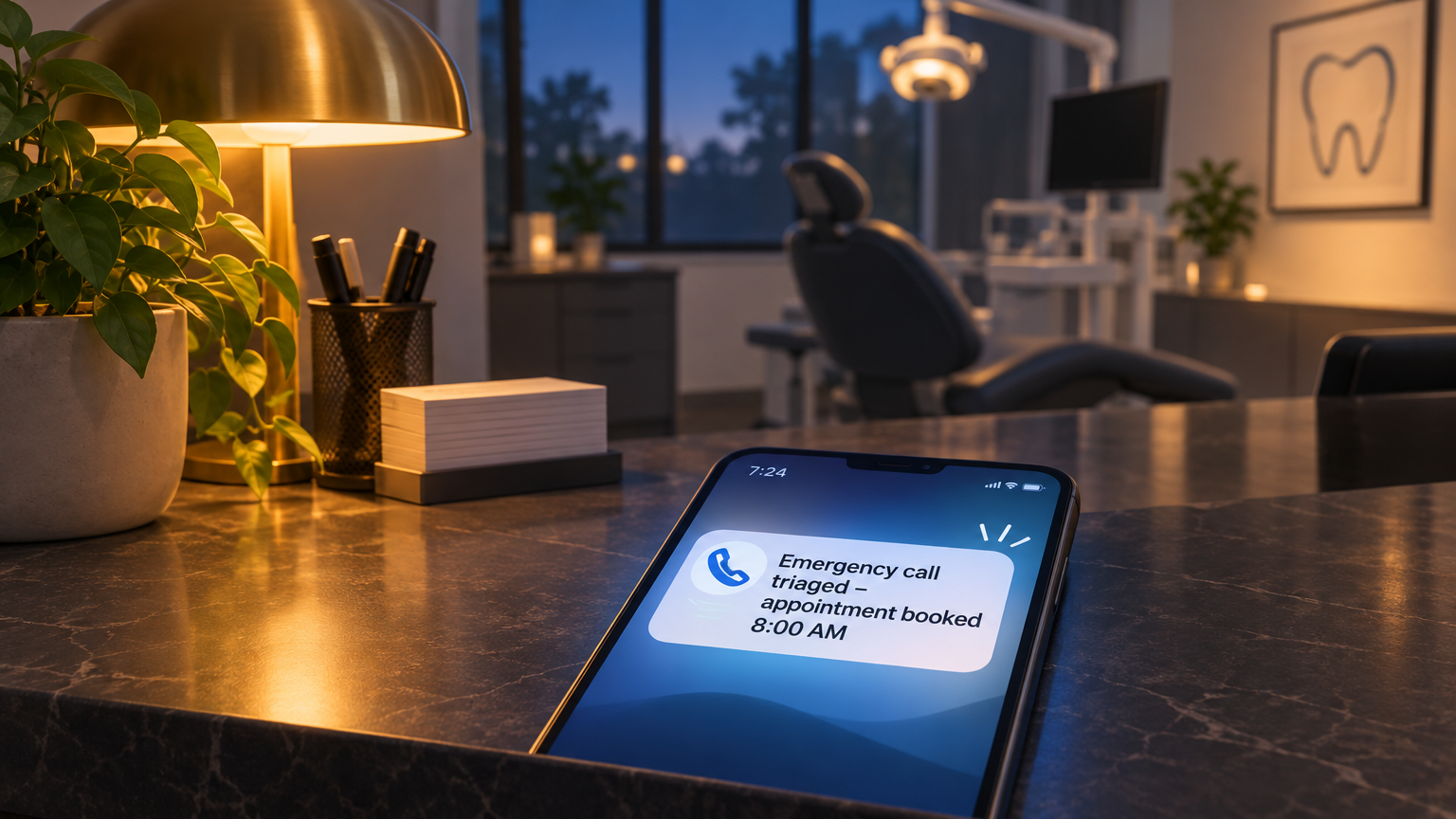
A Patient Is in Pain at 7 PM. Your Office Is Closed. Here's What Happens to That Call.
Short answer: a dental practice should never send an after-hours emergency call to voicemail. An AI phone agent can answer in seconds, sort true emergencies from routine requests using your own rules, alert the right person, and book the first open slot, so the patient in pain ends up in your chair instead of a competitor's or an ER waiting room.
It's 7:12 on a Tuesday evening. A parent calls because their kid took a soccer ball to the mouth and a front tooth looks loose. Your team left at 5. The call rolls to a recorded message asking them to leave a name and number and call back during business hours. Most callers never leave that message. They open the next search result and dial.
What actually happens to a dental call after 5 PM?
Industry data is consistent on one point: patients call when they finally have time, and that is usually when you're closed. One 2026 roundup of dental phone statistics puts roughly 45% of calls outside the 9-to-5 window, and other analyses find the 5 to 9 PM stretch carries the bulk of after-hours volume. Separate research on missed calls reports that only about 14% of new patients leave a voicemail when nobody picks up. Callers who do leave one are often reached the next morning, after the urgency, and sometimes the patient, has moved on.
Emergency visits are also some of the most valuable first visits you get. One industry analysis puts immediate procedure revenue for an emergency call at $400 to $1,500, and notes that about two million people a year go to a hospital emergency department for dental pain. Many of them would have preferred to call a dentist, if someone had answered.
Are most after-hours calls really emergencies?
No, and this is the part owners usually get wrong. Most after-hours calls are routine: a new patient wanting a cleaning, an existing patient moving an appointment, a question about whether you take their insurance. If you only plan for the dramatic 2 AM abscess, you undercount the problem and build a process that ignores the bulk of the lost calls.
A good after-hours setup handles three kinds of callers, and each one needs a different outcome.
Lane 1: True emergencies
Uncontrolled bleeding, facial swelling that is spreading, trauma, a knocked-out adult tooth. You decide, ahead of time and with your dentist's input, which situations trigger an immediate alert to the on-call doctor and which trigger instructions to seek emergency medical care. The AI follows your script. It does not diagnose and it does not give clinical advice. Its job is to ask your questions, capture the details, and get a human involved fast.
Lane 2: Urgent but not dangerous
A cracked filling, a toothache that kept someone up, a lost crown. These patients want to know they're being taken care of. The agent confirms the symptoms you care about, offers the first available morning slot or your reserved same-day emergency block, and sends your team a summary so the first call of the day isn't a cold start.
Lane 3: Routine requests
New patient exams, hygiene visits, reschedules, hours, directions, insurance basics. These get answered and booked directly, with details logged so nothing depends on someone remembering to call back.
What does this look like in numbers?
Here is an illustration, not a promise. Say your practice gets 60 calls a week and about 25 of them land outside business hours. Perhaps five of those are urgent and the rest routine. If an AI agent books just two of those urgent patients into your first morning slots each week, and you use the low-to-mid end of the emergency-visit range above, that's $800 to $3,000 a week in first-visit production. That figure leaves out what each new patient is worth over years of cleanings and treatment, and it leaves out the routine callers who also got booked instead of dropped.
Run your own version. Pull last month's call log, count the calls that arrived outside opening hours, listen to a sample, and multiply by your own booking rate and average first-visit value. Your numbers beat any benchmark.
How do you set up after-hours triage in a week?
You don't need a project plan. You need decisions, written down, that your agent can follow.
- Write your emergency list. With your dentist, define what counts as an emergency, what counts as urgent, and what can wait. Keep it short and unambiguous.
- Decide who gets alerted. Pick the on-call person and the channel, whether that's a call transfer, a text or an email. Define a backup.
- Reserve capacity. Hold one or two morning slots, or a daily emergency block, so the agent has something real to offer.
- Load the basics. Hours, location, new patient process, insurance you accept, and the questions your front desk answers ten times a week.
- Test it with ugly calls. Call it as a nervous parent, a patient who rambles, and someone who won't give a straight answer. Adjust the script until it handles all three.
MissedCalls.ai lets you define business rules and call flows, route by intent or schedule, transfer to a live person when needed, and capture the full context when nobody picks up. Every call is logged with a transcript, summary and outcome, so your team starts the morning knowing exactly who called and why. If you handle protected patient information, raise your privacy requirements in the demo so they're addressed up front.
This works best alongside the rest of your phone strategy. If you haven't yet covered daytime overflow, start with our look at how dental practices capture every new patient call. Once new patients are booked, AI reminder calls help keep the chair full, and reactivation calls bring back the patients who drifted.
Frequently asked questions
Can an AI receptionist diagnose a dental emergency?
No, and it shouldn't try. It follows the screening questions and escalation rules you set, captures the details, and alerts your on-call team or directs the caller to emergency care when your protocol says so.
What if a caller needs a human right away?
Your call flow can transfer the call to an on-call number based on intent or schedule. If nobody answers, the agent captures the caller's information and triggers an immediate follow-up.
Will patients know they're talking to AI?
MissedCalls.ai is built for natural conversation without menus or press-1 prompts. Many practices are open about using an AI assistant, and the best test is to listen to a live demo yourself.
How quickly can a practice go live?
Many teams launch a standard receptionist flow in hours, then refine scripts, routing and integrations over time.
What does the dentist see the next morning?
A transcript, summary and outcome for every call, so the team knows who was booked, who needs a callback and who was escalated overnight.
Hear it handle a call yourself
The fastest way to judge after-hours triage is to listen to it. Book a live demo of MissedCalls.ai and we'll walk through a dental call flow built around your emergency rules, your schedule and your team.
