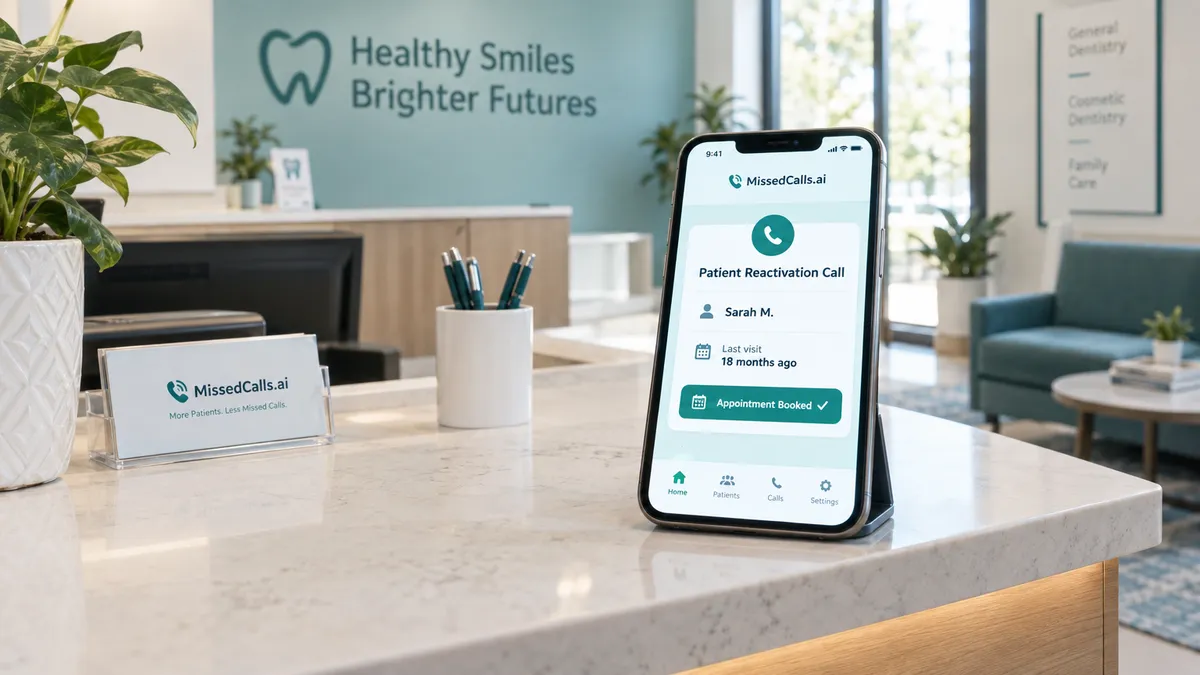
The short answer: AI outbound reactivation calls automatically contact your dormant patient list, remind them it's time to come back, and book appointments directly into your schedule — without any manual effort from your front desk team. Practices that run systematic reactivation programs recover $40,000–$100,000 in annual revenue from patients already in their database.
The Patients You're Forgetting About Are Worth More Than New Ones
Every dental or medical practice has two kinds of growth opportunities: new patients you haven't met yet, and past patients you've already won over who quietly drifted away. Most practices spend the majority of their marketing budget on the first group — and almost nothing on the second.
That's a significant mistake, because the math strongly favors the second group.
The average dental practice loses 15–20% of its patient base every year to attrition. Most of them don't leave angry — they just get busy, change insurance, move through a life transition, or simply forget to schedule. By the time 18 months pass, they're no longer in your active recall. They're in a dormant list that grows bigger every year while your front desk focuses on the patients walking through the door right now.
Industry benchmarks show the average practice with 1,500–3,000 patients of record is sitting on 800–2,000 dormant patients who haven't visited in 12 months or more. That dormant segment often represents 30–50% of the total patient base. And reactivating even 10–15% of them — without a single dollar of paid advertising — can generate $40,000 to $100,000 in recovered annual revenue.
The catch? Someone has to actually reach out.
Why Most Practices Never Run Reactivation Campaigns
Ask any practice manager and they'll tell you the same thing: reactivation is one of those projects that sounds great in a team meeting and never actually happens. The reason is simple — it requires staff time that doesn't exist.
Pulling an inactive patient list from the practice management system takes time. Sorting it by how long each patient has been gone takes more time. Then someone has to work through the list, make calls one by one, leave voicemails, wait for callbacks, and log the results. Meanwhile, the phone is ringing, the waiting room is full, and next week's schedule needs to be confirmed.
The reactivation list gets pushed to next month. Then the month after. Then it disappears entirely.
Research consistently shows that practices without a systematic reactivation process reactivate fewer than 5% of their dormant patients per year — essentially zero. Practices with automated outreach bring back 10–20% of that same list, without adding staff or dedicated calling time.
The difference isn't motivation. It's automation.
How AI Reactivation Calls Work for Dental and Medical Practices
MissedCalls.ai handles outbound patient reactivation through AI-powered voice calls that go out automatically to your lapsed patient list — the people who haven't visited in 12, 18, or 24-plus months, depending on how you define dormant for your practice.
Here's what the workflow looks like in practice:
The call goes out on your schedule. You define the segment — maybe it's everyone who hasn't had a hygiene appointment in 14 months. The AI calls each patient, introduces itself as calling on behalf of your practice, and mentions that it's been a while since their last visit.
The conversation is natural, not robotic. The AI doesn't read a script that sounds like an automated message. It handles the conversation naturally, answers basic questions about availability, and responds to the most common reasons people haven't come back — insurance questions, scheduling concerns, or simply needing to know you're still there.
Interested patients book on the spot. When a patient says yes, the AI books them directly. No callback required. No front desk handoff that creates a drop-off. The appointment lands on your schedule while the patient is still on the phone.
Every call is logged. You get transcripts, outcomes, and a clear record of who booked, who asked to be called back, and who requested to be removed from outreach. Your team picks up exactly where the AI left off with the ones who need a human touch.
The Revenue Math Is Hard to Ignore
Let's make this concrete. Say your practice has 1,200 patients who haven't been in for 18 months. At an average annual patient value of $600–$800, that's a dormant database worth $720,000 to $960,000 in potential production.
A systematic AI reactivation campaign that brings back just 10% of them — 120 patients — at an average first-visit value of $250 in hygiene and exam revenue means $30,000 in immediate production. But that's only the beginning. Research shows that 40–55% of reactivated patients have treatment needs identified at their return visit — unfinished treatment plans, periodontal issues, or new concerns that weren't there before. That adds another $400–$1,500 per patient in follow-on treatment revenue.
And each patient who returns to regular recall generates $500–$800 per year from that point forward, without any additional outreach cost.
All from a list you already have. All from patients who already know your practice. All without spending a dollar on new patient advertising.
For comparison: acquiring a new dental patient through paid advertising typically costs $250–$400. Reactivating a lapsed patient costs a fraction of that — because the hard work of building trust was already done years ago.
Why Phone Calls Outperform Text and Email for Cold Reactivation
Text messages work well for patients who haven't been in for 6–9 months — they're still warm and respond to a simple reminder. But for patients who've been gone 18 months or longer, phone outreach consistently produces stronger conversion rates than text or email alone.
The reason is straightforward: a phone call creates a moment of real engagement. The patient hears a voice, processes the message in real time, and either books then and there or has a chance to ask a question. A text gets read and forgotten. An email doesn't get opened at all for a significant portion of your list.
AI-driven phone reactivation achieves 2–3x the contact rate of manual staff calling efforts — because the calls go out consistently, at the right time of day, without depending on when a team member has a free moment between patients.
If you've already handled the no-show problem for current patients — see our post on how AI reminder calls cut dental no-shows by up to 36% — and you've got inbound calls covered with AI phone answering for new patient inquiries, then outbound reactivation is the next logical step: recovering the revenue sitting dormant in your existing patient database.
What to Do Right Now
You don't need a new marketing campaign to grow your practice this quarter. You need to talk to the patients already in your system who stopped coming back.
MissedCalls.ai can run outbound AI reactivation calls to your lapsed patient list automatically — connecting with dormant patients, answering their questions, and booking them back into your schedule while your team focuses on the patients already in the chair.
👉 See a live demo tailored to your dental or medical practice — book it here.
Frequently Asked Questions
How does AI patient reactivation work for dental and medical practices?
AI outbound reactivation calls automatically contact dormant patients — those who haven't visited in 12, 18, or 24+ months — using natural voice conversations. The AI introduces itself as calling on behalf of your practice, addresses common reasons for lapsing, and books willing patients directly into your schedule without requiring front desk involvement.
How many dormant patients does the average dental practice have?
Industry data shows the average practice with 1,500–3,000 patients of record carries 800–2,000 dormant patients who haven't visited in 12 months or more. That dormant segment typically represents 30–50% of the total patient base.
How much revenue can reactivation calls recover?
Reactivating just 10–15% of a dormant patient list generates $40,000–$100,000 in annual revenue without any paid advertising. Each reactivated patient generates $200–$400 immediately at their return hygiene visit, with 40–55% having additional treatment needs identified at that appointment.
Why don't most dental practices run reactivation campaigns regularly?
The biggest barrier is staff time. Manually calling through a dormant patient list requires hours of dedicated effort that front desk teams rarely have. Automation removes that bottleneck — AI reactivation calls run on a schedule without pulling any time from your team.
Is AI reactivation calling better than text or email for lapsed patients?
For patients who've been gone 18 months or longer, phone outreach consistently outperforms text and email. AI-driven phone reactivation achieves 2–3x the contact rate of manual calling and converts cold patients at 18–28% when the AI reaches a live answer — because voice creates real-time engagement that a text or email simply can't replicate.
