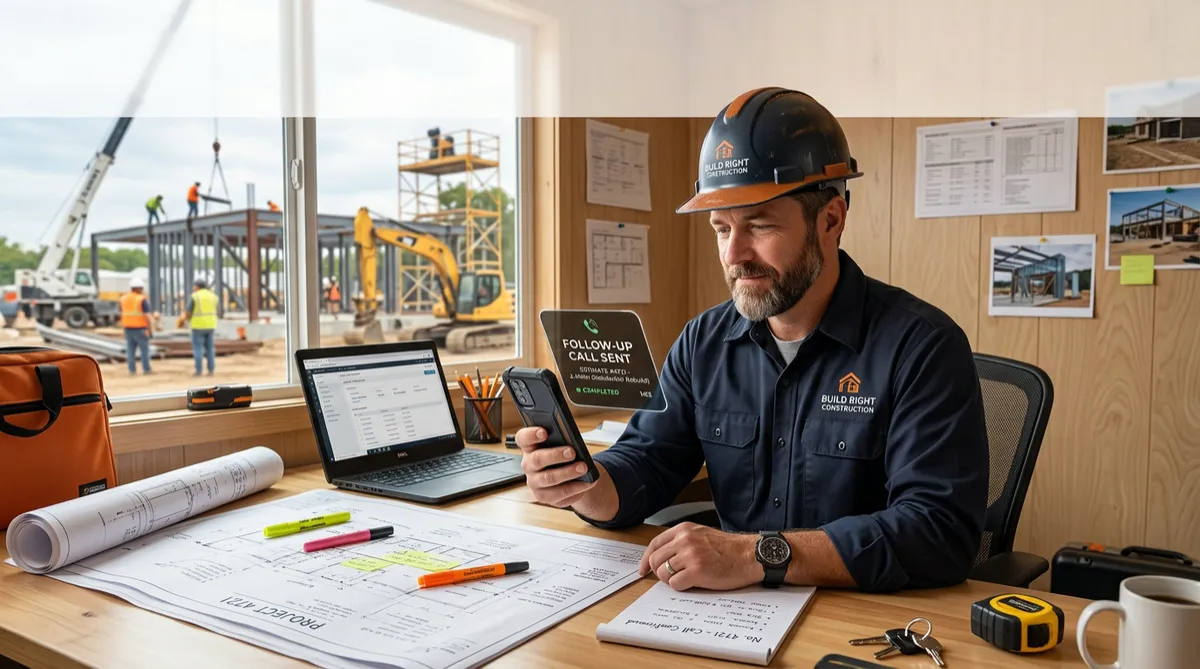
You Sent the Estimate. Now What? How AI Follow-Up Calls Help Contractors Close 30–50% More Jobs
Short answer: Most contractors send one estimate, wait a few days, send a vague "just checking in" text, and then move on. Meanwhile, the homeowner — who liked your bid, meant to call back, and got distracted by work and kids and a Tuesday — ended up booking the contractor who called them three days later. The fix is automated AI outbound follow-up calls that run your estimate follow-up cadence for you, on schedule, every time, without you having to remember.
This post is about that fix — specifically what it looks like for small contracting businesses, why it moves the needle more than almost anything else you can do, and exactly how MissedCalls.ai handles it.
The Contractor's Invisible Revenue Problem
There's a stat that should make every contractor pause: contractors who follow up within one hour of sending an estimate close 30–50% more jobs than those who wait 48 hours or longer. Same price. Same work. Just faster, more consistent follow-up.
Here's the other half of that picture: 80% of sales require at least five follow-up attempts to close — but 44% of contractors give up after just one. That gap is where tens of thousands of dollars disappear every year, silently, with no line item on any invoice to show for it.
When a homeowner requests a quote, they're often getting two or three estimates at the same time. They're comparing. They're busy. They intended to respond to yours, but life got in the way. The contractor who reaches back out — specifically, with context, with their name, with the actual project referenced — wins. Usually not because they're cheaper. Because they showed up.
The challenge is that showing up five times, on schedule, for every open estimate, when you're also running a crew, ordering materials, and managing active jobs, is nearly impossible without a system. So most contractors don't do it. And most contractors leave a significant chunk of their potential revenue on the table because of it.
Why Most Follow-Up Attempts Don't Work
The problem usually isn't that contractors don't follow up at all. It's that the follow-up is generic, inconsistent, and stops too early.
The classic version looks like this: You send the estimate on Monday. You text "Hey, just wanted to check in on that quote" on Thursday. You get no reply. You assume they went with someone else and move on. In reality, they hadn't made a decision yet — they were just busy on Thursday.
Research on contractor lead behavior shows that 62% of leads don't answer the first follow-up call, but 80% of contractors give up after that first attempt. That's not a pricing problem. That's a follow-up volume and consistency problem.
A well-structured follow-up cadence for a mid-range estimate ($2,000–$15,000 job) looks something like this:
- Day 0, within 1 hour: Confirmation that the estimate was sent, one specific detail highlighted, clear next step offered
- Day 1: A brief call or voice message — not a voicemail that says "just checking in," but one that references the project by name and address
- Day 3: A text message follow-up with a soft deadline or scheduling hook
- Day 7: Another outbound call — this is where most contractors have already quit
- Day 14: A final reactivation touch, often catching the homeowner at a moment where a competitor fell through
Running that manually for every open estimate, across 10 or 20 active quotes, is a full-time job by itself. That's exactly what AI outbound calling is built for.
How AI Outbound Calls Handle Contractor Estimate Follow-Up
MissedCalls.ai can place outbound follow-up calls to prospects automatically — triggered when an estimate is sent, spaced across your defined schedule, and configured with the specific language your business uses.
When the AI reaches the homeowner, it doesn't fumble through a script that sounds robotic. It identifies the call purpose (following up on the estimate for the kitchen remodel on Maple Street, for example), asks a targeted question (did they get a chance to review it, do they have any questions on the scope, are they ready to schedule a start date), and either books the next step or captures their preference for a callback time.
When it reaches voicemail — which happens on a large percentage of follow-up attempts — it leaves a natural, professional message that references the actual project, names your business, and gives a clear callback number.
Every call outcome is logged with a transcript and summary. Your team sees at a glance which estimates are warm, which have questions outstanding, which are cold, and which are ready to close — without having to manually track every open quote through a spreadsheet or a pile of sticky notes.
What Does This Look Like in Practice?
Say you run a small general contracting business. In a good month, you're sending 15–25 estimates. Even at a modest average job value of $4,500, getting your close rate up by 10 percentage points means 1–2 more jobs per month — $4,500 to $9,000 in additional monthly revenue from the same estimate volume you're already producing.
That math holds for remodelers, roofers, electricians, HVAC companies, and plumbers. High-intent phone leads in home services convert at roughly 46% when handled correctly. The same leads, left without timely follow-up, often convert at single-digit rates. The work you're doing to generate estimates is already done. The gap is in what happens after you hit send.
What AI Follow-Up Can't Replace — and Doesn't Try To
For high-value projects — commercial builds, full renovations, large commercial contracts — there's no substitute for a senior person making a personal call at the right moment. AI outbound follow-up isn't trying to replace that relationship layer for your biggest jobs.
What it replaces is the part of follow-up that fails most often: the Day 3 call nobody made because the crew had a problem at the Northside job, and the Day 7 text that got drafted but never sent because a supplier called about a delivery window, and the Day 14 reactivation attempt that never happened because by then the estimate felt too stale to bother with.
AI handles the consistent, scheduled touches that keep your name in front of the homeowner while they're still deciding. Your team handles the close when the homeowner raises their hand.
The Connection to Inbound: You Can't Follow Up on Calls You Missed
There's one prerequisite that often gets overlooked in the estimate follow-up conversation: you have to actually capture the lead in the first place.
Data from the contracting industry puts the unanswered call rate at anywhere from 27% to over 74%, depending on team size and how busy the season is. If you're missing 3–5 inbound calls a day from people looking for estimates, no amount of follow-up cadence on the estimates you do send will close that gap.
If you want to understand what the inbound side of this looks like — missed calls during job hours, after-hours coverage, and first-call lead capture — take a look at why contractors lose $45K–$120K a year to missed calls and how after-hours AI answering plugs the biggest gap in your call coverage. Both pieces are relevant to any contracting business running on a small team.
The full picture is this: capture every inbound lead, then follow up on every estimate you send. MissedCalls.ai handles both sides of that equation.
Ready to Stop Losing Jobs to Silence?
If you're sending estimates and hearing nothing back, the problem is almost certainly not your pricing. It's the follow-up. An automated AI outbound calling system that runs your estimate follow-up cadence — on time, every time, with your business name and the specific project referenced — is one of the highest-ROI changes a small contracting business can make right now.
See how MissedCalls.ai handles contractor estimate follow-up — book a tailored demo here.
Frequently Asked Questions
How many times should a contractor follow up on an estimate?
Research shows that 80% of sales require at least five follow-up attempts to close. Most contractors stop after one. A well-structured cadence covers Day 0 (within the hour), Day 1, Day 3, Day 7, and Day 14 — mixing calls, texts, and project-specific voicemails at each step.
What is AI outbound calling for contractors?
AI outbound calling uses a voice AI agent to automatically place follow-up calls to prospects on a schedule. For contractors, the AI calls homeowners after an estimate is sent, leaves a natural voicemail when needed, captures responses when someone picks up, and logs every outcome with a transcript — no manual effort required.
How much does poor follow-up actually cost a contractor?
Contractors who follow up within one hour close 30–50% more jobs than those who wait two days or more. At an average job value of $4,500 and 15–20 estimates per month, even a 10-percentage-point improvement in close rate adds $4,500–$9,000 in monthly revenue from the same lead flow.
Can AI follow-up calls reference the specific job or project?
Yes. MissedCalls.ai is configured with your business information, service types, and call flow preferences — so outbound calls reference the homeowner by name, the specific project quoted, and the exact next step you want them to take.
Does MissedCalls.ai handle both inbound and outbound for contractors?
Yes. MissedCalls.ai covers both sides — inbound answering 24/7 (after-hours lead capture, first-call qualification, appointment booking) and outbound workflows (estimate follow-up calls, appointment reminders, reactivation campaigns for past customers).
