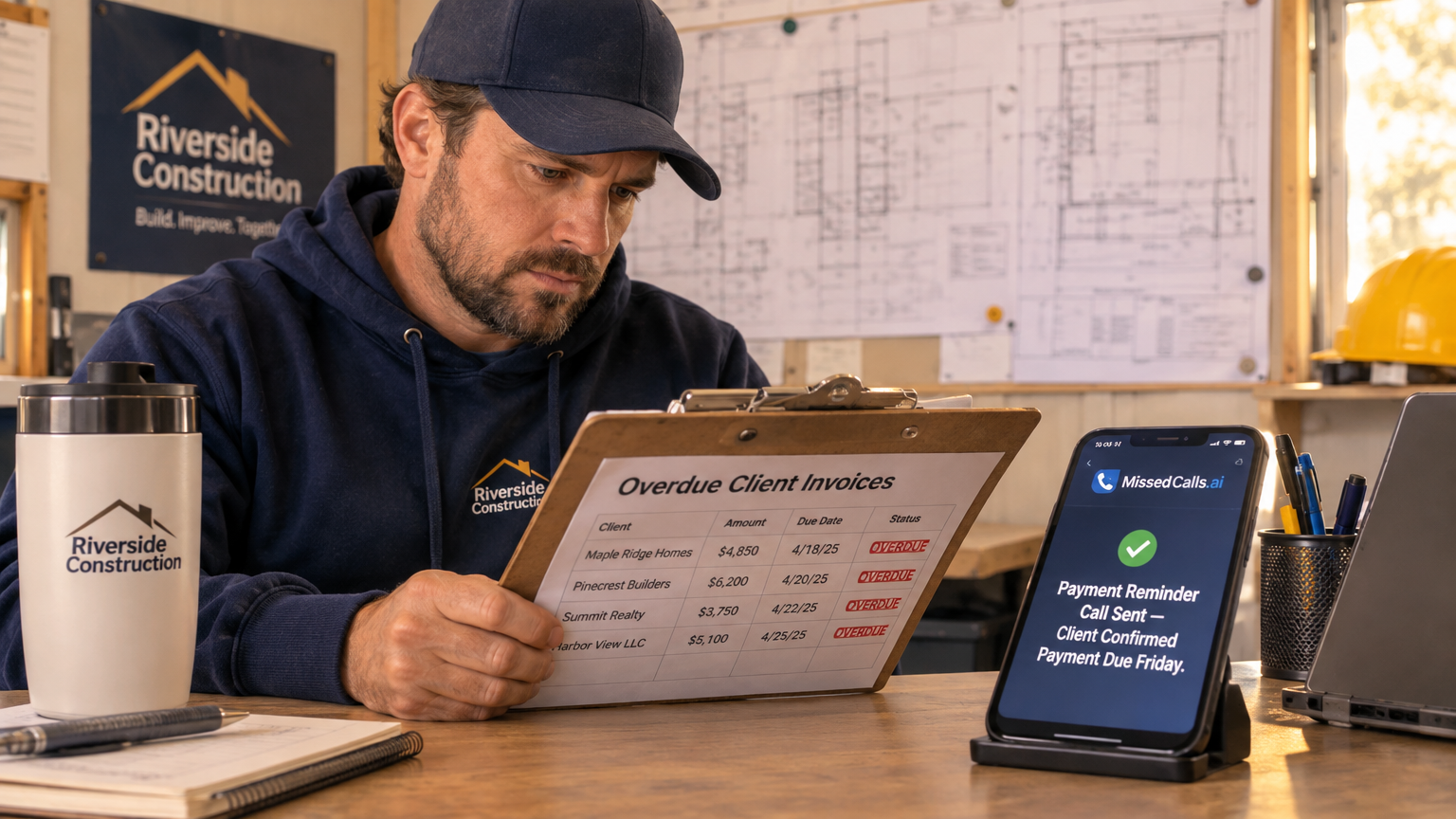
You Finished the Job. Here's Why You're Still Waiting to Get Paid — And What AI Calls Do About It
Quick answer: Construction businesses wait an average of 83 days to collect payment after invoicing — the longest of any industry. The fix isn't a collections agency or a stern email. It's a consistent, early follow-up call. AI outbound payment reminder calls run that cadence automatically so overdue invoices get contacted at day 3, day 10, and day 21 past due without anyone at your company having to find time to make an awkward phone call.
The job is done. The final invoice went out three weeks ago. And that client — who was completely satisfied with the work — still hasn't paid.
You could call them. But you're buried in the next project, your foreman needs an answer about a materials order, and honestly, chasing money is the part of running a contracting business that nobody signed up for.
So the invoice sits. Days become weeks. Weeks become months. The money you already earned stays stuck somewhere between "sent" and "collected."
Here's the uncomfortable truth: this isn't a one-off problem. It's the default state of contractor billing in 2026.
The Construction Payment Problem Is Worse Than Most Contractors Realize
The numbers are hard to look at. Industry data shows 82% of contractors now wait over 30 days for payment on completed work — up from 49% just two years prior. Construction has the longest payment cycles of any industry in the United States, with an average Days Sales Outstanding (DSO) of 83 days. That means the typical contractor is waiting nearly three months from invoice submission to cash in the account.
Meanwhile, your material suppliers want payment in 30 days. Your crew expects a paycheck every two weeks. And every day that invoice sits unpaid, you're essentially giving your client an interest-free loan — using your own working capital to float their project.
The broader picture for small businesses is just as rough. According to QuickBooks' 2026 Small Business Late Payments Report, 59% of small businesses are carrying at least one invoice more than 30 days overdue — up sharply from 47% the year before. The average outstanding balance for businesses waiting on overdue invoices is $17,700. And 39% of owners say a single late payment has made it genuinely difficult to cover payroll or other bills during the prior year.
That's not a cash-flow problem. That's a collections problem disguised as a cash-flow problem.
Why Contractors Don't Follow Up — Even When They Know They Should
Here's what most people don't say out loud: contractors are inconsistent at chasing invoices. Not because they're disorganized — but because collections has no natural trigger the way a ringing phone does.
A ringing phone demands your attention right now. An overdue invoice sitting in your accounting software demands nothing. It just quietly ages while you do the work in front of you.
You saw the invoice on Tuesday. You told yourself you'd call about it Friday. Friday came with an emergency service call and a supply delivery, and the invoice slipped another week. That cycle — repeated across a dozen invoices — is where contractor cash flow actually breaks down. Not from bad clients. Not from lack of work. From nobody making the follow-up call.
And the longer you wait, the more it costs you. Industry data puts the probability of collecting a delinquent account at around 89% at three months past due, dropping to 51% at six months and just 21% at one year. That invoice you're going to "get around to" is worth less money every week you don't call.
What Does a Good Contractor Collections Cadence Actually Look Like?
Most overdue contractor invoices aren't the result of a client trying to avoid payment. They're the result of a client who is busy, assumed you'd remind them, and hasn't had a reason to prioritize it yet.
Industry guidance points to a simple, consistent sequence that collects faster than any other approach:
3 days before due date: A friendly heads-up. “Just a reminder that invoice #1247 for the kitchen remodel — $4,800 — is due on the 15th. Let us know if you have any questions.” This alone cuts late payments dramatically because most people aren't trying to avoid you. They're busy and the invoice got buried.
Day 3–7 past due: A direct, professional follow-up. “Your invoice is now past due. We wanted to reach out and confirm whether payment has been arranged or if there's anything we can help resolve.” Most clients respond here and pay within days of this contact.
Day 14–21 past due: A firmer call with a clear path to pay and a note that you'll be following up again if you don't hear back. This is the call that feels the most uncomfortable to make manually — but it's also the one that recovers the most money from clients who have been procrastinating.
That's the sequence. The problem is that manual execution is unreliable. You're on a roof. You're writing up an estimate. You're dealing with a job site issue. The invoice slides.
How AI Outbound Payment Reminder Calls Work for Contractors
AI outbound payment reminder calls work exactly the way that follow-up sequence should work — but runs automatically, on schedule, whether your team remembers or not.
When an invoice hits a trigger date, MissedCalls.ai initiates an outbound call to the client contact on file. The AI has a natural, professional conversation — identifies itself as calling on behalf of your business, references the invoice, and either confirms payment or captures a commitment with a specific date.
It handles the common responses that slow down manual follow-up:
- “I'll get a check out to you next week” — logged with a callback date
- “Can you resend the invoice?” — noted so your team can follow up with the document
- “We're waiting on approval from our GC” — documented with the reason so you know the hold-up
- “We already sent that payment” — flagged for your team to verify
Every call is documented with a transcript and outcome summary. You can see exactly where each invoice stands without digging through your accounting software or trying to remember who you talked to last week.
What AI doesn't do: threaten, pressure, or damage the client relationship. The tone stays professional and customer-friendly throughout the reminder cadence. When an account genuinely needs escalation — a lien notice, a formal demand, or a human conversation — that's still a decision you make. But by then, you've run a complete, documented follow-up sequence that gives you leverage most contractors never have.
What It Actually Costs When Your Follow-Up System Doesn't Exist
Put a number on it. If you do $600,000 a year in contracting work and 20% of your invoiced revenue runs 30+ days late, that's $120,000 sitting in receivables at any given time. At current borrowing rates, bridging that gap with a line of credit costs $8,000–$12,000 a year in interest — just to access money you've already earned and already spent labor to deliver.
That doesn't count the jobs you couldn't take because your working capital was tied up. It doesn't count the time your team spends chasing invoices manually, calling clients who don't call back, sending emails that get ignored. And it doesn't count the write-offs on the accounts that slipped past six months — where industry data puts the collection probability below 50%.
Automated outbound reminder calls compress that timeline. The earlier the first contact after a due date, the higher the collection rate. And a phone call — a real, natural conversation — gets answered and acted on at a much higher rate than an email.
For related reading on how AI outbound calls help contractors capture revenue at every stage, see how AI reminder calls reduce estimate no-shows, how AI reactivation calls recover past customers, and how AI phone answering captures new leads while you're on the job site.
Is This the Right Fit for Your Contracting Business?
If you're billing customers directly — residential remodels, service calls, smaller commercial projects — and you regularly carry 60–90+ days of outstanding receivables, the ROI calculation is straightforward. Faster collections mean better cash flow, less borrowing, and more working capital available for the next job.
If your work involves complex progress billing with general contractors or developers, AI reminder calls work well for the initial follow-up contacts, even when final escalation involves your contract language and lien rights. The goal is to handle the routine follow-up automatically so your team isn't spending hours on calls that shouldn't require a human — and so the genuinely difficult accounts get the human attention they need sooner.
The question isn't whether you need a consistent collections process. You do — and the data shows most contractors don't have one. The question is whether you want to build it manually or let AI handle the routine part while your team stays focused on running jobs.
See How MissedCalls.ai Handles Payment Reminders for Contractors
If your invoice aging report has accounts that haven't been contacted in 15, 30, or 60 days, that's recoverable revenue waiting on a phone call that hasn't happened yet.
Book a Tailored Demo and we'll walk you through exactly what a payment reminder cadence looks like for your contracting business — including timing, call scripts, escalation triggers, and how outcomes get documented.
Frequently Asked Questions
How do AI payment reminder calls work for contractors?
AI outbound calls are triggered automatically when an invoice reaches a set number of days past due. The AI places a call to the client, has a natural conversation about the outstanding invoice, captures a payment commitment or reason for delay, and logs the full outcome with a transcript. Your team sees the result without making the call themselves. The cadence typically runs at pre-due, day 3–7 past due, and day 14–21 past due.
Will an AI call damage my relationship with a good client?
No — when done correctly, a timely, professional reminder actually reinforces that you run a serious business. Most clients who are late aren't avoiding you; they're busy and the invoice got buried. A polite outbound reminder is welcomed by the majority of clients. The AI stays professional and customer-friendly throughout, and you decide when — if ever — to escalate beyond the standard reminder cadence.
What's the best timing for contractor invoice follow-up calls?
Industry data consistently shows that the earlier the first contact, the higher the collection rate. A reminder 3 days before the due date, another 3–7 days after, and a third at 14–21 days past due catches most overdue invoices before they drift into difficult territory. Waiting until day 30 or beyond reduces your odds of full collection significantly.
Can AI payment reminder calls work alongside lien notices and legal escalation?
Yes. AI handles the first two or three contacts in your reminder sequence — the routine follow-up that most contractors don't complete consistently. If an account still hasn't responded after the AI cadence, you have a documented follow-up record and a clear trigger to escalate to a formal demand, lien notice, or legal action. The AI doesn't replace those tools; it makes sure you've exhausted the easier options first.
How does MissedCalls.ai handle payment reminders for contractor invoices?
MissedCalls.ai places outbound calls on a schedule you define, using natural conversation trained to your business. It handles common responses, documents every call with a transcript and outcome summary, and surfaces only the accounts that need human attention. You set the trigger dates, the script parameters, and the escalation rules — MissedCalls.ai runs the cadence automatically so nothing slips through the cracks.
