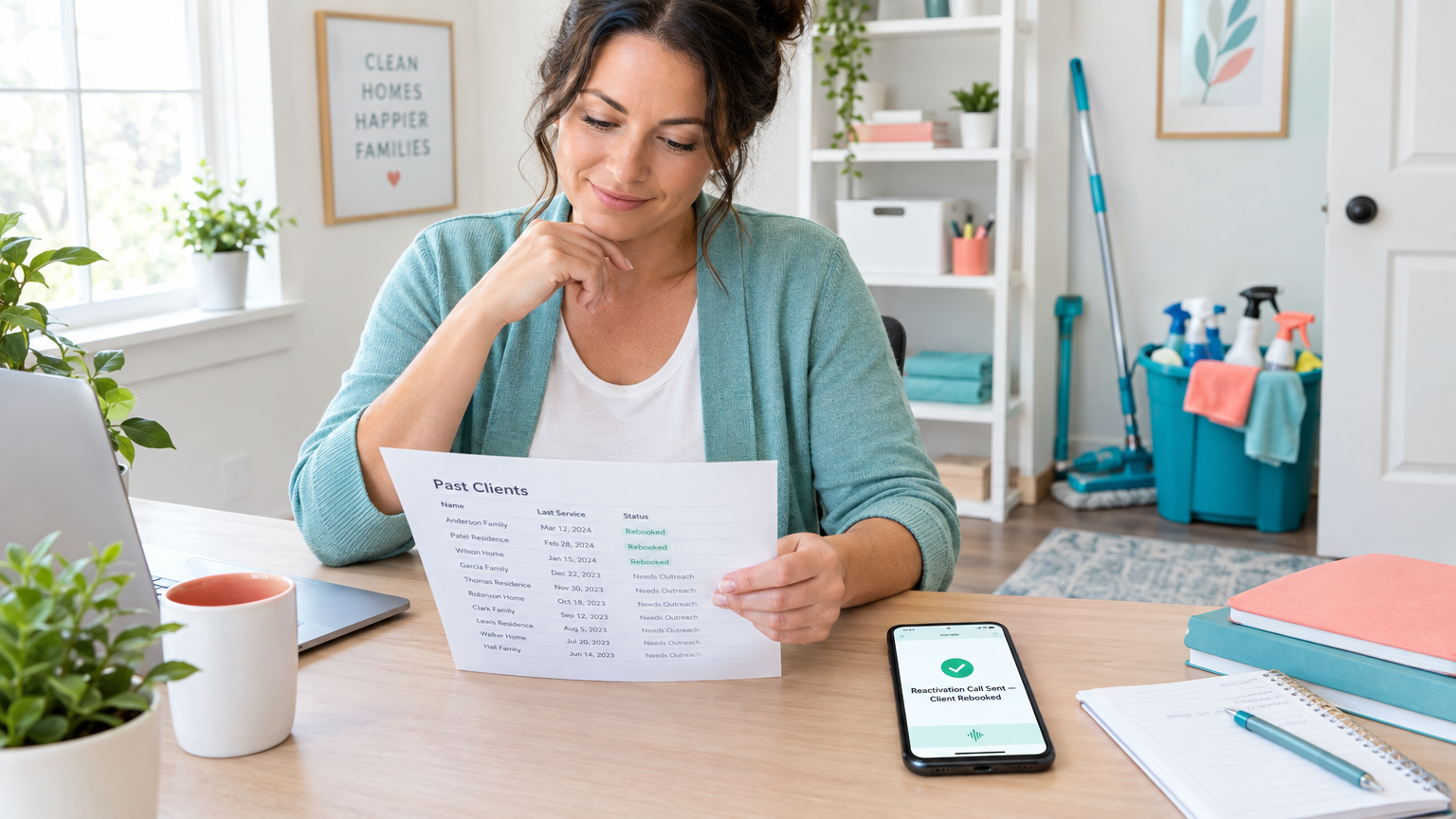
Your Cleaning Clients Said They Needed to Pause. 6 Months Later, They Hired Someone Else.
Quick answer: Residential cleaning companies lose 20-35% of recurring clients every year to silent churn -- not because the work was bad, but because nobody reached out. AI outbound reactivation calls automatically contact lapsed clients, reference their past service, and rebook them into your schedule. A single recovered biweekly client is worth $3,900 in annual recurring revenue.
The Pause That Never Ended
It usually sounds like this: "Hey, can we pause for a couple of months? Things are a little crazy right now." You say sure, no problem. You make a note. And then you never hear from them again.
That is not an edge case in the cleaning business. That is the most common way you lose a client.
They did not rage-quit. They did not call to complain. They just quietly drifted -- and six months later when their house needed cleaning again, they searched Google, found someone else, and booked. Not because that company is better than you. Because that company showed up in the moment they were ready, and you were not there.
The cleaning industry has one of the highest customer churn rates in home services. Residential cleaning businesses commonly report 20-35% annual churn among recurring clients. And the brutal part? Most of those clients did not leave because they were unhappy. Industry data shows residential churn is driven mainly by price sensitivity and life changes, not service dissatisfaction. They left because nobody reached out.
What a Lapsed Cleaning Client Is Actually Worth
When a recurring client stops booking, most cleaning owners think about the most recent job they lost -- maybe $150. That is the wrong number to have in your head.
A biweekly client at $150 per visit generates $3,900 in annual revenue. A weekly client at the same rate generates $7,800. A biweekly client who stays just 2.5 years is worth about $9,750 over the life of that relationship. Multiply that by however many clients have paused over the past 12-18 months, and you are looking at a list of real money sitting dormant in your own records.
Now consider what it costs to acquire a brand-new cleaning client: typically $80-$200 in ads, plus the discounted first clean, plus the sales time to convert them. And even after all that, you still have to earn their trust from scratch.
A lapsed client already trusts you. They already know how your team works. They already had a good enough experience to become a recurring customer in the first place. That is not a lost cause -- that is the cheapest, most qualified lead your business has access to right now.
The numbers back it up. Systematic re-engagement campaigns convert 15-25% of lapsed cleaning clients back into active recurring accounts. At an average of $5,000 in annual value per recurring client, re-engaging just five lapsed customers adds $25,000 in annual recurring revenue. Reactivated clients also have 40% higher lifetime value the second time around -- because trust is already established, they churn less and stay longer.
Why Most Cleaning Owners Do Not Call Their Lapsed List
It is not because they do not know the revenue is there. It is because calling is awkward, time-consuming, and easy to put off.
Imagine sitting down on a Tuesday afternoon to call 40 people who stopped booking 3-9 months ago. Some will not answer. Some will give a vague excuse. Some are going to feel slightly uncomfortable -- and so will you. So you tell yourself you will do it next week, and next week never comes.
Even when owners do commit to calling, they usually get through 10-15 contacts before something pulls them back to running the business. The list sits there. The revenue stays locked up.
This is exactly the problem AI outbound calls are built to solve.
How AI Reactivation Calls Work for Cleaning Companies
MissedCalls.ai can run outbound reactivation calls automatically against your lapsed client list -- with no manual dialing, no awkward silences, and no calls sitting undone because your day got busy.
Here is how the workflow runs in practice:
You identify your lapsed clients -- anyone who stopped booking 60, 90, or 180 days ago. The AI begins dialing through the list at a cadence you control. When a client picks up, the conversation sounds natural and personal: it references their past service, acknowledges the gap without making it weird, and gives them a specific reason to come back -- a schedule opening, an upcoming seasonal cleaning push, or a returning offer for loyal clients.
If they want to rebook, the AI captures it and schedules the appointment directly. If they are not ready, it notes the response and can follow up again at a future date. If they do not answer, it moves on and tries again at a different time.
Your team wakes up to a list of appointments already booked from clients who would have otherwise stayed lost forever.
What Makes a Reactivation Call Actually Work?
Three things convert a lapsed cleaning client better than a generic outreach blast:
1. A personal reference to their history. "We cleaned your home on Ridgemont Drive last spring" is more powerful than "We are a cleaning company in your area." The client immediately knows this is not a cold sales call. It is someone who worked for them before.
2. A specific, timely reason to come back. Holiday prep is one of the best reactivation angles a cleaning company can use. "We are running our fall schedule now and wanted to reach out to past clients first before we open availability to the public" creates real urgency without feeling pushy.
3. A frictionless path to rebook. Do not send them to a website form. Do not ask them to call back. Book it on the call, right then. The easier you make it, the higher the conversion rate.
An AI reactivation call handles all three of these automatically, consistently, and at scale -- running through 50 or 500 contacts with the same quality and tone every single time.
Who Should Be on Your Reactivation List Right Now?
Most cleaning companies sit on a larger lapsed client database than they realize. If you have been operating for more than a year or two, your list probably includes:
- Clients who paused and never came back -- the most common and most recoverable segment
- One-time deep clean customers who never converted to a recurring schedule but had a good experience
- Seasonal clients who booked spring cleaning or holiday prep in a prior year but were not re-engaged this year
- Move-in and move-out clients who are now settled in their new place and potentially ready for recurring service
- Clients who called with a complaint but were not lost -- if you resolved the issue, they are warm candidates
Even a modest cleaning company with 2-3 years in business typically has 80-150 contacts in this category. That is tens of thousands of dollars in potential recurring revenue that is not showing up in any marketing report because it was never counted as a lead -- it was counted as a cancellation.
When Should You Run a Reactivation Campaign?
Twice a year is the standard cadence that gets results. The two best windows for cleaning companies are:
Fall (September through November): Clients think about getting their home ready before the holidays. Thanksgiving, holiday parties, and family gatherings are strong emotional motivators. This is a natural reactivation moment and one of the highest-converting windows in the cleaning calendar.
Spring (March through April): Spring cleaning is practically a cultural cue. Clients who have not thought about cleaning since fall will respond to a call that lands in this window.
That said, there is no reason to wait for a seasonal push. If a client's last clean was 90 days ago and they were previously on a biweekly schedule, that is a live signal. AI reactivation can run continuously against rolling criteria -- not just during seasonal campaigns.
The Math on a 100-Client Lapsed List
Let us make this concrete. Say you have 100 past clients who stopped booking over the last 18 months.
- At a 15% reactivation rate: 15 clients rebooked
- At biweekly $150 per visit: $3,900 each per year
- Total recovered recurring revenue: $58,500 per year
That is the low end of what a systematic re-engagement campaign produces -- and it comes entirely from clients who already know you, already chose you, and already paid you.
Compare that to running $58,500 worth of Google Ads to find 15 brand-new clients who have never heard of you, need a discounted first clean, and might churn in 90 days anyway.
Is This Different from What You Are Already Doing?
Probably. Most cleaning companies send one or two texts or emails after a client pauses, get no response, and move on. Text and email are easy to ignore. A personal voice call -- especially one that references the client's specific history -- has a fundamentally different conversion dynamic.
People respond to being recognized. When a client hears a call that references their home and the fact that they were a regular customer, it does not feel like a marketing blast. It feels like someone from the company actually noticed they were gone and wanted them back. That is the difference between a 3% email open rate and a real conversation.
And unlike your team making these calls manually, an AI never gets to the 15th contact and decides to stop for the day.
How Does This Connect to Your Inbound Calls?
Reactivation is an outbound strategy -- but it works best when your inbound side is also covered. If a lapsed client calls back after receiving a reactivation call and nobody answers, you have lost the moment all over again.
That is why the full picture for a growing cleaning company includes both outbound reactivation (calling the list you have) and inbound AI answering (capturing every call that comes in, including the ones that happen while your crew is on-site). We covered the inbound side in detail in Why Your Moving and Cleaning Company Is Losing Leads Every Time Your Crew Is On-Site.
For how review request calls fit into the post-job workflow -- another outbound angle that compounds your recurring client value -- see How AI Outbound Review Request Calls Turn Every Home Service Job Into 5-Star Revenue.
Ready to Stop Leaving That Revenue in Your Own Records?
Your lapsed client list is not a graveyard. It is a revenue source that nobody has bothered to call. AI outbound reactivation makes the calling automatic, consistent, and scalable -- so you stop leaving recurring revenue on the table every time life gets busy.
Book a tailored demo at MissedCalls.ai and see exactly how the outbound reactivation workflow would run for your cleaning business -- including what a live AI reactivation call sounds like.
Frequently Asked Questions
How do AI reactivation calls work for cleaning companies?
AI outbound reactivation calls automatically dial lapsed clients from your existing customer list, reference their past service by name, and offer a specific reason to rebook such as a schedule opening or seasonal promotion. The AI handles the full conversation naturally, captures the client's interest, and books the appointment directly into your calendar. No manual calling required from your team.
How much do cleaning companies lose to lapsed recurring clients each year?
Residential cleaning companies typically see 20-35% annual churn among recurring clients. A single biweekly client at $150 per visit generates $3,900 in annual revenue. Losing even five recurring clients per month to silent churn represents $19,500 or more in annual revenue walking out the door.
What percentage of lapsed cleaning clients can be won back with outreach?
Systematic re-engagement campaigns run twice per year convert 15-25% of lapsed cleaning clients back into active recurring accounts. At an average of $5,000 in annual value per recurring client, re-engaging just five lapsed customers adds $25,000 in annual recurring revenue.
Why do cleaning clients stop booking without calling to cancel?
Most cleaning clients stop booking because of silence. Nobody checked in after the job, nobody reminded them to rebook, and they simply drifted. Industry data shows residential churn is driven mainly by price sensitivity and life changes, not service dissatisfaction. The work itself is usually fine.
Is it cheaper to reactivate a lapsed cleaning client than to acquire a new one?
Yes, dramatically. Acquiring a new cleaning client costs $80-$200 in marketing. Reactivating a lapsed client through an AI outbound call costs a fraction of that. And lapsed clients already know your quality, your team, and your process. Reactivated cleaning clients have 40% higher lifetime value the second time around because trust is already established.
