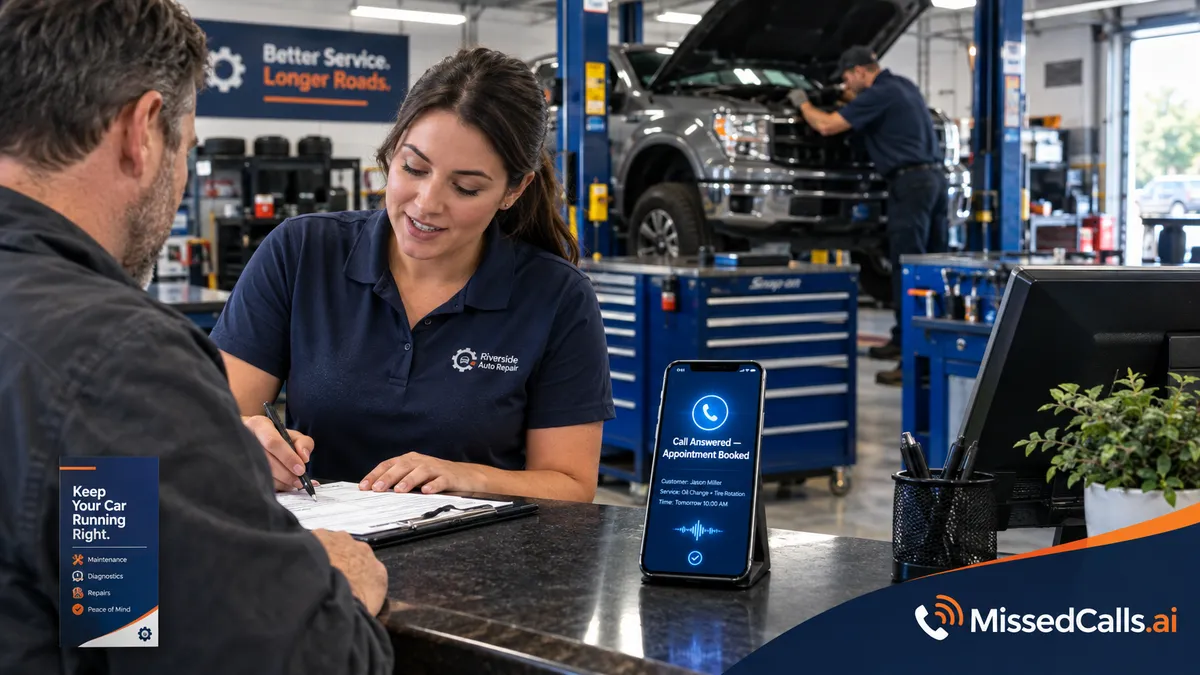
Your Bays Are Half-Empty on Tuesdays. AI Service Reminder Calls Can Fix That.
The short answer: Most auto repair shops lose 70-80% of first-time customers after their initial visit — not because the work was bad, but because nobody ever followed up. AI outbound service reminder calls fix this by automatically reaching out to past customers when they are due for their next oil change, tire rotation, or inspection — and booking the appointment before they call a competitor.
If you run an independent shop or a small multi-location operation, you already know which days feel slow. Tuesday afternoons. Thursday mornings in January. The week after a holiday. The bays are not empty because business is slow — they are empty because your existing customer base has drifted, and there is no system pulling them back.
Here is the frustrating reality: the average vehicle needs service three to four times a year. If you have 400 customers in your database, that is potentially 1,200 to 1,600 service visits per year sitting in your own records — visits that may never come back unless someone reaches out. Most shops do not have the staff time or consistency to run that kind of follow-up manually. So the customers drift, and a national chain quietly picks them up.
AI outbound calls change that math completely.
What AI Service Reminder Calls Actually Do
This is not a robocall blast. When a customer is due for service — based on their last visit date and service type — an AI voice agent places a natural, conversational outbound call. It reminds the customer their oil change or tire rotation is due, answers basic questions about timing or pricing, and offers to book an appointment right then. If the customer does not answer, it leaves a brief, personalized voicemail and can follow up with a text.
Every call is logged with a transcript, an outcome (booked, callback requested, declined, no answer), and any notes from the conversation — pushed directly to your records so your service advisor knows exactly where each customer stands before they walk in.
No manual calling lists. No staff hours burned on outreach. The system works through your customer roster automatically while your team focuses on the cars in the bays.
Why Auto Repair Retention Is Uniquely Broken
In most service industries, customers return on their own schedule. A restaurant customer gets hungry again next week. A salon client runs out of patience with their hair. The repurchase trigger is natural and frequent.
Auto repair is different. The service interval is predictable — typically 3 to 6 months for oil changes, annually for inspections, seasonally for tires — but the customer has no built-in reminder unless you send one. They are not thinking about their car until something goes wrong or a dashboard light comes on. By then, they have often chosen whoever answered first, which may not be you.
Independent shops face an additional challenge: they lack the dealer service center built-in appointment reminders or the national chain text-blast infrastructure. So the follow-up gap is even wider, and the customer churn is even steeper.
Industry estimates suggest independent auto repair shops retain fewer than one in three customers for repeat visits within 12 months of their first service. That is a staggering amount of earned trust and completed work that generates zero repeat revenue — because no one ever called to say: hey, you are coming up on 5,000 miles, want to book your next oil change?
How the Workflow Runs in a Real Shop
A customer comes in for an oil change in early March. Your service advisor notes the mileage and service type. Three months later, an AI outbound call goes out automatically:
Hi, this is a message from [Shop Name]. Our records show your last oil change was in March, so you are likely coming up on your next one. We have availability next Tuesday and Thursday if you would like to get in — and we can have you out in under an hour. Want to lock in a time?
If the customer says yes, the appointment is booked. If they ask about pricing, the AI answers with whatever range you have configured. If they are not ready yet, it notes that and schedules a follow-up in three weeks. If they want to speak with someone, it flags the call for your service advisor to return.
For shops that also want to run broader reactivation outreach — reaching customers who have not been in for 8, 12, or 18 months — the same workflow applies. You can run a lapsed customer campaign in January to fill post-holiday slow weeks, or in September to catch pre-winter tire and brake checks before your competitors run seasonal promotions.
This approach mirrors what works in other service verticals. We covered lapsed-client reactivation for salons and spas and outbound reminder calls for dental practices — auto repair shops have a particularly clear service schedule to work from, which makes the outreach feel timely and relevant rather than generic.
What This Looks Like in Revenue
Run conservative numbers. Say your shop has 300 customers who have not been in for more than six months. Your average service ticket is $280. If an AI reactivation campaign reaches all 300 and converts 15% — a realistic outcome for warm past customers receiving a relevant reminder — that is 45 booked appointments and roughly $12,600 in recovered revenue from a single outreach run.
Run that twice a year. Add ongoing service interval reminders for active customers. Stack in pre-winter outreach for tires and brakes. The cumulative effect on your annual revenue — and on how consistently full your bays stay — compounds significantly.
And your team did not make a single outbound call to get there.
What About Inbound Calls While This Is Running?
This is worth addressing because it is a real operational question. When your outbound campaign gets traction, inbound call volume goes up — customers calling back to book after getting a voicemail, or calling in directly because the reminder hit at the right moment.
If your front desk is already stretched handling walk-ins and active bays, those callbacks can get missed. That is where pairing outbound reminder calls with AI inbound answering matters: every inbound call — whether it is a callback from your campaign or a fresh inquiry — gets answered, qualified, and scheduled automatically, even during your busiest hours. No voicemail. No missed booking right when your outreach is working hardest.
You can see how this full-cycle approach works in our post on contractor reactivation campaigns, which covers both the outbound and inbound dynamics in detail.
Is This Right for Independent Shops?
Yes — and independent shops actually have an advantage here. You likely have a more personal relationship with your customer base than a chain location does, which means a well-crafted service reminder lands better. Your customers know your name, trust your work, and are genuinely glad to hear from you.
The barrier has always been time and infrastructure. You did not have a call center. You did not have a dedicated person to work the phones for outreach. AI removes that barrier. A solo operator or a two-advisor shop can run the same consistent follow-up that a regional chain runs — without hiring anyone to do it.
Frequently Asked Questions
Can AI service reminder calls sound natural enough for my customers?
Yes. Modern AI voice agents use natural conversation — no press-1 menus, no robotic cadence. The call sounds like personalized outreach from your shop, using the customer name and referencing their actual service history. You define the script, tone, and what questions the AI can answer.
What happens if a customer wants to speak to a real person?
The AI can transfer the call to your service advisor in real time, or flag the call with a full transcript and a request for a human callback — whichever fits your workflow. Nothing gets dropped.
How do I control which customers get called and when?
You set the rules: service type, interval, how long since last visit, and whether to include or exclude certain segments. The AI works within whatever parameters you configure, so you are always in control of who gets outreach and when.
Do I need a large customer database for this to be worthwhile?
No. Even with 150 to 200 past customers, a service reminder campaign can generate meaningful revenue from people who already know and trust your work. The return tends to be strong at any realistic shop size.
Can MissedCalls.ai handle both outbound reminder calls and inbound booking calls?
Yes. MissedCalls.ai handles both sides: outbound service reminders and reactivation calls, and inbound AI answering to capture every callback, new inquiry, and appointment request — 24/7, without adding staff.
Ready to Fill Your Slow Days Automatically?
If you have past customers sitting in your records right now who are overdue for service, AI outbound reminder calls are the most direct path to getting them back in your bays — without manual effort, without ad spend, and without hiring anyone.
Book a tailored demo with MissedCalls.ai and see exactly how the outbound service reminder workflow would run for your shop. We will walk through the call flow, the booking logic, and what a realistic return looks like for your customer base.
