62% of Calls May Be Going to a Competitor: What Home Service Businesses Can Do About It
The short answer: if your phone goes unanswered while your technicians are on a job, that caller is almost certainly booking with whoever picks up next. AI phone answering and missed-call text-back give home service businesses a way to capture every lead — even when the whole crew is elbow-deep in someone's crawl space.
You probably got into the trades because you're good at the work. Plumbing, HVAC, electrical, roofing, handyman — whatever your specialty, the actual job is what you do well. The part that quietly drains revenue? The phone that rings while you're under a sink or on a ladder three stories up.
This isn't a small problem. According to call-tracking data, home service businesses miss between 27% and 62% of their inbound calls depending on the day, the season, and whether anybody is free to pick up. At average job values of $350 to $1,400 per ticket, that adds up fast. One widely cited estimate puts the annual missed-call revenue loss for a mid-size HVAC or plumbing contractor between $45,000 and $252,000 per year.
Most of that money doesn't go to voicemail. It goes to the competitor who answered.
Why Home Service Calls Get Missed More Than Any Other Industry
Home service businesses have a structural problem that most other industries don't share: the person doing the work and the person supposed to answer the phone are often the same person.
A solo plumber finishing a drain snake job can't put down the snake to answer a new caller. An HVAC tech who's mid-diagnosis on a refrigerant leak isn't going to step outside to take a call. And if you run a small crew, everyone is usually on a job at the same time — which means the phone rings, goes to voicemail, and the caller moves on.
Here's what makes it worse: 35% to 45% of home service calls come in outside standard business hours — evenings, early mornings, and weekends — exactly when nobody is staffed to answer. Those are also the highest-urgency calls. A homeowner with a burst pipe at 10pm or a broken AC on a Saturday isn't going to leave a voicemail and wait for Monday. They're going down the Google list until someone picks up.
And when your phone hits voicemail? Fewer than 3% of callers to home service businesses leave a message. The rest hang up. 85% of callers who reach voicemail never call back, and the majority contact a competitor immediately.
What Happens When You Miss the Call
The real damage isn't just the job you didn't book today. It's the compounding effect.
When a homeowner calls you about an HVAC tune-up and you miss it, you lose:
- That service call (average ticket: $150–$400)
- The equipment replacement if the system is aging (average ticket: $3,500–$12,000)
- Years of maintenance contract revenue
- Every referral they would have sent your way
A single missed emergency call — the burst pipe, the no-heat job in January, the AC failure on the hottest day of the year — can represent $1,200 to $3,000 in immediate revenue. But the customer who goes to your competitor and has a great experience? They're gone for life.
There's also the Google Ads math. If you're spending $2,000 a month on search ads and your average cost per lead is $60, you're buying roughly 33 calls per month. If you miss 40% of them, you've just burned $800 in ad spend with nothing to show for it. That's nearly $10,000 per year in wasted marketing budget — on top of the lost job revenue.
How AI Phone Answering Works for Home Service Businesses
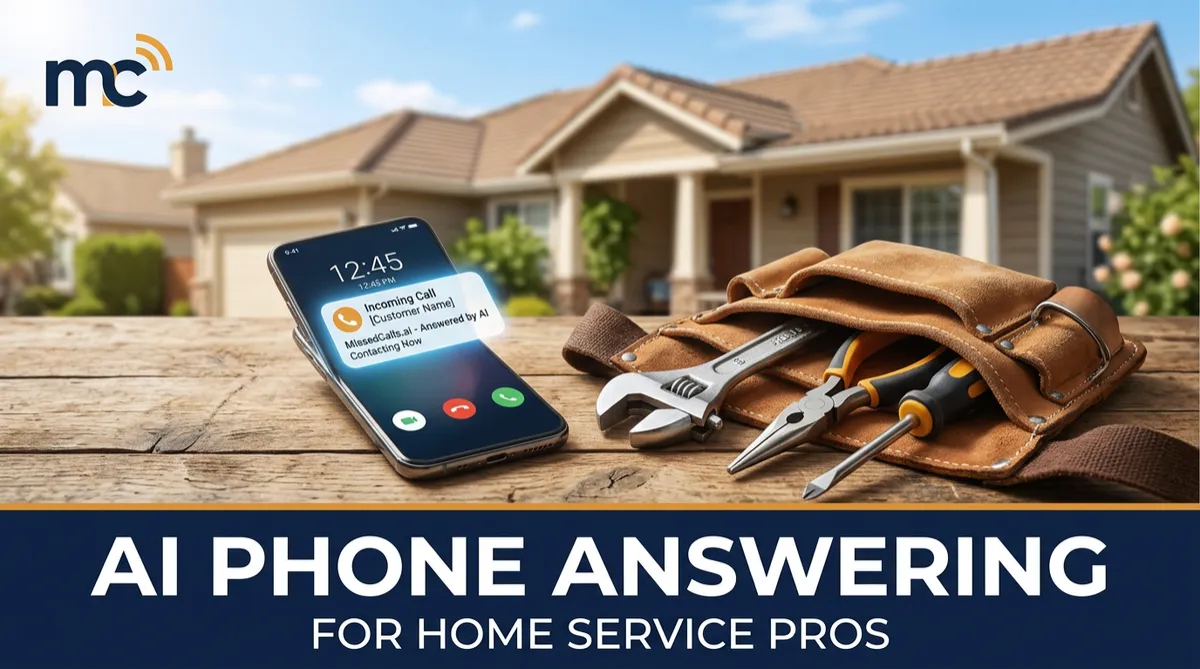
MissedCalls.ai answers your calls in seconds — whether you're on a job, after hours, or just slammed with existing customers. It handles the conversation naturally, without clunky menus or "press 1 for service."
Here's what a typical inbound call flow looks like for a plumbing or HVAC company:
- Call comes in — MissedCalls.ai picks up in under 2 seconds, introduces itself as your business, and greets the caller naturally.
- Issue is captured — The AI asks the right qualifying questions: What's the problem? Where are you located? Is this an emergency or routine service? New customer or existing?
- Appointment is offered — For standard service requests, the AI offers available times and confirms the booking. For emergencies, it escalates immediately.
- Your team is notified — You get a summary: who called, what they need, what was booked or captured, and the full transcript.
Every call is documented. Nothing falls through the cracks.
What About Calls You Miss Anyway?
Sometimes a call slips through before the AI kicks in — or a customer texts instead of calling. That's where missed-call text-back comes in. The moment a call goes unanswered, MissedCalls.ai fires off an automatic text to the caller: something simple, fast, and branded to your business. "Hey, this is [Your Company] — we just missed your call. What can we help you with?"
That text goes out in seconds, while the caller is still thinking about you. It re-opens the conversation before they've had a chance to dial the next number on the list. For home service businesses, this single feature alone recovers jobs that would otherwise be gone.
Is This Only for After-Hours Coverage?
No — and that's a common misconception. AI phone answering helps during business hours just as much as after hours, because the same problem exists anytime your team is occupied. Monday and Tuesday mornings are peak call volume days for home service companies, and that's also when your techs are heading into their first jobs of the week.
The AI handles the overflow. Your team focuses on the work in front of them. And no call goes unanswered.
What MissedCalls.ai Is Not
It's not a phone tree. It's not a voicemail upgrade. It's not a call center where someone in another timezone reads from a script. It's an AI that understands your business — your services, your service area, your hours, your pricing ranges, your booking preferences — and uses that to have real conversations with real callers.
You set the rules. The AI follows them consistently, every time, around the clock.
Ready to Stop Leaving Jobs on the Table?
If you're a home service business running any kind of call volume — 10 calls a week or 100 — MissedCalls.ai is built for exactly this situation. The setup is fast, the conversations are natural, and the ROI is straightforward: more calls answered means more jobs booked.
Book a tailored demo for your home service business →
You'll hear how it sounds for your specific trade, see how the booking flow works, and get a clear picture of what you're currently leaving on the table.
Frequently Asked Questions
How many calls do home service businesses typically miss?
Call-tracking data shows home service contractors miss between 27% and 62% of inbound calls. The miss rate climbs sharply after hours — with some studies showing 60% of after-hours HVAC and plumbing calls going unanswered — and on weekends, when most businesses aren't staffed.
How much revenue does a missed call cost a home service business?
Industry estimates put each missed call at $500 to $1,200 in lost revenue for home service businesses, depending on the trade and average job value. A mid-size HVAC or plumbing company can lose $45,000 to $252,000 per year in missed-call revenue.
Will callers leave a voicemail if I miss their call?
Rarely. Fewer than 3% of callers to home service businesses leave a voicemail. The rest hang up — and 85% of those callers never call back. Most contact a competitor within minutes.
What is missed-call text-back and how does it help?
Missed-call text-back automatically sends an SMS to any caller you don't answer — within seconds of the missed call. It re-opens the conversation while the caller is still thinking about your business, before they've booked with a competitor. For home service businesses, it's one of the fastest ways to recover lost leads.
Does AI phone answering work for emergency service calls?
Yes. MissedCalls.ai can be configured to recognize emergency language — burst pipes, no heat, no AC, flooding — and escalate those calls immediately rather than scheduling them. You define the routing logic; the AI follows it consistently on every call.
