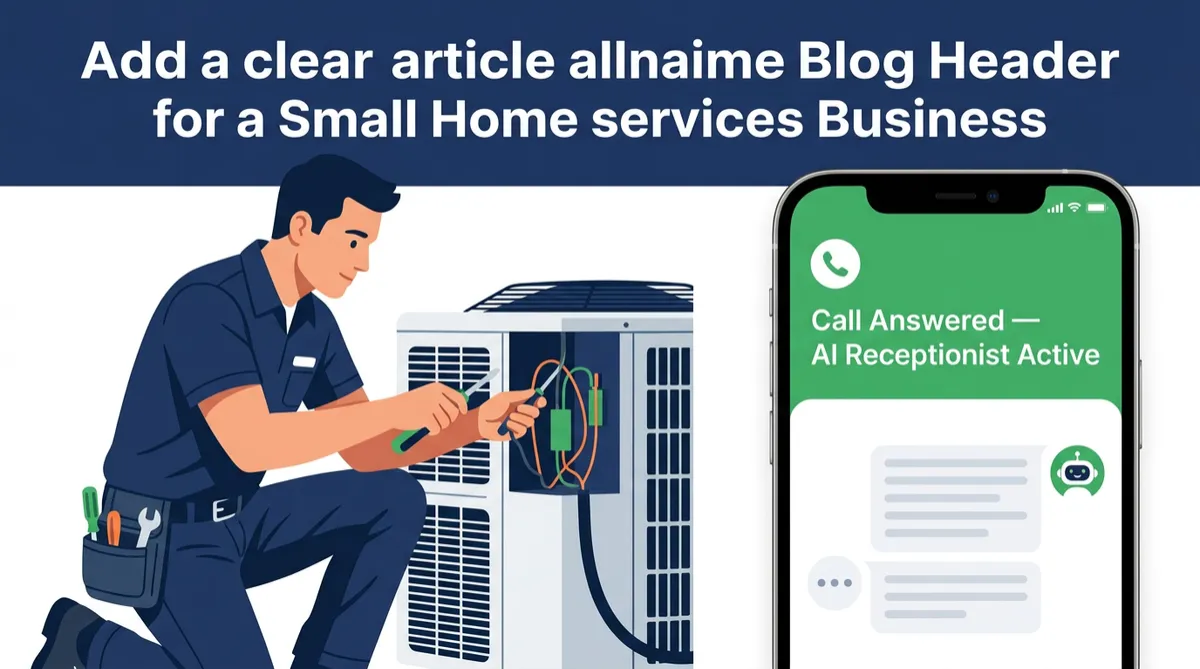
After-Hours Calls Are Your Biggest Revenue Leak — Here's How Home Services Businesses Fix It
Short answer: Between 35% and 40% of all inbound calls to home service businesses arrive after normal business hours — and most go completely unanswered. Every one of those calls is a real person with a real problem and money ready to spend. If you don't pick up, your competitor will.
If you run an HVAC company, a plumbing business, an electrical service, or any other home service operation, you already know how this plays out. You're on a job. Your phone rings at 6:47 PM. You can't answer. The caller hears voicemail — and hangs up. By the time you check your missed calls, they've already booked someone else.
That's not a small problem. That's a revenue leak hiding in plain sight.
The Numbers Home Service Owners Need to See
Let's get specific, because this is the kind of data that changes how you think about your phone line.
According to industry data compiled in 2026, 35–40% of inbound calls to home service contractors arrive after business hours. On weekends, unanswered call rates jump to 41% — compared to just 18% on weekdays. And 27% of all calls to home services businesses simply don't get answered, period.
Here's what makes that painful: 85% of callers who don't reach you the first time will never call back. They move on. They find the next name on Google's list, and that business gets the job.
For context on what this costs: home services businesses lose an estimated $500–$1,200 per missed call, depending on the type of job. An after-hours HVAC emergency ticket runs $450–$600 on average — and that's just the first visit. A customer who calls about a broken furnace in January and gets helped immediately becomes a repeat customer. The one who gets voicemail becomes someone else's repeat customer.
The math adds up fast. If you're missing just five after-hours calls per week — a conservative number for any active service business — that's potentially $130,000–$300,000 in annual revenue walking out the door.
Why Voicemail Isn't a Safety Net Anymore
Here's something that surprises a lot of home service owners: 80% of callers hang up the moment they hear a voicemail greeting. They don't leave a message. They don't wait for a callback. They're gone.
Of the small percentage who do leave a voicemail, nearly half of businesses take over 24 hours to return the call — and by then, the customer has already found an alternative.
Voicemail made sense in 2005. In 2026, it's where leads go to die.
The traditional fix was hiring a receptionist or an answering service. A full-time receptionist costs $35,000–$45,000 per year before taxes and benefits — a significant overhead commitment for a small crew. A traditional answering service is less expensive but rarely trained in your services, your pricing ranges, or how to actually qualify a lead the way your business needs.
Neither solution was built for what home service businesses actually need: someone who answers instantly, sounds professional, knows your business, and doesn't quit at 5 PM.
What Does AI Phone Answering Actually Do for a Home Service Business?
This is the part where a lot of business owners get skeptical — and that's fair. The promise of "AI" gets thrown around so loosely that it's easy to tune out. So let's be specific about what a tool like MissedCalls.ai actually does in a real home services context.
When a call comes in — whether it's 2 PM on a Tuesday or 9 PM on a Saturday — MissedCalls.ai picks up in under two seconds. No menu. No "press 1 for service." Just a natural conversation that sounds like a capable, knowledgeable receptionist who works for your business.
Here's what happens in that conversation:
- It qualifies the call. Is this an emergency or a routine request? What's the issue — HVAC, plumbing, electrical? What's the address?
- It captures the details your tech needs. Issue description, address, best callback time, how they found you.
- It books appointments or schedules callbacks. If you have open slots, it can confirm a time on the spot. If it's an emergency, it can trigger an immediate alert to your on-call tech.
- It answers common questions accurately. Service area, hours, what a diagnostic fee covers, whether you handle that specific type of system — all using information you provide.
- It documents everything. Every call ends with a transcript and summary so you have full context before you call back or dispatch.
The result is that a caller who would have gotten voicemail — and bounced — instead has a real conversation, feels heard, and gets placed into your pipeline.
A Real Scenario: The Saturday Night HVAC Call
It's Saturday, 8:30 PM in July. A homeowner's AC stops working. They search Google, find your business, and call. You're off the clock. Your team is off the clock.
Without coverage, they hear your voicemail and hang up. You lose the call and probably the customer.
With MissedCalls.ai, the call gets answered in seconds. The AI identifies it's an after-hours emergency, collects the address and system details, confirms your emergency service fee, and either books a morning appointment or triggers a text alert to your on-call tech. The homeowner is taken care of. You get a documented lead with everything you need.
That's one call. Now multiply that across every Saturday, every holiday, every dinner hour for a full year.
How Does This Compare to Just Hiring More Staff?
Hiring a part-time after-hours receptionist is one option — but the economics are tricky. You'd need someone available evenings and weekends, reliably, who understands your trade well enough to qualify leads and set proper expectations with callers. Finding and retaining that person is its own challenge.
An AI answering solution costs a fraction of an employee, is available every night and weekend without exceptions, and doesn't need training reminders when your service area changes or your pricing updates. You adjust your business info once, and every future call reflects it.
Businesses that add 24/7 call coverage — whether through staff or AI — typically see customer retention improve by 24% or more. Callers who know they can reach you after hours are more likely to stay loyal, even when a competitor runs a lower price promotion. AI-powered answering also captures an additional 15–20% of appointments that would otherwise be booked outside normal business hours.
Is Your Marketing Budget Working Against You?
Here's an angle that doesn't get talked about enough.
If you're running Google Local Services Ads, paying for SEO, wrapping your trucks, or running Facebook ads — every one of those channels has a cost per lead attached to it. When a lead calls and you miss it, you don't just lose the job. You waste the marketing spend that generated the call in the first place.
If you're paying $50 per lead and missing half your after-hours calls, your effective cost per acquired customer just doubled. Every missed call makes your marketing less efficient — and your competitors more competitive by comparison.
Plugging the after-hours call gap doesn't just add revenue. It makes every dollar you're already spending on marketing work harder.
Getting Started With After-Hours AI Answering
The setup process for a tool like MissedCalls.ai is simpler than most home service owners expect. You're not building software or changing your phone system from scratch. The basic steps look like this:
- Share your business info. Services offered, service area, hours, common FAQ answers, pricing ranges, and any intake questions you want asked.
- Set your call flows. When should calls be routed to a tech? When should the AI take a message vs. book directly? What counts as an emergency?
- Connect your calendar and alerts. The AI can push appointments into your scheduling system and trigger text or email alerts when urgent calls come in.
- Go live. From the first call forward, every after-hours caller gets a real response instead of voicemail.
The whole process doesn't require a new phone number (you can forward your existing line), doesn't require new staff, and doesn't require ongoing management beyond occasional updates when your services or policies change.
What Home Service Owners Actually Want to Know
What happens if the AI can't answer a question?
It captures the caller's details and the question, then passes them to your team with a full transcript. The caller is never left hanging — they're told exactly what to expect for follow-up.
Will callers know they're talking to AI?
MissedCalls.ai is designed to sound natural and conversational. Callers experience a professional interaction — not robotic menus or awkward pauses. The goal is a seamless experience that reflects well on your business, not one that feels like a tech demo.
What if I want a human to handle urgent calls?
You control the logic. You can configure the system to alert your on-call tech immediately for specific call types — like active leaks, no-heat calls in winter, or electrical hazards — while the AI handles routine scheduling and inquiry calls independently.
The Bottom Line for Home Service Businesses
Pipes burst at 11 PM. Furnaces fail on Sunday morning. AC units quit on the hottest day of July. Your customers don't wait for Monday morning to have an emergency — and they won't wait for your voicemail callback either.
The home service businesses that win in 2026 are the ones that answer. Not sometimes. Every time.
MissedCalls.ai gives your business that coverage — without the overhead of additional staff, without the friction of voicemail, and without losing a single lead to a competitor who just happened to pick up.
If you want to see exactly how it would work for your business — your services, your call flows, your hours — the best next step is a live demo tailored to your operation.
👉 Book Your Free MissedCalls.ai Demo
Frequently Asked Questions
How many home service calls come in after business hours?
Industry data shows 35–40% of inbound calls to home service contractors arrive after normal business hours. On weekends, unanswered call rates reach 41% — the highest of any day type.
What does an AI answering service do for a home services business?
An AI answering service like MissedCalls.ai answers every call in seconds, qualifies the caller, captures job details, books appointments, and sends your team a full transcript — 24 hours a day, 7 days a week, including nights and weekends.
How much revenue do missed after-hours calls cost a home service business?
Home services businesses typically lose $500–$1,200 per missed call. After-hours emergency service tickets often run $450–$600 each, and 85% of callers who don't reach you will never call back.
Is AI phone answering better than voicemail for HVAC and plumbing businesses?
Yes. 80% of callers hang up when they reach voicemail without leaving a message. AI answering keeps callers engaged, captures their details, and moves them into your booking pipeline instead of losing them to a competitor.
Do I need to change my phone number to use MissedCalls.ai?
No. MissedCalls.ai works with your existing phone number using call forwarding. You can configure it to handle all calls, overflow calls only, or after-hours calls — without changing your current setup.
